
Dental Practice Loans: Buy-Ins, Acquisitions, Equipment and Start-Ups
A dental practice loan is usually one of four things: a loan to buy into or buy a practice, equipment financing for chairs, imaging and CAD/CAM, a start-up loan that bundles build-out, equipment and working capital for a new office, or a line of credit. Lenders size all of them from net collections, so a practice's mix of PPO, fee-for-service and other patients shapes how much it can borrow as much as gross production does.
The short version: If you have worked in the practice for 24 months, SBA treats your buy-in as an Owner Buyout, where the 10% equity can be reduced or waived; otherwise expect the stricter acquisition rules. Finance CBCT and chairs on their own equipment terms, budget a start-up's working capital from a month-by-month collections ramp, and bring production and collections reports that show your write-offs.
Part of our industry guide: Industry Financing.
Last updated · Reviewed by Cody Dreis
50+ Lenders|Decisions typically in 24 to 48 hours
Common Reasons Operators Apply
Dental practices commonly use Quordx-matched funding for situations like these:
- Chairs, imaging, sterilization, and CAD/CAM equipment
- Marketing campaigns for new patient acquisition
- Practice build-out, operatory expansion, or remodel
- Bridging insurance and PPO reimbursement cycles
Insurance vs fee-for-service: why lenders read collections, not production
Gross production is what your fee schedule says the dentistry was worth. Net collections are what actually arrives after PPO contractual write-offs, patient balances and bad debt. Lenders, valuators and SBA's cash flow test all work from the second number.
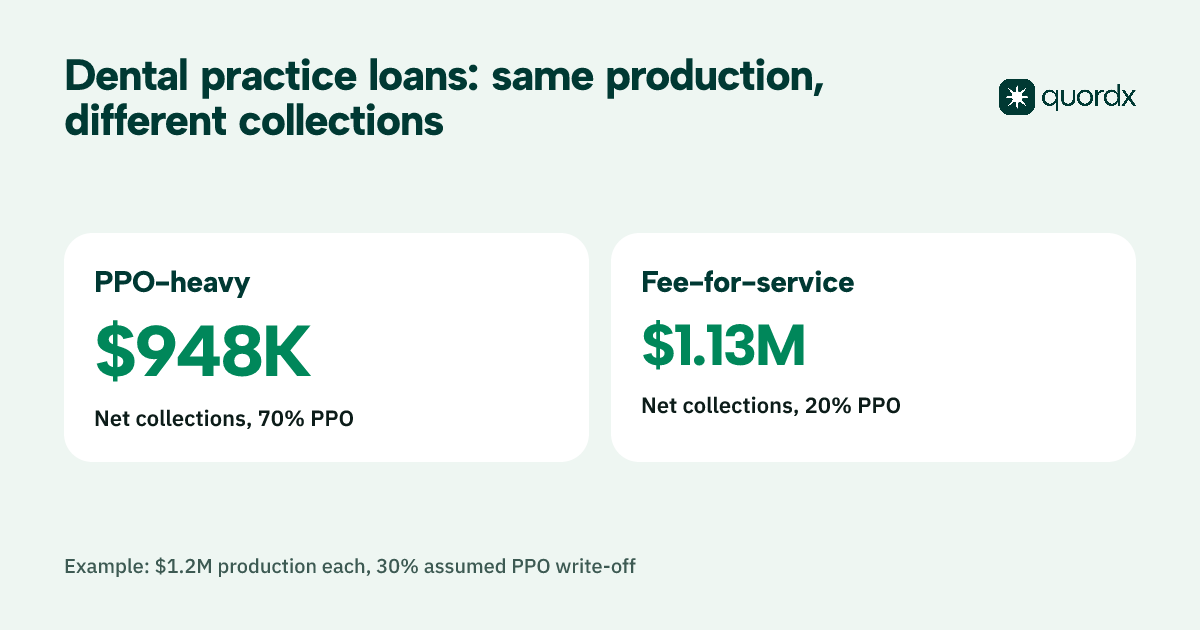
Payer mix moves collections a lot: Here are two practices with identical production and different patient bases. The 30% average PPO write-off is an assumption for illustration, not a market figure.
| Practice A: PPO-heavy | Practice B: mostly fee-for-service | |
|---|---|---|
| Gross production | $1,200,000 | $1,200,000 |
| Share of production from PPO patients | 70% | 20% |
| PPO production after a 30% write-off | $588,000 | $168,000 |
| Fee-for-service production | $360,000 | $960,000 |
| Net collections | $948,000 | $1,128,000 |
Practice B can support more debt: about $180,000 a year more before expenses, even though both dentists did the same work. That is why a lender asks for a PPO participation list and why a buyer should value a practice on collections.
Plan changes are a credit question too: Dropping a major PPO can raise your fees per visit or cost you patients, and a lender will want to see which happened. Original Medicare doesn't cover most dental care such as cleanings, fillings and extractions (Medicare.gov), so older patients often pay out of pocket or through separate dental coverage.
Seasonality shows up in the bank statements: If many of your patients' plans reset annual maximums in January, you may see a busy fourth quarter and a softer start to the year. Time a loan request so the lender sees a full year, not just the January dip.
Buying into a dental practice as an associate
A buy-in is the most common first purchase in dentistry, and SBA's rules for it are friendlier than for buying a practice outright, if you meet the employment test (SOP 50 10 8.1, Appendix 15).
- 24 months in the practice: current employees who have worked in the business for at least the last 24 consecutive months can buy an owner's interest as an Owner Buyout.
- Under 24 months: you can still buy in under those rules only if you take less than 50% and don't become the largest owner. Otherwise the deal is underwritten as an Initial Acquisition.
- Equity: an Owner Buyout needs 10% of the purchase price, and the lender may reduce or waive it if the practice has enough liquidity and no negative net worth. An Initial Acquisition needs 10% of total project cost, which can't be waived.
- Cash flow: both need historical debt service coverage of at least 1.25x.
- Who signs: in a partial buy-in, at least one original owner stays and guarantees, and every new owner is a co-borrower, even at 1%.
Worked example: a 40% buy-in
Say an associate who has worked in the practice for three years buys 40% of a practice valued at $1,500,000, so the price is $600,000. These figures are for illustration.
| With 10% equity | Equity waived | |
|---|---|---|
| Associate's cash | $60,000 | $0 |
| SBA 7(a) loan | $540,000 | $600,000 |
| Monthly payment, 10 years at the 10.00% cap | $7,136.14 | $7,929.04 |
| Upfront SBA fee (3% of the 75% guaranteed portion) | $12,150 | $13,500 |
A waiver costs about $9,500 a year in extra payments here: and it comes with a catch: when the lender waives equity, it can't add dedicated working capital to the loan, so any working capital has to come from existing cash or a line of credit.
Estimate your funding
Answer a few questions about your business to see a likely range.
Buying a dental practice outright
A full purchase by a dentist who hasn't worked there for 24 months is an Initial Acquisition: 10% of total project cost in equity that can't be waived, at least half of it from sources like your own unborrowed cash, and 1.25x coverage. The business portion amortizes over no more than 10 years. The seller can stay only as a consultant, for up to 24 months in total.
Patient retention is the lender's biggest worry: so a planned transition with the selling dentist introducing you to patients helps the file. Build the cash flow test with a market salary for yourself before counting what's left for debt. The full SBA acquisition playbook, including seller notes on standby, is in how to use an SBA loan to buy a business. If the deal includes the building, see SBA loans to buy real estate.
Dental equipment financing: chairs, CBCT, scanners and CAD/CAM
Equipment loans and leases use the equipment as collateral, which is why they are usually easier to get than an unsecured loan of the same size. Lenders look at the practice's collections, your credit and what the equipment is, and they often pay the vendor directly.
Worked example, hypothetical: a $150,000 CBCT package, including installation and training, financed over 72 months at an assumed 9%, costs $2,703.83 a month and $44,676 in interest over the term. Price the case mix first: if the scanner supports implant and endodontic cases you now refer out, estimate how many a month cover the payment before you sign.
- Ask what's financed: some lenders cover installation, room changes, software and training; others only the hardware.
- Call your state's radiation control program early: ask what registration and shielding review an X-ray or CBCT install needs, since the answer affects the timeline and the room budget.
- Match term to life: chairs and cabinetry last longer than scanners and mills, whose software ages fast. A fair market value lease can suit tech you expect to replace.
- Watch for deferred-payment offers: a later first payment helps a new operatory ramp, but interest usually accrues in the meantime.
For tax years beginning in 2026, Section 179 allows up to $2,560,000 of qualifying equipment to be expensed, phasing out above $4,090,000 of purchases. Details in equipment financing and Section 179; confirm with your CPA, since Quordx is not a tax advisor.
Start-up dental office loans
A de novo office has no collections history, so the lender underwrites you: your production record as an associate, the location, the lease, the build-out bids and your projections. SBA counts a business as a start-up until it has generated revenue for a year, requires at least 10% of total project cost as equity, and wants projections showing debt service coverage of at least 1.15x within two years (SOP 50 10 8.1).
Working capital is the line that start-ups underbudget: because insurance collections lag the first appointments. Here is a ramp for a hypothetical office with $55,000 of monthly overhead.
| Month | Collections | Shortfall | Running total |
|---|---|---|---|
| 1 | $15,000 | $40,000 | $40,000 |
| 2 | $25,000 | $30,000 | $70,000 |
| 3 | $35,000 | $20,000 | $90,000 |
| 4 | $45,000 | $10,000 | $100,000 |
| 5 | $52,000 | $3,000 | $103,000 |
| 6 | $58,000 | Covers overhead | $100,000 |
This office burns $103,000 before it breaks even: before paying the dentist or the loan. Budget working capital above the peak, because a slower ramp is the usual surprise. In this example, a $1,000,000 project ($450,000 build-out, $350,000 equipment and technology, $120,000 working capital, $80,000 other costs) needs $100,000 of equity.
Decision rule: if your projections only reach 1.15x by assuming a fast ramp, shrink the project (fewer operatories at opening, some equipment leased) rather than stretching the numbers.
What a dental lender asks for
- Production and collections reports from your practice management software for 12 months, with adjustments shown separately.
- PPO participation list and the share of production from each plan, plus patient and insurance AR aging.
- License, DEA registration and malpractice coverage for every dentist who will own or guarantee.
- Practice and personal tax returns, and your current student loan payment.
- Deal documents: buy-in or purchase agreement, valuation, lease, build-out bids or equipment quotes.
Dental and medical practices share most of the same financing logic, from reimbursement timing to SBA's owner rules. The medical and dental practice financing guide covers those, including why a merchant cash advance fits a practice badly.
Where Quordx fits for a dental practice
Quordx is a broker, not a lender, and dental requests sort into what it can and can't place. Equipment for chairs, CBCT and operatories can go to equipment lenders Quordx works with. Buy-ins, acquisitions and building purchases can go to SBA lending through Quordx, which generally starts around $400,000; smaller SBA loans are better started through SBA's free Lender Match.
A start-up office is harder: The lines of credit and term loans Quordx places come from lenders that generally look for around $17,000 a month in revenue and about a year in business, so a de novo office won't fit them yet. An SBA request of that size can still be sent, and the lender decides whether a start-up fits its policy; a bank's dental practice-lending group is worth calling too.
Where it fits, the application takes about 10 minutes, the lender pays Quordx if a deal funds, and nothing is owed by the practice. Quordx does not serve Virginia, Connecticut, Missouri or North Dakota, and California applicants see a notice first.
Questions Business Owners Ask Before Applying
Can I buy into a dental practice with no money down?
Possibly, under SBA's Owner Buyout rules, if you have worked in the practice for 24 consecutive months and the lender finds the practice has enough liquidity. The lender may then reduce or waive the 10% equity. Without the 24 months, a majority buy-in is an Initial Acquisition, and its 10% can't be waived.
Can a seller note cover part of my equity when buying a dental practice?
Yes, in an SBA acquisition, but only if the seller takes no payments of principal or interest for the life of the SBA loan. A note on that full standby can supply up to half of the required equity.
Will dropping a PPO hurt my chances of a loan?
Not by itself. Lenders look at what happened to net collections and patient counts afterward, so bring the reports from before and after the change.
How much working capital should a new dental office borrow?
Build a month-by-month ramp of collections against overhead and borrow above the peak shortfall, since insurance collections lag the first appointments. SBA start-up loans need projections showing 1.15x coverage within two years.
Can I finance dental equipment for a practice I don't own yet?
Usually only as part of the purchase or buy-in, or once you are an owner, because the practice is the borrower and the equipment's location and use are part of the lender's collateral.
Apply for Funding
No obligation · Initial inquiry doesn't impact credit · Takes about 10 minutes
Sources

Written by
Cody Dreis
Founder, Quordx Capital
Read full bio
Related articles
Keep exploring industry financing
Quordx Capital is a business funding broker, not a lender. Lenders make every credit decision and set the rate, fees and terms, and not every business qualifies. Quordx may be paid by a lender when a deal funds. Full disclosures