

How to Get a Business Loan for a Trucking Company
A trucking company gets financing most reliably through two routes: freight factoring, which turns delivered loads into cash before brokers pay, and equipment financing, which uses the truck or trailer as collateral. Unsecured cash-flow loans and lines exist, but many lenders that make them restrict or exclude trucking, and the ones that don't will read your FMCSA authority, insurance filing and broker list before they care much about your credit score. A carrier in its first year is usually priced like a startup, so factoring plus a down payment on equipment is the realistic starting point. The product to be most careful with is the merchant cash advance, because it is sized off gross freight deposits that mostly go straight back out as fuel and driver pay.
The short version: If brokers pay you on 30-day terms or longer, factor your freight and use fuel advances for diesel. If you need a truck, finance the truck itself and bring cash to the table if your authority is new. Before you apply anywhere, pull your own FMCSA record and confirm your authority is active, your insurance filing is current, and your business name and address match everywhere. Take a daily-debit advance only if the payment fits inside what the business keeps, not what it deposits.
Part of our industry guide: Industry Financing.
Last updated · Reviewed by Cody Dreis
50+ Lenders|Decisions typically in 24 to 48 hours
Why trucking cash flow breaks ordinary loan rules
Freight pays late and costs come due now: You haul on a rate confirmation, deliver, send the signed bill of lading, and then wait for the broker or shipper to pay on its terms. Meanwhile fuel is paid at the pump, drivers get paid every week, insurance is due monthly and the truck note hits on the first.
Deposits overstate what you keep: A lender reading your bank statements sees every freight payment at full value. Most of that money is already spoken for by diesel, driver pay, maintenance and the truck payment, which is why a loan sized on deposits can be far too big for the margin underneath it.
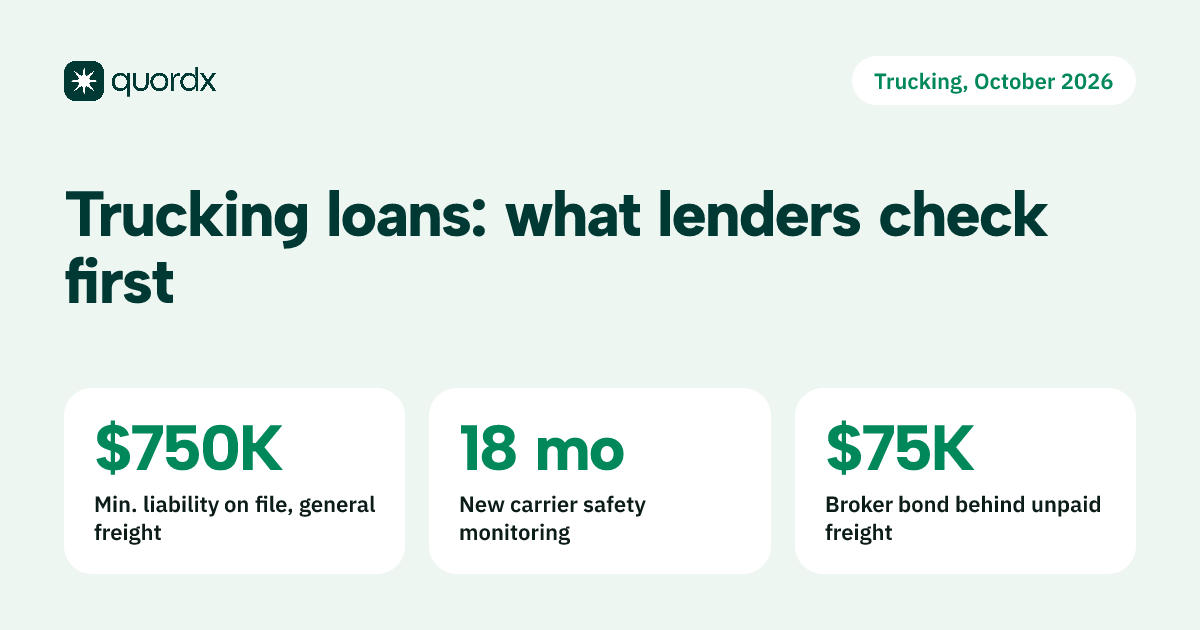
Your customer is often a broker, and brokers fail: FMCSA requires every property broker to keep a $75,000 surety bond or trust fund on file, and since January 16, 2026, a broker whose security drops below $75,000 and isn't restored within 7 business days of FMCSA's notice has its authority suspended (FMCSA, 49 CFR 387.307). That bond is one pool for every unpaid carrier, so it may not stretch far if a large broker goes under owing many of them. Broker credit is a real risk on your books, and the financing that handles it best is the one built around it.
Freight factoring and fuel advances: how they work
Factoring is a sale of your freight bill, not a loan: You send the factor the rate confirmation, signed BOL and invoice. It verifies the load, advances most of the invoice, holds the rest as a reserve, and collects from the broker. When the broker pays, the factor returns the reserve minus its fee.
The broker is told to pay the factor: Once the broker receives a notice of assignment, paying you no longer settles its bill; it has to pay the factor (UCC 9-406). That is normal in trucking, and most brokers have a process for it.
A fuel advance is part of the same deal: Many freight factors will advance a slice of a load's pay at pickup, against the rate confirmation, so you can fuel the truck that is hauling it. The advance comes out of what the factor pays you when the load delivers.
Worked example: one load, factored with a fuel advance
This is an illustration with hypothetical terms, not a quote or a market rate. Say a load pays $3,000. The factor advances $600 for fuel at pickup, advances 90% of the invoice when it is delivered, and charges a flat 3% fee.
| Step | Cash to you | How it is worked out |
|---|---|---|
| Fuel advance at pickup | $600 | Hypothetical, against the rate confirmation |
| Advance on delivery | $2,100 | 90% of $3,000 is $2,700, minus the $600 fuel advance |
| Reserve held by the factor | $300 | $3,000 minus $2,700 |
| Factor's fee (3%) | $90 | Taken from the reserve |
| Rebate when the broker pays | $210 | $300 minus $90 |
| Total cash from the load | $2,910 | $600 plus $2,100 plus $210 |
Scale it to a month: At four loads a week for four weeks, 16 loads of $3,000, that fee works out to $1,440 on $48,000 of freight. That is the price of getting paid on delivery instead of 30 or more days later, and it is the number to compare against any other way of covering the gap.
What to read in a factoring contract
- Recourse or non-recourse: with recourse, you buy back a load the broker never pays. Non-recourse shifts some of that risk to the factor, usually for a broker's insolvency rather than a dispute over the load. Our page on recourse vs non-recourse factoring covers the difference.
- Whole book or spot: some contracts require you to factor every load; others let you pick loads.
- Minimum volume, term and termination: check the notice period and any fee for leaving, because switching factors later depends on it.
- The UCC filing: the factor will usually file a lien on your receivables, which can block other lenders from taking them as collateral.
Broker credit checks work in your favor
A factor underwrites the broker as much as it underwrites you, and it may refuse to buy loads from a broker it rates as slow or risky. Ask your factor to check a new broker before you book the load. A refusal is cheap information compared with hauling for a broker that never pays.
Estimate your funding
Answer a few questions about your business to see a likely range.
Financing trucks and trailers
Tractors and trailers are financed as equipment: the lender pays the dealer or seller and takes the unit as collateral. Lenders look at the unit's year, mileage and condition, your CDL and driving history, your time under your own authority, and how much you put down. Our guide to semi truck financing goes deeper on the purchase itself.
Equipment finance agreement or TRAC lease
An equipment finance agreement (EFA): works like a loan: you own the truck and make fixed payments. Because you own it, the truck can qualify for the Section 179 deduction, which is capped at $2,560,000 for tax years beginning in 2026 and can't exceed your taxable business income. Our page on Section 179 and equipment financing explains the rules; ask your CPA how they apply to you.
A TRAC lease: is a lease on a motor vehicle or trailer with a terminal rental adjustment clause, which lets the rent be adjusted up or down at the end by what the lessor gets when the unit is sold (Internal Revenue Code section 7701(h)). You certify that more than half the use will be in your business, and for federal tax purposes you are not treated as the owner. The tradeoff is a lower payment now in exchange for carrying the resale risk at the end. Our page on equipment leases vs loans compares the two.
Worked example: a used tractor
Say you buy a used tractor for $90,000 with 15% down, $13,500, and finance $76,500 over 48 months at a hypothetical 12% rate. The payment is about $2,014.54 a month, and you repay about $96,697.84 in total, so roughly $20,197.84 is interest. Add the federal heavy vehicle use tax: vehicles at 55,000 pounds or more file Form 2290, and the stamped Schedule 1 is your proof of payment for registration (IRS). The IRS's own example shows $550 for a full tax period on an 80,000-pound vehicle.
Authority age and insurance: what lenders pull from FMCSA
Carriers hauling federally regulated freight for pay across state lines need interstate operating authority (an MC number) in addition to a USDOT number. The filing fee is $300, and new applications through FMCSA's registration system may take 20 to 25 business days, plus 8 weeks or more if the agency reviews them further (FMCSA). The grant date shows in FMCSA's licensing records, which is where a lender reads your authority age.
No insurance on file, no authority: FMCSA will not grant operating authority until the minimum financial responsibility is on file, and your insurer files it, not you (FMCSA). The minimums for for-hire property carriers:
| What you haul | Vehicle | Minimum liability | Filed on |
|---|---|---|---|
| General freight (non-hazardous) | 10,001 lbs GVWR or more | $750,000 | BMC-91, BMC-91X or BMC-82 |
| General freight (non-hazardous) | Under 10,001 lbs GVWR | $300,000 | BMC-91, BMC-91X or BMC-82 |
| Certain hazardous materials | Any | $1,000,000 | BMC-91, BMC-91X or BMC-82 |
| Explosives, poison gas or radioactive materials | Any | $5,000,000 | BMC-91, BMC-91X or BMC-82 |
The first 18 months are a probation period: New carriers are monitored for 18 months, with a safety audit within 12 months of starting operations. Some violations, such as having no drug and alcohol testing program or running without the required insurance, fail the audit automatically, and a carrier that fails and doesn't fix it faces revocation of its USDOT registration (FMCSA).
What that means for your application: A lender treats a lapse in insurance, an out-of-service order or a revoked authority as a stop sign, because the truck can't legally earn. Fix the record first. Also make sure the business name and address on your authority match your bank account and secretary of state filing, since FMCSA itself warns that mismatches delay the grant.
Owner-operators vs fleets: different files, different loans
| Leased-on owner-operator | Owner-operator with own authority | Small fleet | |
|---|---|---|---|
| Who pays you | The motor carrier, through settlements | Brokers and shippers | Brokers and shippers |
| Freight to factor | Usually none | Yes | Yes |
| Best first financing | The truck, underwritten on your lease and settlements | Factoring plus a truck loan or lease | Factoring, equipment, then a line once books are clean |
| What lenders study | Lease terms, settlement history, CDL record | Authority age, insurance, broker list | Broker concentration, driver payroll, safety record, tax returns |
Leased-on drivers have federal payment protections: If you run under another carrier's authority, your lease must say the carrier pays you within 15 days after you submit the required delivery documents, and it must list every chargeback the carrier can deduct (49 CFR 376.12). Lenders read that lease and your settlements the way they would read invoices.
Fleets can reach for bank and SBA money: Trucking companies are eligible for SBA 7(a) loans, which can finance equipment and real estate such as a yard or terminal. For 7(a) loans of $700,000 or less approved in fiscal year 2027, the SBA's upfront guaranty fee is 0% for refrigerated and frozen trucking and for hauling farm products, grain or livestock under the listed trucking codes, and for businesses in rural areas (SBA Information Notice 5000-881797).
Is a merchant cash advance a good idea for a trucking company?
Usually not. An MCA buys a share of your future deposits for a fixed payback and collects it by daily or weekly debit. In trucking, the deposits it is sized on are gross freight, so the debit can eat the whole margin.
Worked example, all figures hypothetical: A three-truck carrier deposits $60,000 a month. Fuel takes $18,000, drivers $14,000, truck notes $7,500, insurance $4,500, and maintenance, tires, tolls and everything else $10,000, leaving $6,000. It takes a $50,000 advance at a 1.30 factor rate, so it owes $65,000 over about six months, roughly 126 business days.
| Line | Amount |
|---|---|
| What the carrier keeps each month | $6,000 |
| Daily debit ($65,000 over 126 business days) | About $516 |
| Monthly debits | About $10,833 |
| Shortfall each month | About $4,833 |
| Total cost of the advance | $15,000 |
The advance takes more each month than the business keeps: That gap gets filled by a second advance, late truck payments or skipped maintenance. Our pages on merchant cash advance cost and the factor rate show how to price one before you sign.
Never stack an advance on a factoring line: The factor already holds a lien on your receivables, and many factoring agreements forbid other liens or sales of future receipts. Stacking can put you in default with the factor that is funding your loads.
What to have ready before you apply
- MC and USDOT numbers, your authority grant letter and a current FMCSA snapshot
- Certificate of insurance showing auto liability and cargo coverage
- Recent rate confirmations, signed BOLs and an invoice aging by broker
- Any current factoring agreement, with its termination terms
- CDLs and a driver roster for every driver
- A truck and trailer list with VIN, year and mileage, plus a dealer quote for anything you are buying
- IFTA filings and your Form 2290 Schedule 1
- Recent business bank statements and your latest tax return
Decision rule: if your request is about waiting on brokers, apply for factoring. If it is about a unit, apply for equipment financing. If it is about a one-time cost like a major repair or an insurance down payment and you have a year or more of clean books, a short-term loan or line can work, as long as the payment fits inside your net.
Where Quordx fits for a trucking company
Quordx is a broker, not a lender or a factor. For carriers, factoring and equipment financing are the usual routes through the lenders Quordx works with; some cash-flow lenders Quordx works with don't serve trucking at all. So a request for an unsecured advance may come back pointed at factoring or a truck loan instead, and if neither fits your file, the honest answer may be a referral to a freight factor directly.
The application takes about 10 minutes, and most options can be explored without a hard credit pull. You don't pay Quordx; the lender does, and only if a deal funds. Quordx does not serve businesses in Virginia, Connecticut, Missouri or North Dakota.
Questions Business Owners Ask Before Applying
Can I get financing with a brand-new MC number?
Factoring is the most realistic first step, because the factor leans on your brokers' credit more than your history. Equipment lenders will consider new authorities but usually want a larger down payment and driving experience. Unsecured loans generally wait until you have a year or more of deposits.
Do I need good credit to factor my freight?
Less than for a loan. The factor's main question is whether your brokers pay, so carriers with thin or bruised personal credit often qualify. Expect a UCC filing on your receivables and a check of your FMCSA record.
Should I use a TRAC lease or an equipment finance agreement for a truck?
An equipment finance agreement makes you the owner, which matters if you want depreciation or Section 179. A TRAC lease usually lowers the payment but leaves you responsible for the gap if the truck sells for less than the agreed residual at the end. Run both through your CPA before you sign.
Can I switch factoring companies?
Yes, but read your contract's term and notice period first. The new factor usually pays off any balance with the old one, gets a release, and sends new notices of assignment to your brokers.
Is there an SBA loan for trucking companies?
Trucking companies can use SBA 7(a) loans for equipment, working capital and real estate. For loans of $700,000 or less approved in fiscal year 2027, the upfront fee is 0% for refrigerated, farm product, grain and livestock haulers in the listed codes and for rural businesses. Expect full financial statements and tax returns.
Apply for Funding
No obligation · Initial inquiry doesn't impact credit · Takes about 10 minutes
Sources

Written by
Cody Dreis
Founder, Quordx Capital
Read full bio
Related articles
Keep exploring industry financing
Quordx Capital is a business funding broker, not a lender. Lenders make every credit decision and set the rate, fees and terms, and not every business qualifies. Quordx may be paid by a lender when a deal funds. Full disclosures