

How to Get a Business Loan for a Salon or Barbershop
To get a business loan for a salon or barbershop, show a lender bank statements where the shop's income is easy to follow, and match the product to the need: equipment financing or an SBA microloan for chairs and stations, a term loan or SBA 7(a) for a build-out, and a line of credit for retail product and slow months. The first thing a lender will want to understand is how your money arrives, because a booth-rent shop that collects weekly chair rent and a commission salon that rings up every service look nothing alike on a bank statement.
The short version: Know which model you run and be ready to explain it with your chair list, rent roll or payroll. Size any loan so the payment still works if two or three stylists or barbers leave, since that is the risk lenders worry about most in this trade. Keep licenses, the lease and a full year of bank and processor statements ready before you apply.
Part of our industry guide: Industry Financing.
Last updated · Reviewed by Cody Dreis
50+ Lenders|Decisions typically in 24 to 48 hours
Booth rent vs commission: how lenders read each salon model
Most shops in this trade run one of two models, or a mix. The Bureau of Labor Statistics counted about 80% of barbers and 48% of hairdressers, hairstylists and cosmetologists as self-employed in 2025, and notes that some lease booth space from a salon owner. That is why so many shops collect chair rent instead of service revenue.
| Booth rent (chair rental) | Commission or hourly | |
|---|---|---|
| What hits your account | Weekly or monthly rent from each stylist or barber | Every service and retail sale, mostly by card |
| What goes back out | Lease, utilities, supplies you provide | Commission or wages, payroll taxes, product, lease |
| How deposits look | Smaller, steady, predictable | Larger, daily, more variable |
| What a lender worries about | Empty chairs if renters leave | Thin margins and payroll cost |
| What to show | Rent roll, renter agreements, occupancy | Payroll reports, POS sales by provider, retail sales |
Booth rent underwrites like a small landlord: The lender looks at how many chairs are rented, at what rate, and how long renters stay. A full shop with a waitlist is a strong file. A shop with high turnover is a weak one, even if this month's rent came in.
Commission salons show more revenue and less profit: Gross deposits can look impressive, but most of each ticket goes back out as commission and payroll taxes. Lenders that size loans on deposits will still check whether what is left covers a payment.
Make sure your booth renters really are renters
If you call your stylists booth renters but run them like staff, a lender reviewing your file and the IRS may both see employees. The IRS guide for the trade, Publication 4902, lists signs of an independent booth renter: a key to the shop, setting their own hours, buying their own products, their own phone number and business name, and setting their own prices.
Why it matters for a loan: misclassified workers can mean back payroll taxes, and an unpaid tax bill can become a lien that sits ahead of a lender. If you set the hours, the prices and the product line, talk to your accountant before you apply, not after a lender asks.
Compare your options side by side
Enter your revenue and see how each type of funding sizes up.
Worked example: how many chairs a salon loan needs
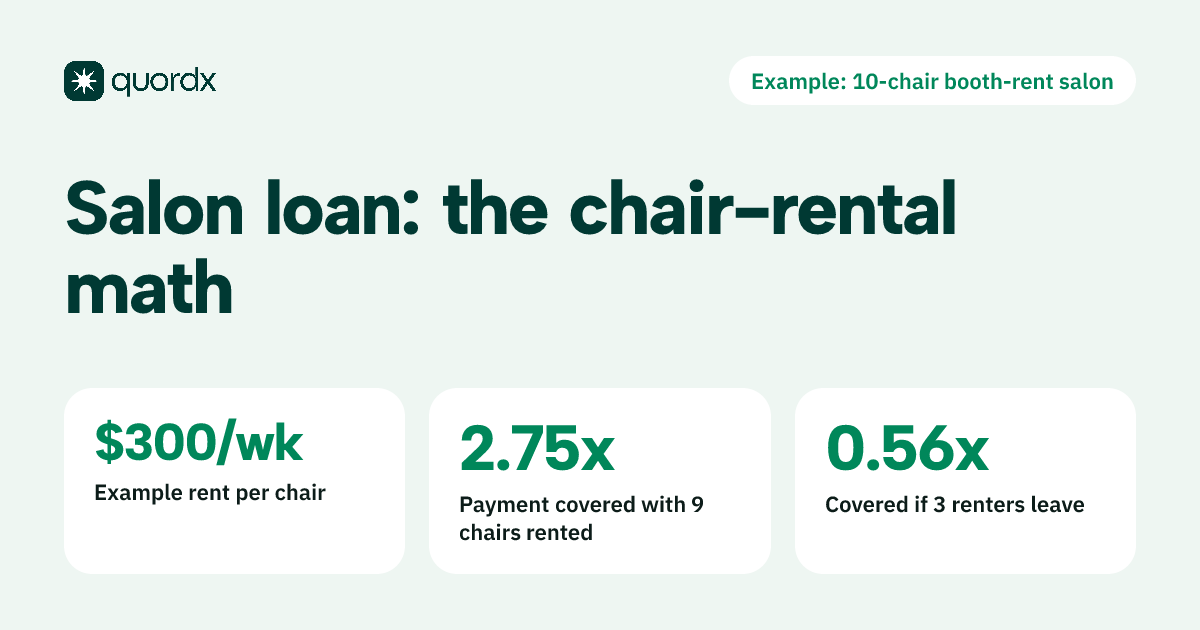
This is an illustration with invented numbers, not a quote. A 10-chair booth-rent salon charges $300 a week per chair. Its lease is $5,000 a month and other fixed costs (utilities, insurance, laundry, booking software, repairs) run $1,800 a month, so $81,600 a year. The owner wants $80,000 to renovate, and says a lender quotes a 5-year loan at 12%: a payment of $1,779.56 a month, or $21,354.67 a year.
| Chairs rented | Annual rent | Left after fixed costs | Times the loan payment is covered |
|---|---|---|---|
| 9 of 10 | $140,400 | $58,800 | 2.75x |
| 7 of 10 | $109,200 | $27,600 | 1.29x |
| 6 of 10 | $93,600 | $12,000 | 0.56x |
Losing three renters turns a comfortable loan into one the shop cannot pay: This salon needs about 7 of its 10 chairs filled just to cover the payment. Run the same table on your own numbers before you pick a loan amount, and show it to the lender: it answers the question they were going to ask.
Decision rule: if your shop drops below 1.0x after losing two chairs, borrow less, stretch the term, or fill the waitlist first.
Card-heavy revenue: what your processor statements tell a lender
When most services run through a card terminal, deposits land daily, net of processing fees. Lenders read those deposits alongside your processor statements, and they look for chargebacks, returned items and days the account went negative. See what lenders look for in bank statements for the full list.
Tips can inflate your deposits: Card tips land in your account and then go back out to staff, and as an employer you must collect income and payroll taxes on reported tips, per Publication 4902. Be ready to show which part of your deposits is tips, so a lender doesn't count money that isn't yours.
A merchant cash advance on card sales
Because steady card volume is easy to see, salons are often offered merchant cash advances that take a share of each day's card batch. Here is an example with assumed terms: a $30,000 advance at a 1.35 factor rate means $40,500 paid back, a $10,500 cost. At a 10% holdback on $45,000 a month of card sales, that is $4,500 a month and about 9 months; if a slow month brings card sales down to $35,000, the share falls to $3,500.
That flexibility is real, and so is the cost. An advance fits a short, specific need with a clear payback, like replacing a broken color processor before a busy season. It is a poor way to fund a renovation that takes years to pay for itself, and taking a second one before the first is paid off is how salons get into trouble.
Financing salon equipment and a build-out
Chairs, stations, shampoo bowls, dryers and color processors: can be financed with equipment financing, where the equipment secures the loan. Used salon furniture rarely resells for much, so expect the lender to lean on your cash flow and credit more than on the equipment itself, and a newer shop may be asked for a down payment.
Taxes can soften the cost: for 2026, Section 179 lets a business expense up to $2,560,000 of qualifying equipment, limited to its business income, and 100% bonus depreciation also applies to qualifying property (IRS Revenue Procedure 2025-32). Interior improvements to a leased commercial space can count as qualified improvement property, which can be elected for Section 179, per IRS Publication 946. Quordx is not a tax advisor, so confirm with your CPA, and see our Section 179 equipment guide.
SBA options by loan size
SBA caps 7(a) variable rates by loan size, and with prime at 7.00% as of October 2026 the caps work out as follows (SBA).
| Loan size | Maximum variable rate | With prime at 7.00% |
|---|---|---|
| $50,000 or less | Prime plus 6.5% | 13.50% |
| $50,001 to $250,000 | Prime plus 6.0% | 13.00% |
| $250,001 to $350,000 | Prime plus 4.5% | 11.50% |
| Over $350,000 | Prime plus 3.0% | 10.00% |
For a one- or two-chair shop, the SBA microloan is often the better fit: up to $50,000 through nonprofit intermediaries, usable for furniture, fixtures, equipment, supplies, inventory and working capital, with a maximum term of seven years (SBA).
Match the loan to your lease: For a 7(a) loan, SBA wants your lease, counting renewal options only you can exercise, to run at least as long as the loan (SOP 50 10 8.1). A 10-year build-out loan on a space with three years left is a problem for any lender, so negotiate the renewal before you apply. If the renovation is for a second location, lenders will judge it partly on how the first shop performs.
Retail product inventory: when to finance the shelf
Retail sales add margin that services don't, especially in a booth-rent shop where retail may be the owner's only sales income. But product sits on a shelf before it earns anything, and an opening order for a new line ties up cash for weeks or months.
Decision rule: fund retail with a business line of credit only if the product sells through before the next order, so each draw repays itself. If a line has been on the shelf for a season, sell it down before you borrow to restock it. Never put retail product on a multi-year term loan.
Licensing and the other documents lenders check
All states require barbers, hairstylists and cosmetologists to be licensed, according to BLS, and your state may also license the shop itself. Lenders and SBA lenders will check that the business and the people doing the work are licensed where they need to be.
- Licenses: the shop or establishment license if your state has one, and current licenses for the people behind the chairs.
- Your lease: the remaining term, renewal options and the rent, since the lease is your biggest fixed cost.
- 12 months of bank statements and processor statements, so the lender sees the busy months and the slow ones.
- Booking or POS reports showing revenue by service and provider, active clients and rebooking.
- For booth rent: the rent roll, renter agreements and any waitlist.
- For equipment or a build-out: the vendor quote or contractor bid.
Key-person risk is real: If you are behind the chair producing a large share of the revenue, a lender will notice. Show who else books regularly, and how the shop runs on a day you are not cutting.
Where Quordx fits for salons and barbershops
Quordx is a broker, not a lender. For an established shop, it can send one application (about 10 minutes) to lenders for equipment financing, term loans and lines of credit; those lenders generally look for around $17,000 a month in deposits and about a year in business, and they make the decisions. SBA loans through Quordx generally start around $400,000, which suits a multi-chair build-out or buying a salon, not a starter loan. The shop pays nothing for the match; a lender pays Quordx if a deal funds.
If your shop is newer or smaller than that, Quordx is not the right route yet. An SBA microloan intermediary or SBA's Lender Match will get you in front of lenders who make small loans. Quordx does not serve businesses in Virginia, Connecticut, Missouri or North Dakota.
Questions Business Owners Ask Before Applying
Can a booth renter get a business loan?
Yes, as a business in their own right. A booth renter files as a sole proprietor or entity and reports income on their own return, so lenders read that return and the renter's own business bank account. Keeping your income in a separate business account makes the file much easier to approve.
Can I get a barbershop loan with bad credit or after a bank turned me down?
Often, yes, though lower credit usually means fewer options and a higher price. Banks and online lenders underwrite differently and each sets its own minimums, so a bank decline does not decide what other lenders will do. Fix any returned payments and negative balances in your account before you apply.
Can I finance used salon equipment with no money down?
Some equipment lenders finance the full price, but a newer shop or used equipment with little resale value may need a down payment. Get the vendor quote first, then compare an equipment loan with an SBA microloan if the total is under $50,000.
Can I get an SBA loan to open a new salon or barbershop?
Yes. For a startup, SBA requires at least 10% of the total project cost from you, and lenders underwrite on projections you can tie to real numbers. Small openings often fit a microloan better than a 7(a).
Do lenders count tips as salon revenue?
They may see them in your deposits, but tips that pass through to staff are not the shop's income. Show the tip amounts from your POS or payroll reports so the lender sizes the loan on revenue you actually keep.
Apply for Funding
No obligation · Initial inquiry doesn't impact credit · Takes about 10 minutes
Sources

Written by
Cody Dreis
Founder, Quordx Capital
Read full bio
Keep exploring industry financing
Quordx Capital is a business funding broker, not a lender. Lenders make every credit decision and set the rate, fees and terms, and not every business qualifies. Quordx may be paid by a lender when a deal funds. Full disclosures