

How to Finance a Gym or Fitness Studio
Most gyms and fitness studios are financed in pieces: an equipment loan or lease for the floor, a term loan or SBA 7(a) for the build-out and opening costs, and a line of credit once the doors are open. Lenders size all of it on one question: how many paying members you keep each month, which is why churn matters as much as your January sign-ups.
The short version: Finance long-lived gear like racks and plates with a loan, and consider leasing cardio and tech that dates quickly. Fund the build-out with a loan whose term fits your lease, and bring at least 10% of the project cost yourself if you plan to use SBA. Show lenders a full year of membership and processor data so a strong January does not get mistaken for the whole year.
Part of our industry guide: Industry Financing.
Last updated · Reviewed by Cody Dreis
75+ Lenders|Decisions typically in 24 to 48 hours*
What each part of a gym costs, and which money fits it
Matching each cost to the right product keeps payments in line with how long the thing you bought lasts.
| Cost | Usual fit | Why |
|---|---|---|
| Racks, rigs, plates, benches | Equipment loan, new or used | Lasts for years and keeps resale value; the gear secures the loan |
| Cardio machines, screens, connected equipment | Equipment loan or fair market value lease | Dates quickly; a lease lets you return or upgrade |
| Build-out: flooring, locker rooms, HVAC, showers, sound | SBA 7(a) or a term loan | Can't be repossessed, so it needs a cash-flow loan sized to your lease |
| Presale marketing and opening reserve | Owner equity, or working capital inside an SBA loan | Spent before members pay |
| Buying the building | SBA 504 or a commercial real estate loan | Long-term, fixed-asset financing |
| Seasonal swings once open | Business line of credit | Draw in slow months, repay when sign-ups return |
SBA 504 can fund owner-occupied buildings and long-life equipment up to $5 million (more for certain manufacturing and energy projects); see SBA 7(a) vs 504 loans for how the two compare.
How lenders read membership recurring revenue
Membership dues billed by card or bank draft every month look like the most predictable revenue a small business can have. Lenders like that, but they test it by asking how many members you lose each month and how many you add to replace them.
Worked example: churn and what it means for a loan
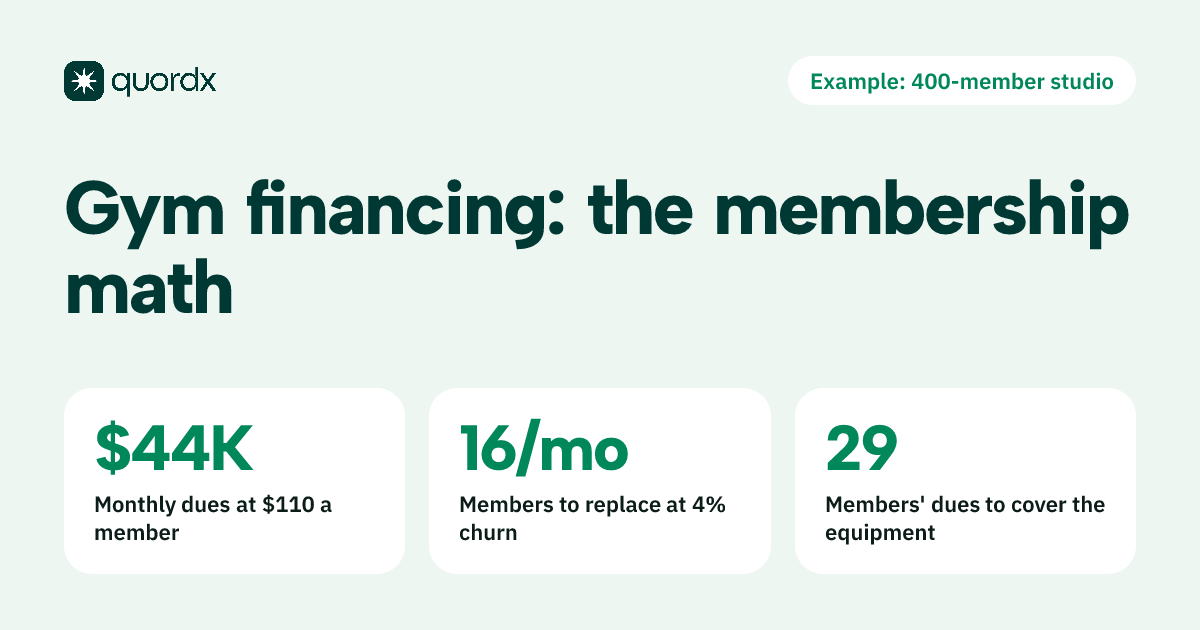
These numbers are invented to show the math. A studio has 400 members paying $110 a month, which is $44,000 a month in dues. If 4% of members cancel each month, the studio loses 16 members a month, 192 a year, so it must sign up nearly half its base every year just to stay at 400.
Now add an equipment loan. Say the owner finances $150,000 of equipment over five years and the lender quotes 10%: the payment is $3,187.06 a month, which equals the dues of about 29 members. If churn outruns sign-ups by 29 members, the equipment payment is unfunded. That is the number a lender is really testing.
- Member count and monthly recurring revenue, by month, for at least the last 12 months.
- Cancellations and freezes, so the lender sees churn, not just sign-ups.
- Processor statements, including failed payments and chargebacks.
- Revenue mix: dues versus personal training, classes, retail and drop-ins, since dues are the most dependable part.
- Your lease and build-out budget, because rent is the largest fixed cost.
If you need to show a lender how revenue gets checked against your deposits, our page on how lenders verify business revenue walks through it.
Compare your options side by side
Enter your revenue and see how each type of funding sizes up.
January sign-ups, prepaid memberships and seasonality
If your gym sells hard at the start of the year and slows afterward, a lender reading only your first-quarter statements may overrate the business, and one reading only the slow months may underrate it, so give them all 12.
Prepaid memberships are cash you have not earned yet: Say 50 members prepay $1,100 for a year in January. Your account jumps by $55,000, but you earn it at about $4,583 a month and owe those members a year of access. Treat it as a liability on your books, keep a reserve against it, and don't let a lender (or yourself) read it as a one-month windfall.
Decision rule: if your slow-season months can't cover all debt payments on their own, set up a business line of credit before the slow stretch arrives instead of taking a lump-sum loan in the middle of it.
Prepaid memberships and state health club rules
Some states regulate how gyms sell and hold membership money, and the rules can affect your opening budget. New York is a clear example.
Presales may be locked up until you open: In New York, money from memberships sold before a club is fully operating goes into escrow, separate from your operating and construction accounts. It is released no more than 30 days after full operation, with partial releases tied to construction progress, unless the club files financial-responsibility information with the state instead (N.Y. General Business Law 622). In that case, presale revenue cannot pay for your build-out.
A bond may be part of the opening cost: New York also requires most health clubs to file a bond, letter of credit or certificate of deposit before selling contracts: $50,000 for clubs selling terms of 12 months or less, $75,000 for terms up to 24 months, and $150,000 above that, with more for clubs with three or more locations (Section 622-A). There are exemptions, including for some clubs that offer monthly dues of $150 or less on terms of 12 months or less without automatic renewal.
New York also caps contract terms at 36 months (Section 623). Check your own state's health club or health studio law before you plan to fund an opening with presales.
Gym equipment financing vs leasing
The tax treatment follows the contract. If an agreement counts as a lease, you may deduct the payments as rent; if it counts as a conditional sales contract, you are treated as the buyer and recover the cost through depreciation (IRS). A lease with a $1 buyout usually works like a purchase.
| Equipment loan or $1 buyout | Fair market value lease | |
|---|---|---|
| Who owns it | You | The lessor, until you buy it at the end |
| Monthly payment | Higher | Usually lower |
| End of term | You keep it | Return, renew, upgrade or buy |
| Best for | Racks, rigs, plates, benches, flooring | Cardio and connected equipment you will replace |
| Tax | Depreciation, including Section 179 and bonus | Payments deducted as rent, if it is a true lease |
Used equipment stretches the budget: Commercial strength equipment holds up for years, and lenders can finance used equipment, usually wanting a dealer invoice or clear title. Get an inspection and a bill of sale that lists serial numbers.
Watch the tax timing in year one: For 2026, Section 179 allows up to $2,560,000 of qualifying equipment to be expensed, but only up to your business income, so a new gym running a loss may not use it right away. Bonus depreciation, permanent at 100% for qualifying property, has no income limit and can create a loss (IRS Notice 2026-11). Quordx is not a tax advisor; ask your CPA, and compare structures on our equipment lease vs loan page.
Franchise or independent: how gym financing differs
A franchise gives the lender a published playbook: The franchisor's disclosure document must include Item 7, a table of the estimated initial investment, Item 10, any financing the franchisor or its affiliates offer, and Item 19, where the franchisor states sales or earnings figures if it chooses to make them (16 CFR 436.5). Your budget and projections start there.
For SBA, check the brand first: A brand that meets the FTC definition of a franchise must be on SBA's Franchise Directory before an SBA lender can approve the loan. Our guide to buying a franchise with a business loan covers the directory, equity rules and a full budget.
An independent studio sells the lender on you: With no franchise history to lean on, the lender weighs your experience running or coaching in a gym, your presale list, local competition and a budget backed by real quotes. Expect more questions and a closer look at your projections.
Either way, a new gym is a startup to SBA: That means at least 10% of the total project cost from you, and projections showing cash flow covers debt payments at least 1.15 times within two years on a standard 7(a) loan (SOP 50 10 8.1).
Financing the gym build-out
Build-out is the hardest part to finance because a lender can't take back flooring or showers. SBA allows up to 10 years for leasehold improvements, plus up to 12 months to finish the work, and for a 7(a) loan it wants your lease, counting renewal options only you control, to run at least as long as the loan.
Ask the landlord first: A tenant improvement allowance or a few months of free rent reduces what you borrow, and it is worth asking for on a long lease. Get contractor bids in writing, since a lender sizes the loan on bids, not guesses. More on this in our page on business loans for renovation.
Where Quordx fits for a gym or studio
Quordx is a broker, not a lender, and what it can place depends on where your gym is. For an operating gym, one application (about 10 minutes) can reach lenders for equipment financing, term loans and lines of credit; those lenders generally look for around $17,000 a month in revenue and about a year in business, and they decide. SBA loans through Quordx generally start around $400,000, which can fit a larger club build-out or the purchase of an existing gym.
For a brand-new studio with no revenue yet, or a smaller SBA loan, start with SBA's Lender Match, and ask your franchisor what financing it offers. Lenders pay Quordx when a deal funds, so a gym owner pays nothing for the introduction.
Questions Business Owners Ask Before Applying
Can I finance used gym equipment?
Yes. Equipment lenders can finance used commercial gear, especially strength equipment that holds its value, though terms may be shorter than for new. Bring a bill of sale or dealer invoice with serial numbers.
Is it better to lease or buy gym equipment?
Buy what lasts and holds value, such as racks and plates, and consider a fair market value lease for cardio and connected equipment you expect to replace. Compare the total of all payments plus any buyout before you choose.
Can a new gym get an SBA loan?
Yes, as a startup. Plan on at least 10% of the total project cost from your own funds, and projections that show cash flow covering debt payments at least 1.15 times within two years on a standard 7(a) loan.
How do lenders treat a gym's slow season?
Give them a full year of statements so they see the busy and slow months together. If your slow months run thin, a line of credit set up ahead of time is usually a better fit than a lump-sum loan taken during the dip.
Do presale memberships count as revenue for a loan?
A lender will see presales as money owed to members until you open, and in some states, New York among them, presale money must be held in escrow or backed by a bond. Show presales as proof of demand, not as cash to fund the build-out.
Apply for Funding
No obligation · Initial inquiry doesn't impact credit · Takes about 10 minutes
Sources
- N.Y. General Business Law 622: Escrow required (health club services)
- N.Y. General Business Law 622-A: Bond, letter of credit or certificate of deposit required
- 16 CFR 436.5: Franchise disclosure items
- IRS: Lease or conditional sales contract for business equipment
- SBA SOP 50 10 8.1: Lender and Development Company Loan Programs

Written by
Cody Dreis
Founder, Quordx Capital
Read full bio
Related articles
Keep exploring industry financing
Quordx Capital is a business funding broker, not a lender. Lenders make every credit decision and set the rate, fees and terms, and not every business qualifies. Quordx may be paid by a lender when a deal funds. Full disclosures