

Business Funding for HVAC and Plumbing Companies
HVAC and plumbing companies usually fund growth with three tools: vehicle and equipment financing for vans and tools, a line of credit for parts and the slow season, and factoring or a receivables line for commercial invoices paid on terms. The right mix depends on how much of your revenue comes from service calls paid on the spot versus installs and contract work paid weeks later. The financing your customers use to pay for a new system or a repipe is a separate product: it is a consumer loan to the homeowner, it doesn't fund your business, and it comes with its own federal rule you should know.
The short version: Put each van on its own loan with the van as collateral, carry the shoulder season with a line you pay to zero every peak, and keep merchant cash advances for one-off gaps with a known payoff. A service-heavy shop gets underwritten on its deposits; a shop doing new-construction rough-ins gets underwritten more like a construction sub. Apply before the slow months, while your statements show the busy ones.
Part of our industry guide: Industry Financing.
Last updated · Reviewed by Cody Dreis
75+ Lenders|Decisions typically in 24 to 48 hours*
Service vs install: how your work mix changes the loan
Lenders read your bank statements to see how money arrives, and HVAC and plumbing shops can look very different depending on the work they do.
| Type of work | How you get paid | What a lender sees | Funding that fits |
|---|---|---|---|
| Residential service and repair | Card or check at the job | Many small deposits, steady weekly | Line of credit, short-term loan |
| Replacement installs (systems, water heaters, repipes) | Deposit up front, balance at completion, often through customer financing | Larger, lumpier deposits that track sales | Line of credit for equipment and labor |
| Maintenance agreements and memberships | Monthly or annual plan payments | Recurring revenue that lenders like | Supports a larger line or term loan |
| Commercial service for property managers | Invoices on net terms | Receivables that lag the work | Invoice factoring or a receivables line |
| New construction as a subcontractor | Progress billing with retainage, paid through the GC | Construction-style payment delays | Pay-app factoring, line of credit |
Decision rule: if more of your revenue comes from GCs and builders each year, start keeping your billing the way a construction sub does, with pay apps, lien waivers and retainage on its own line. Our guide to accounts receivable financing for construction shows what factors require. If you are mostly residential service, your deposits are your best underwriting asset, so keep every dollar running through the business account.
HVAC working capital for the slow season
HVAC demand peaks in the first heat wave and the first hard freeze, and the work drops off in the mild months between. The Bureau of Labor Statistics notes that HVAC technicians sometimes work overtime or irregular schedules during peak heating and cooling seasons (BLS). Payroll, truck payments, insurance and shop rent don't drop with it.
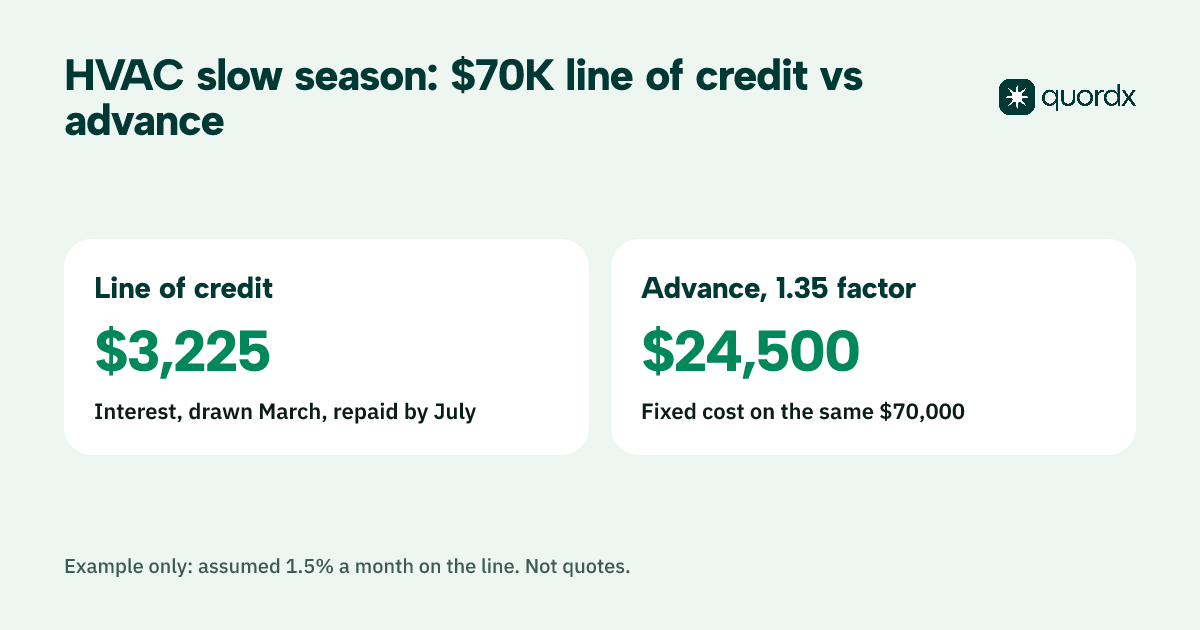
A line of credit is built for this: Here is a hypothetical: a shop draws $40,000 in March and $30,000 more in April to keep techs on payroll and stock up before summer. It repays $35,000 at the start of June and the rest at the start of July. Say the lender charges 1.5% a month on the drawn balance, an assumed rate for illustration only.
| Month | Balance drawn | Interest for the month |
|---|---|---|
| March | $40,000 | $600 |
| April | $70,000 | $1,050 |
| May | $70,000 | $1,050 |
| June | $35,000 | $525 |
| July | $0 | $0 |
| Total | $3,225 |
Compare a $70,000 advance taken in March at a 1.35 factor rate: the payback is $94,500, so the cost is $24,500 whether summer comes early or late. The line costs less because you only pay for the weeks you use the money. See how a factor rate works before you compare offers.
Apply in the busy season or right after it: Underwriters who know the trades look at 12 months of statements, but a file sent in during the slowest quarter can still get sized off weak recent deposits. Set the line before you need it, then draw on it.
Estimate your funding
Answer a few questions about your business to see a likely range.
Financing service vans and fleet trucks
A van is the capacity in a trade business: one more stocked truck lets one more tech run calls. Finance it as a vehicle or equipment loan, with the van as collateral, rather than with unsecured working capital that costs more and comes due faster.
Example with assumed numbers: a cargo van at $68,000 plus $14,000 of shelving, ladder racks and upfit comes to $82,000. With 10% down ($8,200) and $73,800 financed at an assumed 9% for 60 months, the payment is about $1,532 a month, with about $18,100 of interest over the term. Many lenders will finance the upfit when it appears on the dealer or upfitter invoice, so ask for it on the quote.
Decision rule: add a van when you are turning down calls you could have billed, and when the gross profit one tech brings in each month covers the payment several times over. Don't buy ahead of the techs to drive them.
The tax side: for tax years beginning in 2026, Section 179 lets a business expense up to $2,560,000 of qualifying equipment (IRS Revenue Procedure 2025-32). Heavy SUVs are capped at $32,000, but the cap doesn't apply to a vehicle with a fully enclosed driver compartment and cargo area, no seating behind the driver, and no body section sticking out more than 30 inches ahead of the windshield, which describes many cargo vans (IRS Publication 946). Confirm your vehicle with your CPA.
Tools and equipment: jetters, cameras and recovery machines
Hydro jetters, sewer cameras, pipe-bursting and trenchless rigs, recovery machines and lifts can all be financed as equipment, new or used. The bigger the ticket, the more the deal looks like any other equipment financing: the lender wants the quote or invoice, the serial number, and some sense that the machine will earn its payment.
Small tools usually aren't worth a loan. A tool you replace every year or two belongs on a business card you pay off monthly or in your operating budget, not on a five-year note.
Parts inventory: stocking trucks and pre-buying equipment
Every stocked truck carries parts, and most shops keep a warehouse or shop shelf behind them. HVAC contractors also pre-buy condensers, furnaces and coils ahead of the season, often to lock in a distributor's pricing or availability.
Supplier terms are the cheapest inventory financing you have: A supply house account on 30-day terms costs nothing if you pay on time, so the first step is asking your distributors for higher limits before the season. If you give up an early-payment discount, that discount is the price of the credit.
For the rest, use your line of credit: drawn for the pre-buy and repaid as the units are installed. Dedicated inventory loans exist, but lenders advance only part of the inventory's value and want regular stock reports, which is heavy for a parts room. Our page on inventory financing explains how those work. Count your stock before you borrow against it: slow-moving parts tie up cash that a loan just makes more expensive.
Customer financing vs business financing
Many HVAC and plumbing shops offer homeowners financing on a new system, water heater or repipe through a consumer lender. That loan is the homeowner's debt. The lender pays you, often soon after the job is signed off, and the customer repays the lender.
| Customer financing | Business financing | |
|---|---|---|
| Who borrows | The homeowner | Your company, usually with your personal guarantee |
| Who underwrites | The consumer lender, on the homeowner's credit | A business lender, on your revenue, credit and assets |
| What it pays for | That customer's job | Vans, equipment, payroll, inventory, growth |
| What it does for your cash | Gets you paid faster on installs | Funds the business between payments |
The Holder Rule travels with customer financing: The FTC rule covers loans from a lender you refer customers to or are affiliated with by contract or business arrangement (16 CFR 433.1). If you accept the proceeds of such a loan, or take a consumer credit contract yourself, the contract must carry a notice that lets the customer raise claims about your work against whoever holds the debt, with recovery capped at what the customer paid under it (16 CFR 433.2).
Read the dealer agreement for fees and chargebacks: Programs can charge the contractor a fee per financed job, especially on promotional plans, and may be able to come back to you if a customer disputes the work. Those costs belong in your pricing, and a business lender may ask about them.
Plumbing business loans: what is different from HVAC
Plumbing demand is steadier through the year than HVAC, since leaks, drains and water heaters fail in every season, with bumps during hard freezes. That steadiness helps underwriting: twelve months of even deposits read better than a summer spike and a quiet spring.
The pressure point for plumbing contractors is usually commercial and new-construction work: Picture a commercial job where you pull $18,000 of materials, finish the rough-in and wait 45 days for the GC, while your crew gets paid every Friday. That is a construction cash gap, and the tools are the same: a line of credit sized to the gap, or factoring of approved billings.
Drain and sewer equipment: such as jetters, cameras and trenchless rigs is where plumbing shops tend to borrow for equipment, and it finances like any other machine with resale value.
Buying another HVAC or plumbing company
Buying a competitor's customer list, maintenance agreements and techs is a common way for trade shops to grow, and SBA 7(a) loans, up to $5 million, are the usual tool (SBA). Lenders will want the seller's tax returns, the list of recurring contracts and how many customers renew, and a plan for keeping the techs. See how to use an SBA loan to buy a business for the deal math.
What lenders want from an HVAC or plumbing company
- Licenses and insurance: trade licenses, general liability, workers' comp and commercial auto.
- A fleet schedule: year, make, VIN, mileage and lienholder for each vehicle.
- Field-service reports: job counts, average ticket, tech count and active maintenance agreements from your dispatch software.
- Twelve months of bank statements, so a lender sees your peak and your shoulder seasons together.
- AR aging if you invoice property managers, builders or GCs.
- Customer deposits shown as owed work, not as profit, until the job is done.
Where Quordx fits for HVAC and plumbing shops
Quordx is a broker, not a lender. For a trade shop, it can send one application, about 10 minutes, to lenders for vans and equipment (generally starting around $15,000), term loans and lines of credit, factoring of commercial invoices, and SBA loans for an acquisition, which through Quordx generally start around $400,000. Lenders Quordx works with generally look for around $17,000 a month in revenue and about a year in business for the cash-flow products.
What it doesn't do: Quordx doesn't set up customer financing programs for your homeowners, and dedicated inventory loans aren't something it places, so a pre-buy goes on a line. For a smaller SBA loan, SBA's Lender Match is the better route. Each lender makes its own decision, typically within 24 to 48 hours*, and the business pays Quordx nothing.
Questions Business Owners Ask Before Applying
Can I finance a used service van or truck?
Yes. Lenders finance used vehicles, usually with shorter terms on older or higher-mileage units, and they will want the VIN, mileage and a bill of sale or dealer invoice. A van with recent upfit can carry more value than the chassis alone if the upfit is on the invoice.
Does offering customer financing hurt my ability to get a business loan?
Not directly, because the loans are your customers' debts, not yours. A business lender may ask about chargebacks or recourse in your dealer agreement, since money you might owe back to the program is a potential liability. Faster payment on installs usually helps your bank statements.
How much revenue does an HVAC company need to get a business loan?
It depends on the product. Equipment and vehicle loans lean on the asset and your credit, while lines of credit and working capital loans are sized from revenue; lenders Quordx works with generally look for around $17,000 a month for those. SBA loans focus on cash flow after expenses and the owner's credit.
Should I use a merchant cash advance to get through the slow season?
Usually not. An advance has a fixed payback, and its debits start right away, during the months your deposits are lowest. If you have no line, a short-term loan with a set end date is cheaper and easier to plan; set up a line during the next busy season.
Can a new HVAC or plumbing company get funding?
A licensed tradesperson starting a company can often finance a first van or major tool, because the vehicle secures the loan and lenders weigh years in the trade. Lines of credit generally wait until there are about 12 months of business deposits. Startup SBA loans are possible with a solid plan and down payment.
Apply for Funding
No obligation · Initial inquiry doesn't impact credit · Takes about 10 minutes
Sources
- BLS Occupational Outlook Handbook: Heating, air conditioning and refrigeration mechanics and installers
- 16 CFR 433.2: Preservation of consumers' claims and defenses (FTC Holder Rule)
- IRS Publication 946: How to Depreciate Property (Section 179 vehicle rules)
- IRS Revenue Procedure 2025-32 (2026 Section 179 limits, section 4.24)
- SBA: 7(a) loans

Written by
Cody Dreis
Founder, Quordx Capital
Read full bio
Related articles
Keep exploring industry financing
Quordx Capital is a business funding broker, not a lender. Lenders make every credit decision and set the rate, fees and terms, and not every business qualifies. Quordx may be paid by a lender when a deal funds. Full disclosures