
Business Loans for Auto Repair Shops: Equipment, Parts and Your Building
Auto repair shops usually finance equipment such as lifts, alignment machines and diagnostic or calibration systems with loans secured by that equipment, cover parts and slow-paying insurance or fleet work with a line of credit, and buy their building with an SBA 504 or 7(a) loan. Shops are generally easy for lenders to read, because retail customers pay at pickup and deposits arrive every day. The harder parts are the money that comes later, from insurers, warranty companies and fleet accounts, and, if you buy the property, the environmental history of a site where oil and solvents were handled for years.
The short version: Put each major machine on its own equipment loan and check that the work it adds covers the payment several times over. Use a line of credit, not a cash advance, for the gap between finishing insurance or fleet work and getting paid. If you are buying the building, order the environmental review early, because a Phase I environmental site assessment can decide whether the deal closes.
Part of our industry guide: Industry Financing.
Last updated · Reviewed by Cody Dreis
75+ Lenders|Decisions typically in 24 to 48 hours*
How an auto repair shop gets paid, and what lenders see
Retail repair work is mostly paid by card when the customer picks up the car, which gives a shop the steady daily deposits lenders like. The rest of the revenue arrives later, and how much of it you carry changes what you can borrow.
| Who pays | When the money comes | What it means for financing |
|---|---|---|
| Retail customers | At pickup, mostly by card | Steady daily deposits; supports a line of credit or term loan |
| Fleet and commercial accounts | Monthly invoice on net terms | Receivables a factor or AR line can finance |
| Insurers (collision and comprehensive claims) | After the estimate, any supplements and the repair are approved | Parts and labor carried for weeks; plan a line for it |
| Extended warranty and service contract companies | After the claim is authorized and the repair invoiced | Short delays that add up on large jobs |
Decision rule: if fleets and insurers make up a meaningful share of your billing, keep an AR aging by payer. It turns slow money into something a lender can count, and it is what a factor will ask to see for fleet invoices. The guide to accounts receivable financing and invoice factoring explains how that works.
Financing lifts, alignment and diagnostic equipment
The equipment secures the loan: Lifts, alignment machines, tire changers and balancers, scan tools and calibration systems can be financed with the equipment as collateral, and the term can follow how long the equipment stays useful. A secured loan is usually easier to get and cheaper than unsecured working capital; our equipment financing guide covers loans, leases and what lenders check, and financing used equipment covers older machines.
Get installation and training on the invoice: Lifts need anchoring into suitable concrete, and calibration systems need floor space, targets and training. Some lenders finance those soft costs only when the vendor's quote lists them, so ask for an itemized quote before you apply.
A/C equipment has federal rules of its own: Technicians who service motor vehicle air conditioning for pay must be trained and certified through an EPA-approved program, and the refrigerant handling equipment they use must be certified by EPA or an independent standards testing organization (EPA). Before financing a used A/C machine, confirm it is certified for the refrigerant your customers' cars use.
The tax side: Publication 946 lists machinery, equipment and testing equipment among the property that can qualify for Section 179, and the deduction requires the property to be placed in service, ready and available for its use, during the year (IRS Publication 946). The 2026 limit is $2,560,000 (IRS Revenue Procedure 2025-32). Quordx is not a tax advisor; confirm with your CPA.
Estimate your funding
Answer a few questions about your business to see a likely range.
Worked example: does an ADAS calibration system pay for itself?
Windshield replacements, bumper repairs and alignments on newer cars can call for recalibrating the cameras and sensors behind driver-assistance features. A shop without the equipment sends that work out, along with the revenue.
Here is an illustration with assumed numbers. Say a shop gets a quote of $92,000 for a calibration system, targets, installation and training, and finances all of it over 60 months at a hypothetical 10%. The payment is about $1,955 a month, and interest over the term is about $25,300.
| Calibrations a month | Revenue at $250 each | Payment covered |
|---|---|---|
| 8 | $2,000 | 1.0x |
| 16 | $4,000 | 2.0x |
| 24 | $6,000 | 3.1x |
Decision rule: count only the calibrations you can already see, from jobs you now send out and from body shops and glass installers likely to send you work. If that volume covers the payment two to three times after technician time, the system is a reasonable bet. If it only works at the top of your forecast, wait, or start with a smaller setup.
Parts inventory: what to stock and how to pay for it
Supplier terms are usually your cheapest credit: Many parts suppliers sell to shops on accounts billed monthly, so a part installed today may not be due for weeks. Pay those accounts on time, because a clean supplier history helps when a lender asks for trade references.
Stock that turns is worth carrying: Filters, fluids, common brake parts and the tire sizes you sell most move fast enough to tie up cash only briefly. A large seasonal tire buy before winter is different: it is a one-time pile of inventory that a line of credit should carry and the season should repay.
Don't fund parts with long-term money: A five-year loan for parts you sell in five weeks means paying for stock long after it is gone. A line you draw and repay fits the cycle; see how a business line of credit is priced.
Insurance work: why payments lag and how to cover the gap
An insurance job is paid on the insurer's approval, not when you finish: The adjuster writes an estimate, your team finds more damage after teardown, and a supplement goes back for approval while the car sits. The customer owes the deductible, and the insurer may pay you directly or send a check to the vehicle owner, sometimes made out jointly with a lienholder.
The cash gap is parts and labor on cars you can't bill yet: The more collision and comprehensive work a shop takes on, the more of that work in progress it carries, and it shows up as months where deposits lag the hours your technicians logged.
A line of credit is the right tool: Draw to cover parts on supplement-heavy jobs and repay when the claims pay. Some specialist factors buy insurance receivables, but a general factor may decline them because the amount can change after approval and payment runs through the claim process. Our page on roofing company loans walks through the same problem in another trade.
Referral programs help on both sides: Being on an insurer's direct repair list brings steady volume, and a lender reading your statements sees regular payments from that insurer. Keep the agreements on file, since an underwriter may ask how much of your volume depends on one insurer.
Buying your shop's building: SBA 504 or 7(a)
Owning the building ends rent increases and renewal worries: and it puts the property's value on your side of the balance sheet. SBA has two programs that fit, and they work differently.
| SBA 504 | SBA 7(a) | |
|---|---|---|
| What it finances | Owner-occupied real estate and long-term equipment | Real estate, equipment, working capital, buying a business, refinancing |
| How it is built | A bank loan for at least 50%, a CDC loan for up to 40%, your down payment | One loan from an SBA lender |
| Maximum | Up to $5 million (more for certain manufacturing and energy projects) | $5 million |
| Working capital or inventory? | No | Yes |
| Best for | Buying or building the shop's property | Buying a shop with its building and operations together |
Worked example: a $1.4 million building purchase through 504
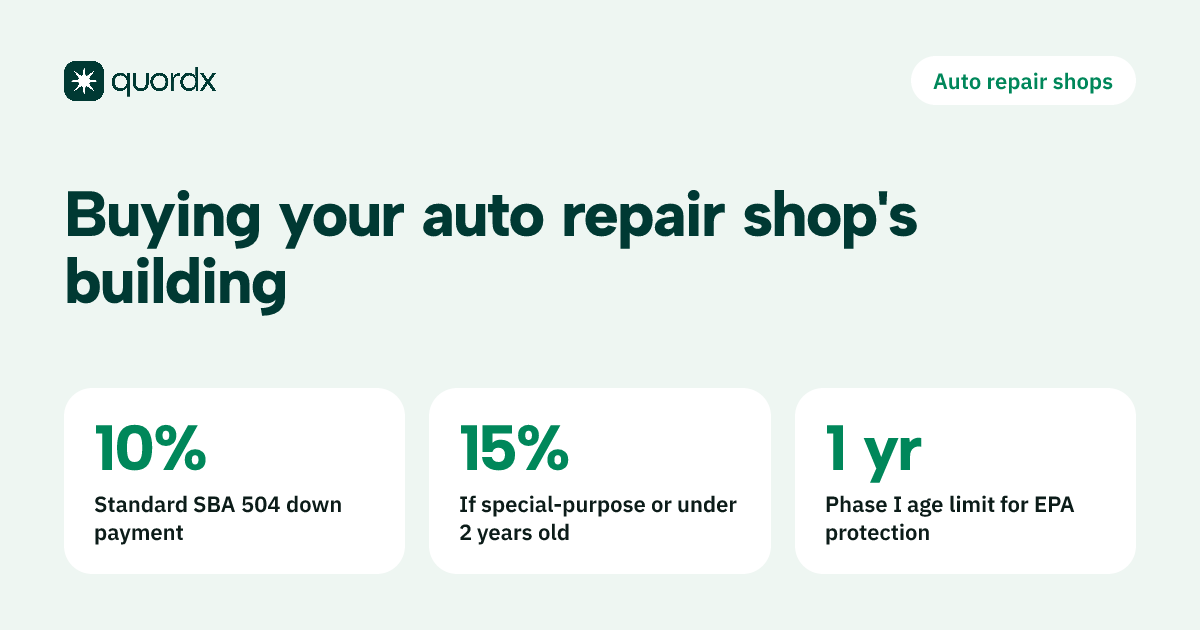
Say a shop buys its building for $1,250,000 and spends $150,000 adding two bays, a $1,400,000 project. In the standard 504 structure, a bank lends at least 50% ($700,000), a Certified Development Company lends up to 40% ($560,000), and the owner puts in at least 10% ($140,000).
The down payment can rise: SBA's rules require at least 15% if the business has operated two years or less or if the building is limited or single-purpose, and at least 20% if both apply. A property built around service bays and lifts can be treated as special-purpose, so ask the CDC early; at 15%, the owner's share of this project is $210,000.
Other 504 rules that matter: for an existing building, the business must occupy at least 51% of the rentable space, which limits how much of a larger property you can lease out (13 CFR 120.131). 504 projects also carry a job creation or retention standard of generally one job per $95,000 of SBA-backed financing, or another program goal the CDC can document. The CDC portion carries a rate pegged to 10-year Treasury rates, while the bank sets the rate on its share (SBA).
Environmental issues on a repair shop property
A repair shop's history can be in the ground: Years of used oil, solvents and antifreeze, and on older sites underground tanks, are why lenders look hard at shop property. How waste oil and solvents were stored, and whether old tanks were removed properly, are typical questions in an environmental review.
Expect a Phase I environmental site assessment: It is a records review, site visit and interviews looking for signs of contamination, and ASTM E1527-21 is the standard practice for it. Under EPA's All Appropriate Inquiries rule, the inquiry must be done within one year before you take ownership, with certain parts updated within 180 days, and it is one of the steps a buyer needs to claim federal liability protections such as the bona fide prospective purchaser defense (EPA).
If the Phase I finds something: the lender may ask for a Phase II with soil or groundwater sampling, a cleanup plan or a price change before it closes. Build that time and cost into your purchase contract with an environmental contingency, so you can renegotiate or walk away.
Leasing doesn't make it irrelevant: Read your lease for who is responsible for contamination found during your tenancy, and document the property's condition when you move in.
Merchant cash advances and repair shops
Shops get advance offers constantly: because most retail tickets are paid by card, which is exactly what an advance is repaid from. One can make sense for a one-time need with a fast payback, such as a large parts order for a fleet contract that pays on known terms.
It is the wrong way to buy equipment: An advance puts a lift you will use for years on a few months of daily or weekly debits. Read the payback, not the payment: a factor rate tells you the fixed total you'll repay, so compare it with an equipment loan's total interest before you sign.
What lenders look at in an auto repair shop
- Bank and processing statements, usually the last 12 months, showing daily card deposits.
- Shop management reports: revenue split between labor and parts, car count, average repair order and technician hours.
- Payer mix: how much comes from retail customers, fleets, insurers and warranty companies, with an AR aging for the slow payers.
- Equipment list and quotes for what you want to finance, with installation itemized.
- Your lease or deed, and for a purchase, the environmental reports.
- Insurance: garage liability and garagekeepers coverage, plus workers' comp.
- Staffing and certifications: technician count, and EPA Section 609 certification for A/C work.
Expect questions about trends: A falling car count paired with a rising average repair order is something an underwriter will ask you to explain, so look at your own reports first.
Where Quordx fits for an auto repair shop
As a broker, Quordx doesn't lend. For a repair shop, it can send one application, about 10 minutes, to lenders for equipment financing (generally from around $15,000), term loans and lines of credit for parts and insurance gaps, and factoring for invoices to fleet and commercial accounts. Lenders it works with generally look for around $17,000 a month in revenue and about a year in business for the cash-flow products, and SBA 7(a) loans through Quordx generally start around $400,000, which can fit buying an established shop together with its building.
Where to look instead: Quordx doesn't place SBA 504 loans or bank mortgages, so for a 504 building purchase start with SBA's list of Certified Development Companies, and for a smaller SBA loan use Lender Match. Lenders make their own decisions, typically within 24 to 48 hours*, and pay Quordx when a deal funds.
Questions Business Owners Ask Before Applying
Can I finance used shop equipment?
Yes. Lenders finance used lifts, alignment machines and diagnostic equipment, though terms are often shorter on older units, and the lender will want a bill of sale or dealer invoice and serial numbers. For anything that handles refrigerant, confirm it is EPA-certified before you buy.
How much revenue does an auto repair shop need for a business loan?
Lines of credit and working capital loans are sized from your deposits, and lenders Quordx works with generally want to see around $17,000 a month. Equipment loans rely more on the equipment and your credit, and SBA loans on cash flow after all expenses, including the new payment.
Can a repair or body shop factor insurance claims?
Sometimes, through a factor that specializes in it. A general factor may decline insurer receivables because the amount can change with supplements and payment depends on the claim process. A line of credit is usually simpler for carrying parts and labor while claims are approved.
Do I need a Phase I environmental assessment to buy my shop's building?
Plan on it. Lenders look closely at repair shop property, and under EPA's All Appropriate Inquiries rule the assessment is a step toward federal liability protection for a buyer, done within one year before you take ownership. If it finds a problem, expect a Phase II with testing.
Should I buy my shop's building or keep leasing?
Buying makes sense when you plan to stay for many years, the payment is close to your rent plus taxes and upkeep, and the down payment won't drain your working capital. Keep leasing if the location may not suit you long term or the environmental review raises questions you can't resolve.
Apply for Funding
No obligation · Initial inquiry doesn't impact credit · Takes about 10 minutes
Sources

Written by
Cody Dreis
Founder, Quordx Capital
Read full bio
Keep exploring industry financing
Quordx Capital is a business funding broker, not a lender. Lenders make every credit decision and set the rate, fees and terms, and not every business qualifies. Quordx may be paid by a lender when a deal funds. Full disclosures