

Roofing Company Business Loans: Storm Season, Insurance Checks and Crews
A roofing company business loan usually means one of four things: a line of credit or short-term loan to front materials and crews when storm work surges, truck and equipment financing, factoring for commercial roofing invoices, or, as a last resort, a merchant cash advance. The hard part in roofing is insurance work, because the homeowner's insurer often pays in pieces and holds back part of the claim until the roof is finished. A big storm season can leave you shorter on cash than a slow one, since every new job adds materials and payroll before the last checks have cleared. Lenders that understand roofing look at how much of your work is insurance-driven, how long those checks take, and whether you have a real local base.
The short version: Plan storm-season cash around the slowest part of the insurance payment, not the first check. Use a line of credit sized to the materials and payroll you will front during a surge, finance trucks and trailers on their own, and keep advances for a short gap with a known payoff. Residential insurance receivables generally can't be factored; commercial roofing invoices owed by businesses can.
Part of our industry guide: Industry Financing.
Last updated · Reviewed by Cody Dreis
50+ Lenders|Decisions typically in 24 to 48 hours
Common Reasons Operators Apply
Roofing contractors commonly use Quordx-matched funding for situations like these:
- Equipment, trucks, and crane or lift additions
- Hiring crews for storm season and post-event restoration
- Bonding and licensing costs for commercial bids
- Bridging deductible collection and insurance reimbursement
How insurance roof claims get paid, and why it slows your cash
On a replacement cost policy, the insurer may first pay the actual cash value of the roof, which is the replacement cost minus depreciation for age and wear. Once the roof is replaced and receipts are submitted, the insurer pays the difference, called recoverable depreciation (North Carolina Department of Insurance). The homeowner pays the deductible.
Each step can stall: If the home has a mortgage, the check may be made out to the mortgage company as well, and it has to endorse it. Items the adjuster missed go back as a supplement for another review. The final depreciation payment waits on your invoice, photos and the homeowner sending them in.
Your customer is the homeowner, not the insurer: In Florida, a homeowner can't assign post-loss benefits under a residential or commercial property policy issued on or after January 1, 2023, and an attempted assignment is void (Fla. Stat. 627.7152(13)). Other states have their own rules, so check yours before you plan to bill an insurer directly.
Worked example: the cash timing of one insurance roof
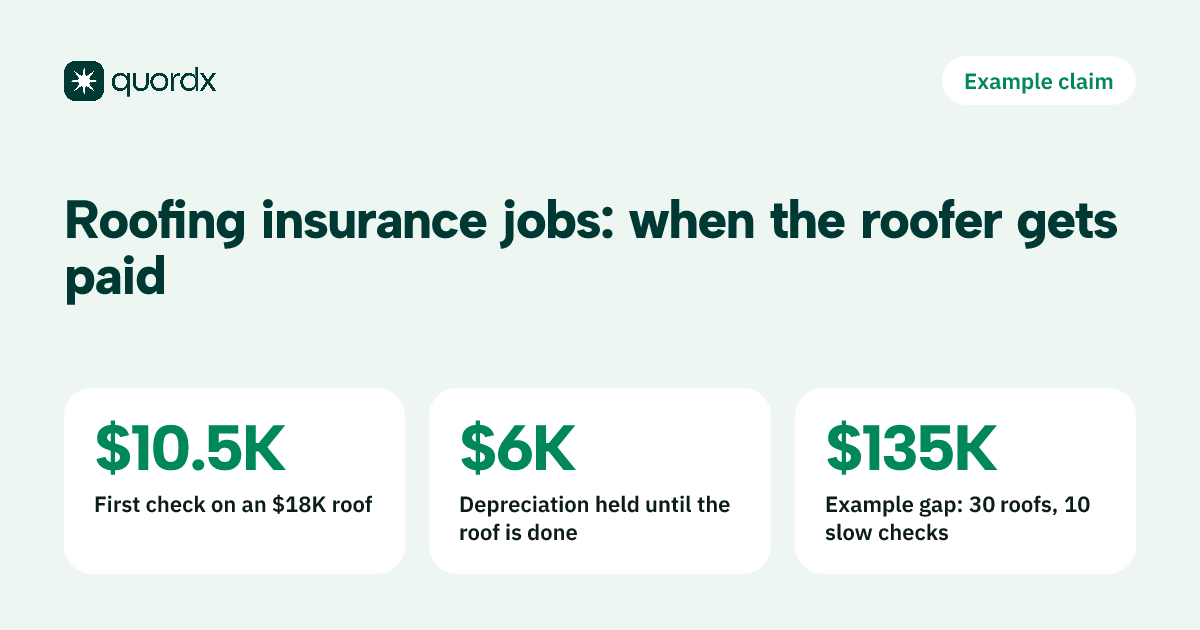
These numbers are assumptions chosen to show the mechanics, not typical claim figures. The insurer's estimate puts the replacement cost at $18,000, takes $6,000 of depreciation on an older roof, and the homeowner's deductible is $1,500. Your costs are $7,000 of materials ordered before tear-off and $4,500 of crew labor paid the week of the install.
| Step | Amount | When you have it |
|---|---|---|
| First insurance check (actual cash value less deductible) | $10,500 | After the homeowner and any mortgage company endorse it |
| Materials and crew paid | minus $11,500 | Before or during the install |
| Deductible from the homeowner | $1,500 | At completion, per your contract |
| Recoverable depreciation | $6,000 | After completion and paperwork, on the insurer's timeline |
| Gross profit on the roof | $6,500 | $18,000 minus $11,500 |
Even when the first check arrives on time, you are $1,000 out of pocket per roof until the job is finished: Across 30 roofs sold in the weeks after a hailstorm, that is $30,000. If 10 of those first checks are held up waiting on a mortgage company endorsement, add their $105,000, and the gap is $135,000, on work that will eventually earn $195,000 of gross profit.
Decision rule: size storm-season working capital as (cost per roof minus the first check) times the roofs in progress, plus the first checks you expect to be late. Then add a cushion for supplements. If the result is bigger than you can carry, sell fewer roofs at once rather than borrow against a payment you don't control.
Estimate your funding
Answer a few questions about your business to see a likely range.
Storm season: borrowing for a surge without getting trapped
A line of credit fits storm work best: because you draw as jobs start and repay as depreciation checks land. Set it up before storm season, when your statements show a full year, not in the middle of a surge.
Watch what a surge does to your offers: Revenue-based lenders size advances from recent deposits, so the months right after a storm can make you look much bigger than your normal year. A payment sized to that peak keeps running into the winter, when exterior work slows in cold-weather states.
Lenders look closely at roofing for a reason: After storms, out-of-state crews arrive and some take deposits for work they never finish. A roofer with a local address, a state license where one is required, years of jobs in the same market and solid reviews is a different file from a company that follows storms, and underwriters check which one you are.
Paying crews and buying materials
Materials first: your supplier account is the cheapest credit in roofing. Net 30 terms cost nothing if paid on time, so ask your distributor to raise your limit before the season. Suppliers have lien rights on the jobs they supply, so expect them to want payment, or a joint check, on larger jobs, and get their lien waivers when you pay.
Crews next: payroll and subcontracted crews have to be paid weekly whether or not the insurance checks have cleared. That is the expense to put on a line of credit or short-term loan, because no supplier will finance it for you.
If you do commercial work as a sub to a GC, the payment chain looks like construction: pay applications, retainage and lien waivers. Our page on accounts receivable financing for construction covers that side in full.
Roofing equipment and truck financing
Pickups, dump trailers, box trucks, shingle conveyors, material lifts and hoists can all be financed as equipment, with the equipment as collateral. That keeps your line of credit free for materials and payroll. Lenders want the dealer quote or invoice and, for used units, the VIN or serial number and condition.
Tax timing: for tax years beginning in 2026, Section 179 lets a business expense up to $2,560,000 of qualifying equipment (IRS Revenue Procedure 2025-32). Heavy SUVs are capped at $32,000, but the cap doesn't apply to a vehicle with an open or capped cargo area at least 6 feet long that isn't reachable from the cab, which covers many full-bed work pickups (IRS Publication 946). Your CPA can confirm how your trucks qualify; see equipment financing for loan versus lease.
Can a roofing company factor insurance claims?
Usually not on residential insurance jobs: Factors buy invoices owed by businesses with credit they can check. A residential roof is owed by a homeowner, paid with an insurer's money on the insurer's timeline, and often subject to supplements, so it doesn't fit a factor's model.
Commercial roofing is different: Invoices to property managers, building owners and businesses on net terms can be factored like other business receivables. Work as a sub to a general contractor can be financed against approved pay apps by a construction-specialist factor, less retainage. See how invoice factoring works for the basics.
Roofing merchant cash advance: when it fits and when it hurts
A merchant cash advance gives you a lump sum now in exchange for a larger fixed amount collected by daily or weekly debits. Say a funder offers $60,000 at a 1.35 factor rate over about five months, or 105 business days. You owe $81,000, about $771 every business day, starting right away.
The problem is timing: In the example above, the money that would repay an advance is the depreciation checks, which arrive weeks after each roof is done. The debits don't wait for them, and an advance taken at the end of storm season keeps debiting through the slow months.
When it can fit: a short gap with a payoff you can name, such as depreciation already approved on finished roofs, an amount well below your normal monthly deposits, and no other advance in place. Read what a merchant cash advance costs before you sign one, and never take a second one to cover the first.
What lenders look at in a roofing company
- License and insurance: state or local roofing license where required, general liability and workers' comp.
- Home base: how long you have operated from the same address and market.
- Work mix: insurance replacement, retail (cash) roofs and commercial, since each pays on a different clock.
- Open claims: depreciation and supplements still owed on finished jobs, listed with expected dates.
- Customer deposits: treated as money owed until the roof is done, and not spent on other jobs.
- Bank statements: at least 12 months, so a lender sees the storm months and the quiet ones, plus any debits to other funders.
What Quordx can do for a roofing company
Quordx is a broker, not a lender. For a roofer, one application of about 10 minutes can reach lenders for trucks and equipment (generally starting around $15,000), term loans and lines of credit, and factoring of commercial roofing invoices, including approved pay apps when you work as a sub. Lenders Quordx works with generally look for around $17,000 a month in revenue and about a year in business for the cash-flow products, and they will want your full year of statements, not just the storm months.
Be clear about the limits: Quordx can't place factoring of residential insurance receivables, doesn't set up financing programs for your homeowners, and some working capital lenders restrict roofing or hold it to higher revenue minimums. Pay-app factoring through Quordx generally doesn't cover general contractors or bonded jobs. Lenders decide, typically within 24 to 48 hours; they, not you, pay Quordx when a deal funds, and Quordx does not serve roofers based in Virginia, Connecticut, Missouri or North Dakota.
Questions Business Owners Ask Before Applying
How long does recoverable depreciation take to come in?
It depends on the policy and the insurer, and it starts only after the work is done and the paperwork is submitted. Some policies set a deadline for completing repairs to claim it, so ask the homeowner to check theirs. Send your final invoice and photos the day the roof is finished.
Can I get a roofing business loan without collateral?
Yes, lines of credit and working capital loans don't require a specific asset. Expect a personal guarantee and a UCC lien on business assets anyway, which is standard for unsecured business credit. Truck and equipment loans are secured by the vehicle or machine.
Should my roofing company take an assignment of benefits?
In Florida, assignments of post-loss benefits are void for property policies issued on or after January 1, 2023. Other states set their own rules, and some limit what a contractor can do on a claim. Ask a local attorney before building your process around billing insurers directly.
Can a new roofing company get financing?
A first truck or trailer is the most realistic first loan, because the vehicle secures it. Lines of credit and working capital lenders generally want about a year of business deposits, and a new company that works storms far from home will have a harder time.
Do lenders count storm-season revenue?
They count it, but most look at a full 12 months, so one big storm month gets averaged against slow ones. Revenue-based funders can be quick to offer more after a surge; size what you take to your normal year, not the peak.
Apply for Funding
No obligation · Initial inquiry doesn't impact credit · Takes about 10 minutes
Sources

Written by
Cody Dreis
Founder, Quordx Capital
Read full bio
Related articles
Keep exploring industry financing
Quordx Capital is a business funding broker, not a lender. Lenders make every credit decision and set the rate, fees and terms, and not every business qualifies. Quordx may be paid by a lender when a deal funds. Full disclosures