
Business Loans for Retail Stores: Inventory, Holiday Buys and Build-Outs
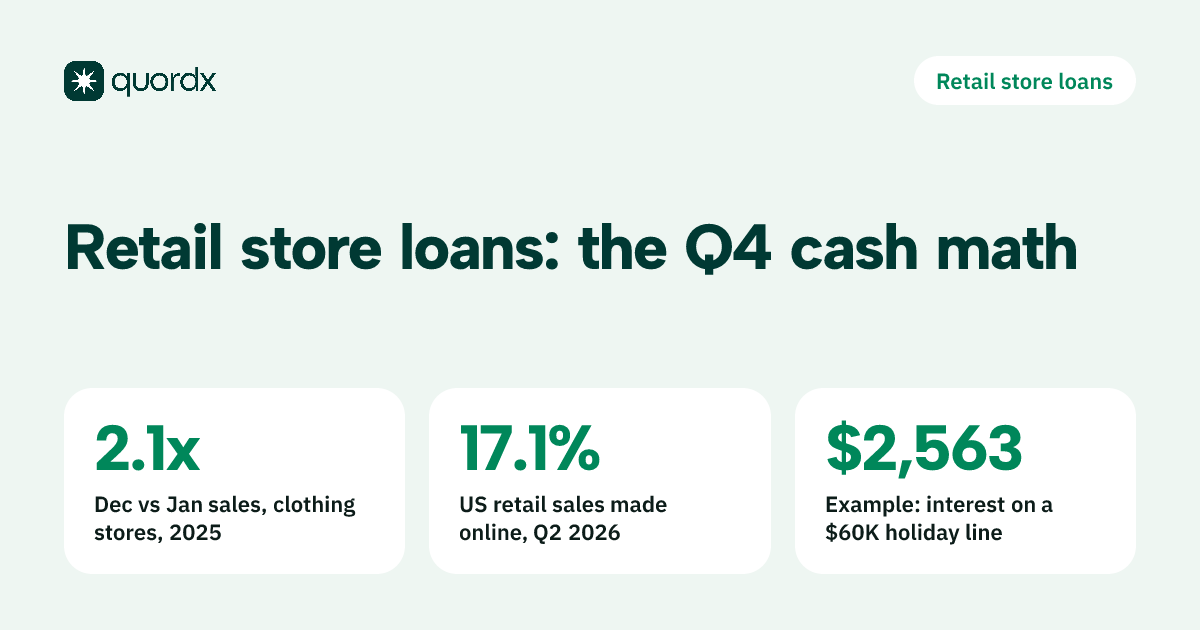
Retail stores usually borrow for three things: inventory bought months before it sells, the build-out and fixtures for a store, and the cash gap after a slow January. A line of credit fits the inventory cycle best, an equipment loan or SBA 7(a) fits fixtures and build-outs, and lenders size all of it from your card deposits and POS records. The holiday buy is where retail cash gets tight: in 2025, US clothing stores sold about 2.1 times as much in December as in January, and the stock for December had to be paid for by fall (Census Bureau).
The short version: Borrow for the holiday order on a line you repay from December and January sales, not on a 12-month loan whose payments outlast the season. Put fixtures and build-out on longer money. Run every card sale and cash deposit through one business account, because that history is what a lender underwrites, and use a merchant cash advance only for a short, specific need you can price.
Part of our industry guide: Industry Financing.
Last updated · Reviewed by Cody Dreis
75+ Lenders|Decisions typically in 24 to 48 hours*
How retail cash flow works, and why the calendar matters to lenders
You pay for inventory long before you sell it: A store ordering holiday stock pays deposits or supplier invoices in late summer and fall, sells through November and December, and marks down what's left in January. Net terms from a supplier help, but compare their due date with the week the goods will actually sell.
The Census Bureau's monthly retail figures, before seasonal adjustment, show how lopsided the year is for many kinds of store.
| Store type (2025 sales) | January | November | December | December vs January |
|---|---|---|---|---|
| Clothing and accessories stores | $18.2B | $28.9B | $39.1B | 2.1x |
| Sporting goods, hobby, music and book stores | $6.6B | $8.9B | $11.9B | 1.8x |
| Electronics stores | $5.0B | $6.5B | $8.1B | 1.6x |
January is the month a lender may judge you on: Sales fall, gifts come back as returns and holiday stock gets marked down. An application sent in February shows that slump; one sent in late summer or early fall shows the build-up to your best quarter, so apply then if you can.
Financing the holiday inventory buy: a worked example
Say a gift and apparel store orders $60,000 of holiday stock at cost, delivered by October 1, and prices it at twice cost, $120,000 at full retail. It expects to sell 65% at full price by December 31, which is $78,000 of sales, and to clear the other 35% in January at 40% off, which brings in $25,200. All of these are assumptions for illustration.
It compares two ways to pay for the order: a line of credit drawn October 1 at a hypothetical 1.25% a month on the balance, interest only while drawn, or a 12-month term loan at a hypothetical 14% APR with the first payment on November 1.
| Line of credit | 12-month term loan | |
|---|---|---|
| Amount | $60,000 drawn October 1 | $60,000 funded October 1 |
| How it is repaid | $35,000 on January 2 from holiday sales, $25,000 on February 1 from clearance | 12 payments of $5,387, November through October |
| Paid before holiday sales come in | Interest only, $750 a month | $10,774 in principal and interest by December 1 |
| Interest cost | $2,562.50 | $4,647 |
| Still paying next summer? | No | Yes, until the next holiday order is due |
The line costs less because the money comes back when the stock sells: The term loan charges for a full year on what is really a 90-day need, and it takes about $10,800 out of the store before the busy season starts.
Size the borrowing to sell-through, not to the order: If your full-price and markdown assumptions don't repay the line by the end of clearance, you ordered too much, and borrowing more makes it worse. A store that tracks inventory by SKU can show a lender last year's sell-through, which is the best evidence that this year's buy will turn back into cash.
Dedicated inventory loans and floor plan lines are a separate product, built around the stock as collateral; see how to get inventory financing for how lenders value it.
Estimate your funding
Answer a few questions about your business to see a likely range.
What lenders read in your POS and card data
Your card processor already holds your sales history: Lenders ask for bank statements and often your processing statements, and some will connect to your POS or accounting software. From those they see monthly sales, average ticket, the share of sales on cards, refunds, chargebacks and how much actually arrives as deposits.
Gross sales and net deposits are different numbers: Processing fees, refunds and chargebacks come out before the money lands, so your deposits run below what the register shows. Underwriters size repayment from what reaches the bank, and a fixed daily debit sized from gross sales leaves you short on slow days.
Cash you don't deposit doesn't exist to a lender: If part of your sales are cash, deposit all of it in the business account. Revenue that appears on your tax return but never in the bank is hard to underwrite and invites questions.
Refund patterns get read too: A spike in January returns is normal for a gift-heavy store, but a refund or chargeback rate that climbs all year reads as a problem. Have a one-line explanation ready for any month that looks odd.
Retail merchant cash advance: how it works and when it fits
A retail merchant cash advance buys part of your future card sales: The funder pays a lump sum and collects a fixed payback, the advance times a factor rate, by taking a percentage of each day's card settlements through your processor or by debiting a set amount from your bank account. It is not a loan, so it isn't quoted as an interest rate. Our merchant cash advance guide covers the mechanics and the disclosure rules some states require.
Worked example: a $30,000 advance taken before the holidays
Say a store with about $45,000 a month of card sales takes $30,000 at a hypothetical 1.30 factor rate, so it owes $39,000, with 12% of card sales withheld. At $45,000 a month, the funder collects $5,400 a month and the advance is repaid in a little over 7 months. If sales run at $70,000 a month instead, it collects $8,400 a month and is repaid in under 5.
The $9,000 cost doesn't change with the timing: Repaying in 5 months instead of 7 means you paid the same fee for less time with the money, so a strong holiday season makes the advance more expensive in annual terms, not less. That is the trade a split-based advance makes: slow months cost you less cash, and fast months make the money dearer.
When it fits: a short, specific need with a clear payoff, such as a closeout buy you can resell quickly, when no line is available. When it doesn't: funding the routine holiday order every year, or adding a second advance on top of one you already have; see two merchant cash advances at once. Advances offered through your POS or payment platform count as existing positions to the next funder.
Store leases, build-outs and fixtures
Lenders tie build-out money to your lease: A build-out only earns while you occupy the space, so a lender compares the years left on your lease, including renewal options you control, with the loan term. If the lease ends before the loan does, expect to negotiate an extension before closing.
Ask the landlord before you ask a lender: A tenant improvement allowance, where the landlord pays part of the build-out, or a few months of free rent can be cheaper than any loan. Get it in the lease, and check whether the allowance is paid up front or reimbursed after you finish, because the second version means you still need to fund the work first.
Fixtures finance like equipment: Shelving, display cases, counters, signs, POS hardware and security systems can go on an equipment loan or lease, with the items as collateral. IRS Publication 946 lists grocery store counters and signs as examples of tangible personal property, the kind that can qualify for Section 179, and interior improvements to a nonresidential building can qualify as qualified improvement property (IRS Publication 946). Quordx is not a tax advisor, so confirm the treatment with your CPA.
For a bigger project, SBA 7(a) can cover it in one loan: SBA lists fixtures, equipment, working capital and real estate among the uses of a 7(a) loan, which goes up to $5 million (SBA). The process is slower and the paperwork heavier, so start well ahead of your opening date.
Running a store and an online shop: how lenders see the mix
Online is a real share of retail now: The Census Bureau estimates e-commerce was 17.1% of total US retail sales in the second quarter of 2026, seasonally adjusted (Census Bureau). If your store also sells online, lenders treat those dollars differently from register sales.
Platform payouts arrive net and on their own schedule: Your website platform or marketplace deposits sales after fees, refunds and any reserves, on its own payout cycle, so online revenue can look smaller and lumpier in the bank than in your dashboard. Connect the platform accounts if the lender offers it, and keep a simple monthly reconciliation of gross sales to deposits.
Decision rule: if online is a small add-on, apply as a store and count the payouts as part of revenue. If online is becoming the bigger channel, an ecommerce business line of credit built around platform data may size you better, and our page on whether Amazon sellers can get business loans covers marketplace payout timing.
Count platform financing as debt: Advances offered inside a selling platform are repaid from your payouts. The next lender sees them as existing obligations, and they shrink what is left to repay anything new.
Opening a second store or buying your building
A second location is a bigger, slower loan: Lenders want the first store's track record, a lease for the new space, a build-out budget and a projection of how long the new store takes to cover its own costs. SBA 7(a) is a common fit because it can fund build-out, fixtures, opening inventory and working capital together.
Buying the building is a different decision: SBA 504 loans finance owner-occupied buildings and long-term equipment through Certified Development Companies, but they can't be used for working capital or inventory (SBA). They go up to $5 million (more for certain manufacturing and energy projects).
Occupancy rules can rule out a mixed-use building: For an existing building, SBA requires the business to occupy at least 51% of the rentable space, so a property with one store and several tenants may not qualify (13 CFR 120.131).
What lenders look at in a retail store
- Twelve months of bank statements and recent processing statements, including the holiday quarter and the January after it.
- POS reports: monthly sales, average ticket, refunds and the card versus cash split.
- Inventory records: stock at cost, sell-through by category and how much is old or seasonal.
- Your lease: term, renewal options, rent and any personal guarantee you signed.
- Gross margin, because it decides how much of each sale is left to repay a loan.
- Existing advances and platform loans, visible on your statements as daily or weekly debits.
- Sales tax filings, which should agree with what your POS reports.
Where Quordx fits for a retail store
Quordx is a broker, so it doesn't lend. For a store, an application of about 10 minutes goes to lenders for lines of credit, term loans and working capital to carry the holiday buy, and for equipment financing on fixtures and POS hardware, generally from around $15,000. Lenders it works with generally look for around $17,000 a month in revenue and about a year in business for the cash-flow products, and SBA loans through Quordx generally start around $400,000, which suits a second location more than a single store's restock.
What it doesn't place: dedicated inventory or purchase order financing, asset-based lines, business credit cards or bank loans to buy your building. For a smaller SBA loan, start with SBA's Lender Match; for a 504 building loan, SBA's list of Certified Development Companies. Lenders decide on their own, typically within 24 to 48 hours*, and pay Quordx when a deal funds.
Questions Business Owners Ask Before Applying
When should a retail store apply for holiday inventory financing?
In late summer or early fall, before supplier deposits come due and while your statements show a normal selling season. An application sent after the January slump gets sized off your weakest months. Set up the line before you place the order.
Can a new retail store get a business loan?
Equipment financing for fixtures is the most realistic start, since the items secure the loan. Lines of credit and working capital lenders generally want about a year of sales history, and SBA lenders look at your projections, your experience and the cash you put in. Expect to show a signed lease.
Is a merchant cash advance a good idea for a retail store?
Only for a short, specific need you can price and repay quickly, when a line isn't available. The payback is fixed when you sign, a strong season makes it more expensive in annual terms, and a second advance on top of the first squeezes daily cash fast. Compare it with revenue-based financing and a line before you sign.
Do lenders count cash sales?
Only the cash you deposit. Lenders underwrite what shows up in your business bank account, so undeposited cash doesn't help you qualify. Deposit all of it, and keep your POS cash reports to show where the deposits came from.
Can I finance store fixtures and a POS system?
Yes. Shelving, display cases, counters, signs and POS hardware can be financed with an equipment loan or lease, with the items as collateral. Software and installation are sometimes included when they appear on the vendor's invoice.
Apply for Funding
No obligation · Initial inquiry doesn't impact credit · Takes about 10 minutes
Sources

Written by
Cody Dreis
Founder, Quordx Capital
Read full bio
Keep exploring industry financing
Quordx Capital is a business funding broker, not a lender. Lenders make every credit decision and set the rate, fees and terms, and not every business qualifies. Quordx may be paid by a lender when a deal funds. Full disclosures