

Landscaping Business Loans: Winter Cash, Equipment and Snow Removal
Landscaping companies usually borrow for two things: equipment and trucks, financed against the machines themselves, and working capital to carry payroll, payments and insurance through the winter, when mowing stops and spring invoices haven't been paid yet. The best fit for the winter gap is a line of credit set up in the fall and paid back by midsummer, while mowers, loaders, trailers and trucks each go on their own equipment loan. How much you can get depends on a full year of deposits, how much of your work is commercial contracts versus residential, and whether snow removal brings in money while the grass is dormant.
The short version: Work out your winter gap (monthly fixed costs times the dead months, minus what snow work nets), add the spring materials and hiring you pay for before the first invoices come back, and ask for a line that covers the total. Apply in late summer or early fall, while your statements still show the busy season. Finance each machine or truck on its own loan, and keep merchant cash advances out of the winter plan.
Part of our industry guide: Industry Financing.
Last updated · Reviewed by Cody Dreis
50+ Lenders|Decisions typically in 24 to 48 hours
Common Reasons Operators Apply
Landscaping businesses commonly use Quordx-matched funding for situations like these:
- Materials for hardscape and irrigation projects
- Hiring crews ahead of mowing and snow seasons
- Equipment additions to add hardscape, irrigation, or snow services
- Bridging customer payment cycles on commercial contracts
Why landscaping cash runs short in winter
The work is seasonal, and the bills aren't: The Bureau of Labor Statistics notes that some grounds maintenance work is available mainly in the spring, summer and fall, and that workers sometimes provide other services in winter, such as snow removal (BLS). Truck and equipment payments, insurance, yard rent and the core crew you want back in April keep costing money every month.
The gap is longer than the snow on the ground: It opens when residential customers stop service in late fall and lasts past the spring start, because you buy mulch, seed and fertilizer and put crews back on payroll weeks before the first maintenance invoices are paid. If your commercial clients pay on net 30 terms, April's work turns into cash in May.
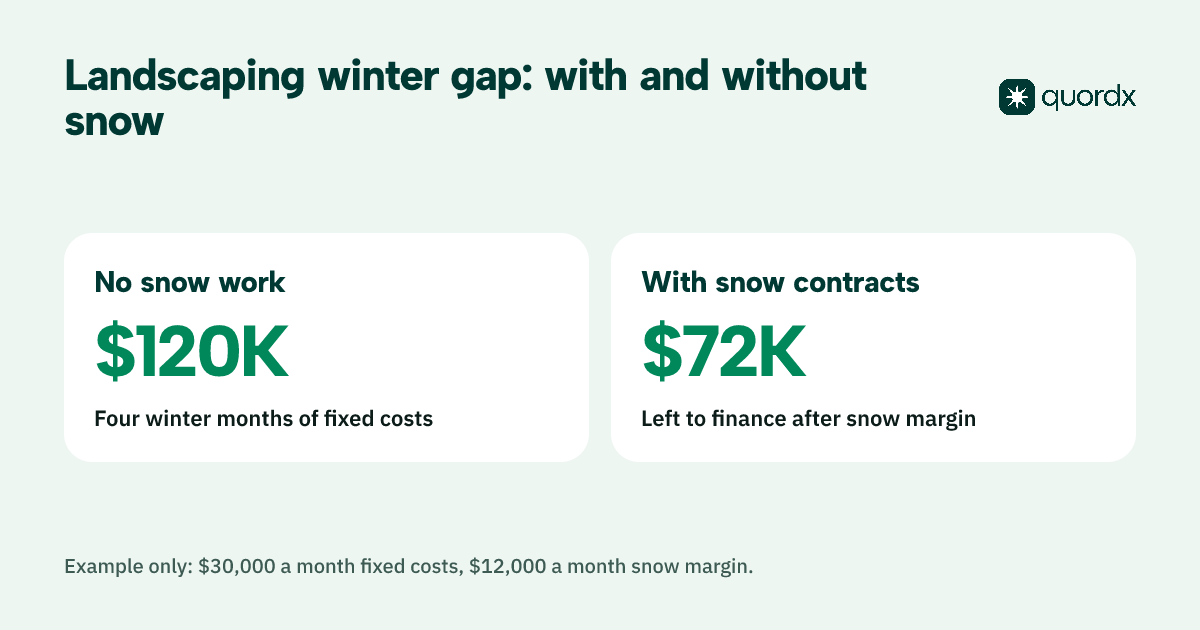
Worked example: a landscaping company's winter gap, with and without snow
This is an illustration with assumed numbers. Say a landscaping company keeps a core crew of four through the winter and has $30,000 a month of costs that don't stop: $16,000 of payroll, $7,500 of truck and equipment payments, $2,500 of insurance, $3,000 of yard rent and $1,000 of phones, software and office costs. Its off-season runs December through March.
In the snow version, the company holds plowing and salting contracts that bill an average of $26,000 a month over those four months, and it spends $14,000 a month on salt, fuel, overtime and subcontracted plows to do the work. That leaves $12,000 a month toward the fixed costs.
| December through March | No snow work | With snow contracts |
|---|---|---|
| Fixed costs (4 x $30,000) | $120,000 | $120,000 |
| Snow billing (4 x $26,000) | $0 | $104,000 |
| Direct snow costs: salt, fuel, overtime, subs | $0 | $56,000 |
| Snow margin toward fixed costs | $0 | $48,000 |
| Winter gap to finance | $120,000 | $72,000 |
Now add the spring ramp: Say March brings $25,000 of materials and early seasonal hires before any spring invoices are paid. In the snow version, the borrowing peaks at $97,000 at the end of March and stays there through April while commercial invoices age.
Then pay it down from summer revenue: If the company repays $35,000 in May, $35,000 in June and the last $27,000 in July, and the lender charges a hypothetical 1.25% a month on the balance drawn, the whole winter costs about $4,900 in interest. That uses month-end balances of $18,000, $36,000, $54,000, $97,000, $97,000, $62,000 and $27,000 from December through June.
Decision rule: ask for a limit above your calculated peak, not equal to it. A wet April or a slow-paying property manager pushes the peak higher, and a line that is maxed out in March leaves you nothing for a broken mower.
Estimate your funding
Answer a few questions about your business to see a likely range.
Winter working capital for a landscaping company: which product fits
A line of credit is the natural fit: because the need comes back every year and you pay interest only on what you draw. Set it up in the fall, draw as the gap opens, and pay it to zero during the summer. Lenders often review lines once a year, and a balance that never comes down looks like permanent borrowing rather than seasonal money. Our guide to the business line of credit explains how lines are priced and renewed.
A short-term loan works if you can't get a line: Take it in late fall, sized to the gap, with a payoff date in summer. The catch is that fixed payments start right away, during the months your deposits are lowest, so ask whether the lender offers a payment schedule that follows the season.
A merchant cash advance is the wrong tool for a winter you can see coming: The payback is fixed when you sign, and daily or weekly debits begin in the months with the least money coming in. If one is already on your statements, read how a factor rate works before you sign another.
Apply in September or October, not February: Underwriters who understand seasonal work look at 12 months of statements, but an application sent in the middle of winter can still get sized off the weakest recent months. Getting the line approved while your account still shows the summer is the easiest improvement you can make to the whole plan.
Commercial vs residential landscaping contracts: how the mix changes the loan
Lenders read how your money arrives. A route of weekly residential mowing, a design-build crew installing patios and a book of HOA contracts produce very different bank statements, even at the same annual revenue.
| Type of work | How it is usually paid | What a lender sees | Funding that fits |
|---|---|---|---|
| Residential maintenance | Card on file or monthly billing, often paused in winter | Steady small deposits April to November, little in winter | Line of credit sized on 12 months |
| Residential design-build | Deposit up front, balance at completion | Large, lumpy deposits; some are customer money until the job is done | Line of credit for materials |
| Commercial maintenance (HOAs, property managers, office parks) | Monthly invoices on net terms | Predictable receivables that lag the work | Factoring or a receivables line; supports a larger line |
| Snow and ice contracts | Seasonal fixed fee, per push or per event | Winter deposits that offset the gap | Equipment loans for plows; line for salt |
Commercial invoices can be financed on their own: Invoices to property managers, HOAs and businesses on net terms are receivables a factor can buy, because the factor underwrites a business customer's ability to pay. Homeowner invoices generally don't fit. The guide to accounts receivable financing and invoice factoring covers advances, reserves and notifying your customers.
Ask commercial clients to pay in 12 equal monthly installments: Some contractors bill a year of maintenance, sometimes with snow included, as equal monthly payments, which keeps money arriving through the winter. It lowers the gap you have to finance and makes your statements look like the steady business they describe.
Treat design-build deposits as the customer's money until the job is built: A lender, especially an SBA lender, may ask how much of your bank balance is deposits for work not yet done. Spending April's patio deposits on March payroll is how a seasonal squeeze turns into a real problem.
Snow removal as a counter-season
Snow work turns winter fixed costs into winter revenue: The trucks, the crew and the yard are already paid for, so plowing and salting contracts spread those costs over twelve months instead of eight. In the example above, snow cut the amount to finance from $120,000 to $72,000.
The contract type decides how much weather risk you carry:
- Seasonal, fixed-fee contracts pay the same whether it snows twice or twenty times. Lenders like the predictability, and a mild winter doesn't wreck your gap plan.
- Per-push or per-event contracts pay only when it snows. A heavy winter pays well; a light one leaves you holding salt and equipment payments with little to bill.
- Hourly or time-and-materials work follows your labor and equipment hours, with the same weather exposure as per-push.
Finance the snow equipment like any other equipment: Plows, spreaders and pushers for a loader can go on an equipment loan, ideally bundled with the truck or loader when you buy it. Salt is different: it is inventory bought in the fall, so it belongs on the line of credit and gets repaid from winter billing.
Decision rule: if your snow contracts are mostly per-push, plan the line as if the winter will be mild and treat a heavy one as a bonus. If they are mostly seasonal, you can count most of that margin toward the gap.
Financing mowers, trucks, trailers and loaders
Each machine can secure its own loan: Equipment financing uses the mower, loader, trailer or truck as collateral, so it is usually easier to get and cheaper than unsecured working capital, and the term can match how long the machine will work. Dealers often arrange financing at the counter; compare that offer with an outside lender before you sign. Our equipment financing guide covers loans, leases and what lenders check.
Ask about a seasonal payment schedule: Some equipment lenders will set payments that are higher in the working months and lower or skipped in winter. It can cost a little more over the term, but it lines the payment up with the months the machine earns.
Worked example: a loader that works both seasons
Say a compact track loader for hardscape jobs costs $68,000, plus $6,000 for a snow pusher, for a total of $74,000. With 10% down ($7,400) and $66,600 financed at an assumed 8.5% over 48 months, the payment is about $1,642 a month, with about $12,200 of interest over the term. These are hypothetical terms, not a quote.
The pusher changes the math: Without snow work, the loader earns from April to November, so eight working months carry twelve payments. With a pusher on seasonal parking-lot contracts, it can earn in the other four months too.
Section 179 and when to buy
Section 179's 2026 limit is $2,560,000 of qualifying equipment, reduced dollar for dollar once a business places more than $4,090,000 in service in the year (IRS Revenue Procedure 2025-32). Heavy SUVs are capped at $32,000, but that cap doesn't apply to a vehicle with a cargo area at least 6 feet long that isn't reachable from the passenger compartment, which describes many full-size pickups (IRS Publication 946).
Timing decides the year of the deduction: Publication 946 says property is placed in service when it is ready and available for its specific use, so a mower ordered in December that arrives in February belongs on next year's return. Quordx is not a tax advisor; run your purchase plan past your CPA. See our page on equipment lease vs loan for how the choice changes the tax treatment.
Paying for the spring crew
Hiring is a winter expense: Recruiting, training and the first weeks of seasonal payroll come before the first spring invoices are paid. Put those costs into the line-of-credit plan instead of treating them as an April surprise.
Seasonal visa workers move the deadline earlier: The Department of Labor's H-2B program lets employers with a seasonal or peakload need hire temporary non-agricultural workers. Employers request a prevailing wage determination at least 60 calendar days before it is needed, and file the job order and application 75 to 90 days before the date of need (DOL). For an April 1 start, that puts the paperwork, and any fees you pay someone to handle it, in early to mid January.
What lenders look at in a landscaping company
- Twelve months of bank statements, so the underwriter sees the whole cycle, plus last year's business tax return.
- Revenue by type: maintenance, design-build and snow, and residential versus commercial, from your invoicing or field-service software.
- Commercial contracts and an AR aging if you want a larger line or factoring.
- An equipment and vehicle list with year, make, VIN or serial number and who holds any lien.
- Proof of insurance: general liability, commercial auto and workers' comp.
- Existing debt, including any merchant cash advances; the debits are on your statements either way.
- Customer deposits you are holding for design-build jobs not yet finished.
Where Quordx fits for a landscaping company
Quordx is a broker that sends one application, about 10 minutes, to lenders for each part of a landscaping company's year: equipment and truck financing (generally from around $15,000), lines of credit and term loans for the winter gap, and factoring for commercial maintenance invoices. Lenders Quordx works with generally look for around $17,000 a month in revenue and about a year in business for the cash-flow products, judged across the full year rather than the winter months. SBA loans through Quordx generally start around $400,000, which suits buying another company's routes and equipment, not a winter line.
What it can't help with: a smaller SBA loan is better found through SBA's Lender Match, and Quordx doesn't set up homeowner financing for design-build jobs. Each lender makes its own decision, typically within 24 to 48 hours, the lender pays Quordx if a deal funds, and companies based in Virginia, Connecticut, Missouri or North Dakota are outside Quordx's service area.
Questions Business Owners Ask Before Applying
Can a landscaping company get a loan in the winter?
Yes, but expect it to be sized off your weaker recent months unless the lender reviews a full year of statements. Send 12 months of statements and last year's tax return, and explain the seasonal pattern up front. The better plan is to set up a line in early fall and draw on it in winter.
Does snow removal revenue help me qualify?
Yes, because it puts deposits in your account in months that would otherwise be nearly empty, and lenders size most cash-flow products from deposits. Seasonal fixed-fee contracts count for more than per-push work, since they don't depend on the weather.
Can a new landscaping company get financing?
Equipment financing is the most realistic start, because the mower or truck secures the loan and the lender leans on your credit and down payment. Working capital lenders generally want about a year of history, so plan on building one full season of statements before you apply for a line.
Can residential landscaping invoices be factored?
Generally no. Factors buy invoices owed by businesses that pay on terms, so homeowner billing doesn't fit. Commercial maintenance invoices to property managers, HOAs and businesses are the part of a landscaping company a factor can finance.
Apply for Funding
No obligation · Initial inquiry doesn't impact credit · Takes about 10 minutes
Sources

Written by
Cody Dreis
Founder, Quordx Capital
Read full bio
Keep exploring industry financing
Quordx Capital is a business funding broker, not a lender. Lenders make every credit decision and set the rate, fees and terms, and not every business qualifies. Quordx may be paid by a lender when a deal funds. Full disclosures