

How to Get Financing for a Medical or Dental Practice
You get financing for a medical or dental practice by matching each need to its own tool: equipment financing for imaging and clinical equipment, an SBA 7(a) or bank practice loan to buy a practice or buy into one, real estate financing for the building, and a line of credit for the weeks between a visit and the insurer's payment. Lenders underwrite a practice on its collections, its payer mix and the provider's license, so the paperwork that matters most comes out of your practice management system, not your bank account alone.
The short version: Size working capital to the claims you have in process, not to a guess. Finance equipment over its useful life, use SBA 7(a) or a bank's practice-lending group for an acquisition, and keep merchant cash advances out of the plan, because a fixed daily debit fits badly with insurance money that arrives in batches. Before you apply, pull 12 months of production, adjustments, collections and AR aging by payer.
Part of our industry guide: Industry Financing.
Last updated · Reviewed by Cody Dreis
75+ Lenders|Decisions typically in 24 to 48 hours*
Why medical practices run short on cash: the reimbursement lag
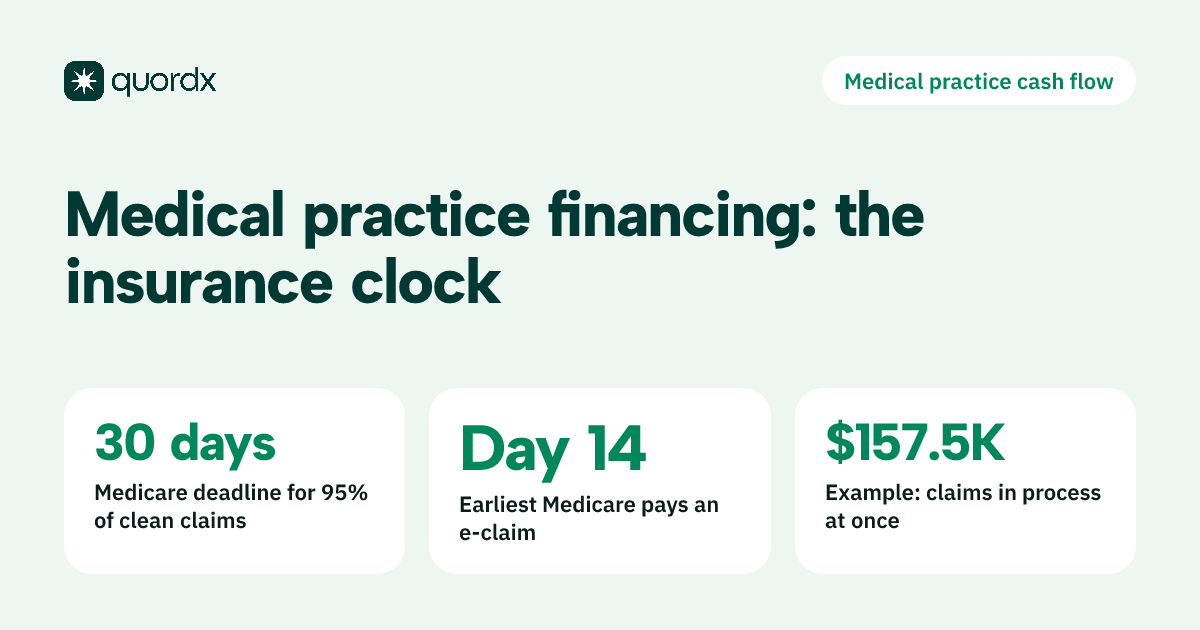
A practice pays staff, rent and supplies on a fixed schedule, but most of its revenue arrives later, on each payer's clock. Medicare's claims contractors must pay at least 95% of clean claims within 30 days of receipt, and they may not pay an electronic claim until 13 days have passed (28 days for paper) (42 U.S.C. 1395u). Commercial plans pay on their contract terms and state rules, and a denied or corrected claim starts the wait over.
The cash tied up in claims is a balance, not a one-time gap: It sits there every day the practice runs, and it grows when you add a provider or a payer slows down.
Worked example: how much cash is sitting in claims
Say a two-physician practice collects $180,000 a month, with 75% of it from insurers, and insurance money arrives an average of 35 days after the visit. These are assumptions for illustration, not industry averages.
| Line | Math | Amount |
|---|---|---|
| Insurance collections per month | $180,000 x 75% | $135,000 |
| Insurance collections per day | $135,000 / 30 | $4,500 |
| Claims in process at any time | $4,500 x 35 days | $157,500 |
| Add a provider billing $45,000 a month to insurers | $1,500 a day x 35 days | +$52,500 |
| Payers slow from 35 to 50 days on average | $4,500 x 15 extra days | +$67,500 |
Decision rule: if the need is permanent, like a new provider's claims, a revolving line of credit sized to the extra balance fits. If it is one payer running late, chase the payer before you borrow, and size any line to the slowdown, not to the whole practice.
Practice financing options by what the money is for
Most expensive mistakes come from using a short, costly product for a long-lived purchase, or the reverse. Match the term to the life of what you are buying.
| Need | Usual tool | How the term is set |
|---|---|---|
| Imaging, lasers, exam rooms, sterilization | Equipment loan or lease | Around the equipment's useful life; SBA equipment loans are generally 10 years or less |
| Buying a practice or a partner's share | SBA 7(a) or a bank practice loan | SBA allows up to 10 years for the business portion |
| Buying the building | SBA 7(a), SBA 504 or a commercial mortgage | SBA 7(a) real estate terms run up to 25 years |
| New provider, payer delays, seasonal dips | Line of credit | Revolving; you pay interest on what you draw |
| Build-out of a new location | SBA 7(a) or a bank construction or term loan | Tied to the lease or property and the equipment |
For the building, compare the two SBA programs in SBA 7(a) vs 504 loans. For a reimbursement gap, the mechanics of a revolving line are in the business line of credit guide.
Estimate your funding
Answer a few questions about your business to see a likely range.
Medical equipment financing for imaging and clinical equipment
Equipment financing uses the equipment as collateral, so the lender cares about what it is, whether it holds resale value, and whether your collections can carry the payment. New and used equipment can both be financed, though some lenders treat older or highly specialized units more cautiously.
The quote is rarely the whole cost: Imaging often needs room work, shielding, electrical upgrades, installation, software and training. Some lenders finance those soft costs with the equipment and some only the hardware, so ask before you sign the vendor's order.
Worked example, hypothetical: a practice adds a $300,000 imaging system with $40,000 of room preparation and installation. Financed in full over 60 months at an assumed 9%, the payment is $7,057.84 a month, and the practice pays $423,470 over the term. If each study collects $120 after supplies (another assumption), the practice needs about 59 studies a month just to cover the payment.
Decision rule: run that break-even before you buy. If your referral volume can't clear it in the first year, a lease with a lower payment, a used unit or a later purchase may beat a new system.
Taxes can change the math: For tax years beginning in 2026, Section 179 lets a business expense up to $2,560,000 of qualifying equipment, reduced dollar for dollar once purchases pass $4,090,000, and 100% bonus depreciation applies to qualifying property acquired after January 19, 2025. See equipment financing and Section 179 and talk to your CPA; Quordx is not a tax advisor.
SBA loans for a medical practice
An SBA 7(a) loan can fund real estate, working capital, equipment, refinancing and changes of ownership, complete or partial, up to $5 million (SBA). SBA guarantees up to 75% of loans above $150,000, which makes banks more willing to lend against a practice's goodwill.
Rates are capped: For loans above $350,000, the maximum variable rate is the base rate plus 3.0% (SBA). With prime at 7.00% as of October 2026, that ceiling is 10.00%. Lenders can price below it.
There is an upfront guaranty fee: For loans approved from October 1, 2026, a 7(a) loan between $700,001 and $5 million pays 3.5% on the guaranteed portion up to $1 million (SBA Information Notice 5000-881797). On a $990,000 loan, 75% guaranteed, that is $25,987.50.
Every owner must be a U.S. citizen or national: Under SBA's current rules, all direct and indirect owners must be U.S. citizens or U.S. nationals with their principal residence in the United States, and lawful permanent residents (green card holders) are not eligible owners (SOP 50 10 8.1). Physicians on a green card who want SBA financing need a non-SBA bank loan instead.
Buying a medical practice: what lenders check
A practice purchase is mostly goodwill: patients, referral relationships and payer contracts. Lenders therefore test whether the cash flow survives the seller leaving.
Pay the buyer a real salary before you test the debt: A practice's earnings often include the selling physician's own pay. Say a practice shows $520,000 a year before owner pay, interest, taxes and depreciation, and a market salary for the buying physician is $300,000 (both assumptions). Test the debt against the remaining $220,000, because that is the cash actually left to pay it.
| Line | Amount |
|---|---|
| Purchase price | $1,000,000 |
| Working capital and closing costs | $100,000 |
| Total project cost | $1,100,000 |
| Buyer equity at 10% | $110,000 |
| SBA 7(a) loan, 10 years at the 10.00% cap | $990,000 |
| Annual payments | $156,995 |
| Debt service coverage on $220,000 | 1.40x |
Counting the full $520,000 would show 3.31x coverage and hide the real margin. At 1.40x, the deal clears SBA's 1.25x minimum with room for a slow first year, but not much more.
Plan the transition: In an outright purchase, SBA lets the seller stay on only as a consultant, for no more than 24 months in total. Ask each commercial payer how a change of ownership affects your contract and credentialing, because claims can stall while that is sorted out. The full set of SBA acquisition rules, including seller notes, is in how to use an SBA loan to buy a business.
Medical merchant cash advance: why it's usually the wrong fit
A merchant cash advance buys a share of future receipts for a fixed payback, usually collected by daily or weekly debit. It is quick to get, and that is about its only advantage for a practice.
Worked example, hypothetical: $60,000 at a 1.30 factor means $78,000 repaid. Over about six months of business days, that is roughly $619 a day, or $3,095 a week, taken whether or not an insurance batch arrived. The cost is $18,000. Drawing the same $60,000 on a line at an assumed 10.5% for 60 days costs about $1,036.
Insurance money arrives in lumps: often one or two remittances a week, while the debit runs every business day. A practice can be profitable and still bounce the debit in a slow week.
Decision rule: if a practice with steady collections is being offered only an advance, find out why before signing. A tax lien, a falling collection rate or an existing advance usually explains it, and fixing that first opens cheaper money. If you already carry one, the merchant cash advance guide explains the true cost.
Can you finance medical insurance receivables?
Sometimes, but not the way a general factor finances business invoices. Medicare generally won't pay amounts due a physician or other supplier to anyone else, with narrow exceptions such as a court order or a billing agent paid in the practice's name (42 CFR 424.80). A lender can't simply tell Medicare to pay it instead.
That is why healthcare receivables lending is a specialist product: Lenders that do it work within those payer rules and underwrite each payer's history of denials, adjustments and payment speed. For most practices, a bank line of credit secured by receivables, sized to the claims balance, is the simpler route.
What lenders ask a medical practice for
- Proof you can practice: an active state license, DEA registration if you prescribe, and your malpractice declarations page.
- Practice management reports for 12 months: production, contractual adjustments, net collections and new patients.
- AR aging by payer, so the lender can see who pays slowly and how concentrated the practice is in one payer.
- Tax returns and financial statements for the practice, and personal returns for owners who will guarantee.
- For equipment: the vendor quote including installation, software and room work.
- For an acquisition: the purchase agreement, the seller's financial statements and a business valuation the lender orders.
Student debt is not a dealbreaker by itself: Lenders count the payment in your personal cash flow alongside the practice's, so a large balance on an income-driven plan reads very differently from the same balance on a short standard plan. Bring the current payment letter.
Dental practices: what changes
Dental financing follows the same logic with different details: more fee-for-service revenue, chairs and CBCT instead of large imaging suites, and associate buy-ins as a common first purchase. Original Medicare doesn't cover most dental care, so the payer picture looks different too (Medicare.gov). The dental practice loan guide covers buy-ins, start-up offices and how PPO write-offs change what a lender will lend.
Where Quordx fits for a medical practice
Quordx is a broker, not a lender. For practices it can send an equipment request to equipment lenders it works with, including large-ticket imaging, and an SBA 7(a) request for an acquisition, buy-in or building, where SBA loans through Quordx generally start around $400,000. Lines of credit and term loans are an option too; those lenders generally look for around $17,000 a month in revenue and about a year in business.
What Quordx can't place: smaller SBA loans, SBA 504 or Express, and specialist insurance receivables financing. For an SBA loan under about $400,000, SBA's free Lender Match is the better start, and a bank's practice-lending group is worth a direct call too.
If a request fits, the application takes about 10 minutes, the lenders set terms and decide, and Quordx's fee comes from the lender when a deal funds.
Questions Business Owners Ask Before Applying
Can I get a practice loan with a green card?
Not an SBA loan, as of October 2026. SBA's current rules require every direct and indirect owner to be a U.S. citizen or national, and lawful permanent residents are not eligible owners. A conventional bank practice loan or equipment financing doesn't carry that rule.
Can I finance used medical equipment?
Yes, many equipment lenders finance used units. Expect more questions about age, service history and resale value, and possibly a shorter term, because the lender is relying on the equipment as collateral.
Can I factor my Medicare claims?
Not with a standard notification factor. Medicare generally pays only the provider, with narrow exceptions like a court order or a billing agent paid in the provider's name. Specialist healthcare receivables lenders and bank lines secured by receivables work around this.
How long does an SBA loan for a medical practice take?
SBA lists 5 to 10 business days for its own review of a standard 7(a) loan, but the lender's underwriting, the valuation and the closing come on top of that. For a purchase, start the loan process well before the target closing date.
Is it better to lease or finance imaging equipment?
Lease when the technology will be outdated before it wears out, or when you want the lowest payment and the option to upgrade. Finance when you expect to use the unit for most of its life and want the Section 179 deduction and the equity at the end.
Apply for Funding
No obligation · Initial inquiry doesn't impact credit · Takes about 10 minutes
Sources

Written by
Cody Dreis
Founder, Quordx Capital
Read full bio
Related articles
Keep exploring industry financing
Quordx Capital is a business funding broker, not a lender. Lenders make every credit decision and set the rate, fees and terms, and not every business qualifies. Quordx may be paid by a lender when a deal funds. Full disclosures