
Business Acquisition Loans: How to Finance Buying a Business With an SBA Loan
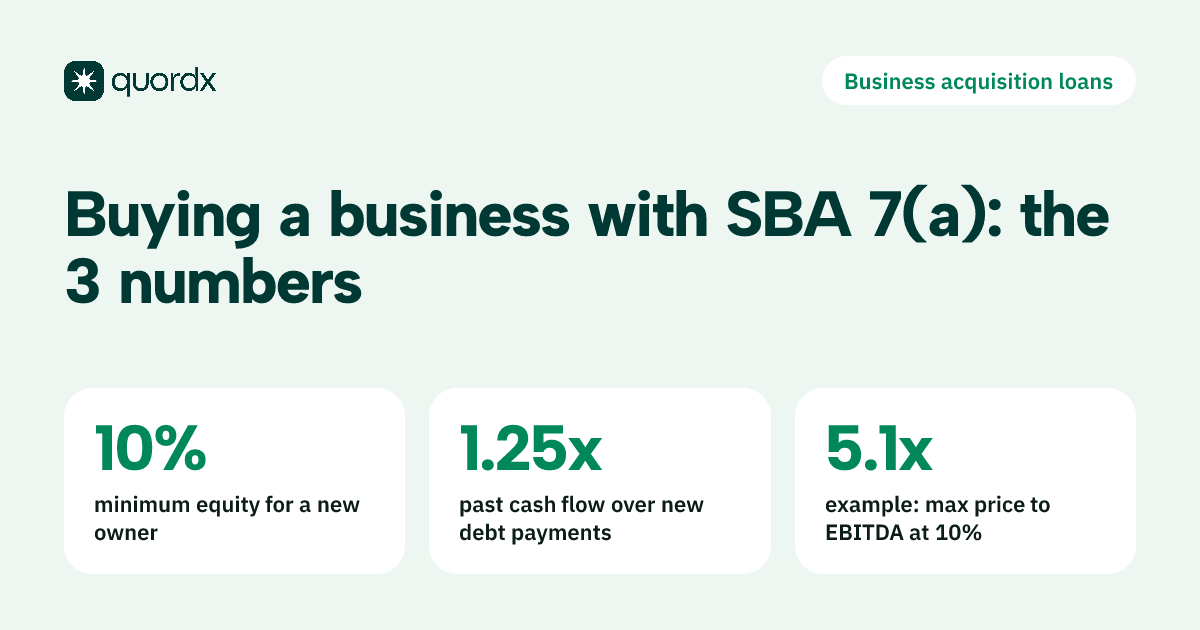
A business acquisition loan is financing to buy an existing company, and for most small-business buyers the main route is an SBA 7(a) loan: up to $5 million, repaid over as long as 10 years, with an equity injection of at least 10% of the total project cost. To get one, the business's own historical cash flow has to cover every post-sale debt payment at least 1.25 times, and a valuation the lender orders has to support the price. When a deal doesn't fit those rules, conventional bank loans, seller financing, asset-based lines and equipment loans fill the gaps, often side by side.
The short version: Budget 10% of the total project (price plus working capital and closing costs), and plan for at least half of that to come from your own unborrowed cash or another source SBA counts in full, because a seller note can supply the other half only if it takes no payments for the life of the SBA loan. Before you sign a letter of intent, turn the seller's advertised earnings into the EBITDA a lender will accept and divide it by the new annual debt payments; if the answer is under 1.25, the price or the structure has to change. Expect the lender to order the valuation, check the seller's numbers against IRS transcripts and require personal guarantees from every owner of 20% or more.
Part of our guide to Business Loans.
Last updated · Reviewed by Cody Dreis
75+ Lenders|Decisions typically in 24 to 48 hours*
Business acquisition loans: the main ways to finance buying a business
Few purchases are funded with one loan. A typical deal stacks three layers: your equity, a note the seller carries, and a senior loan from a bank or SBA lender. The senior loan is the piece most buyers search for, and the choice you make there sets the rules for the other two.
| Route | How it works | Your money in | Best fit | Watch for |
|---|---|---|---|---|
| SBA 7(a) loan | A lender's loan with a 75% SBA guaranty on loans over $150,000 | At least 10% of total project cost for a new owner | Goodwill-heavy deals up to $5 million | Valuation, 1.25x history test, personal guarantees, upfront fee |
| Conventional bank loan | The bank lends on its own policy with no SBA guaranty | Set by the bank | Buyers with hard collateral or an existing banking relationship | Some bank programs require 2 years under current ownership, and a sale restarts that clock |
| Seller financing | The seller takes part of the price as a promissory note | Negotiated | Closing a gap between price and what a lender will fund | In an SBA deal it counts as equity only on full standby |
| Earnout | Part of the price is paid later, based on results | Negotiated | Price disputes in deals without SBA money | Prohibited in an SBA 7(a) acquisition |
| Asset-based line or equipment loan | Lent against receivables, inventory or equipment | Depends on the collateral | Distributors, manufacturers and other asset-heavy companies | Advances track collateral value and don't fund goodwill |
| SBA 504 loan | A bank and a Certified Development Company finance owner-occupied property | At least 10% of the 504 project | Deals that include the building | Must be a separate loan; it can't be blended into the 7(a) term |
If most of the price is goodwill: customer relationships or a brand, a 7(a) loan is built for it. SBA's rulebook lets acquisition loans finance intangible assets, including goodwill, customer lists and noncompete agreements, once the valuation rules below are met (SOP 50 10 8.1, Appendix 15).
If the business owns real receivables, inventory or equipment: an asset-based line or equipment loan can carry part of the price and shrink the SBA loan. SBA lets a working capital line sit beside the 7(a) term loan, and a lender can even fund part of the purchase price on that line under set conditions. For how 7(a) works outside acquisitions, see our SBA loans guide.
SBA 7(a) rules for buying a business in 2026
SBA calls a purchase a change of ownership. The rules sit in Appendix 15 of SOP 50 10 8.1, the lender rulebook whose technical updates took effect October 1, 2026. Every deal falls into one of four types, and the type sets your minimum equity and your cash flow test, so find yours first.
| Type | What it is | Minimum equity | Can the lender waive it? | Cash flow test |
|---|---|---|---|---|
| Initial Acquisition | A new majority or largest owner buys the business (the default category) | 10% of total project cost | No | 1.25x |
| Business Expansion | A business with 2 full fiscal years under current owners buys 100% of another in the same 4-digit NAICS group | 10% | Yes, with enough liquidity | 1.15x |
| Owner Buyout | Existing owners or 24-month employees buy out an owner, in full or in part | 10% of the purchase price | Yes, with enough liquidity | 1.25x |
| ESOP or cooperative | Employees buy a controlling interest (51% or more) | None for an ESOP; 10% for a cooperative | ESOP: not applicable; cooperative: no | 1.25x |
Rules that apply to every SBA acquisition
- The business borrows. A 7(a) loan can't go to an individual alone; the business is the borrower or a co-borrower. An individual buying 100% of the stock signs the note with the business.
- Stock or assets both work. Buying substantially all of a seller's assets and continuing the operation counts as a change of ownership. If there's no clear continuity of operations, the lender may underwrite it as a start-up instead, with start-up rules.
- Ownership and size. Every direct and indirect owner and every required guarantor must be a U.S. citizen or U.S. national whose principal residence is in the United States, and the buyer plus the business being bought must together meet SBA's size standard.
- The seller leaves. In an Initial Acquisition or Business Expansion, the seller can't stay as an owner, officer, director or employee. The business can hire the seller as a consultant for up to 24 months in total.
- No earnouts. Seller earnouts are prohibited. A rebate from the seller to the buyer based on performance is allowed, but it must go toward the 7(a) loan's principal. A working capital true-up in the purchase agreement isn't treated as a rebate.
SBA lenders also have to document that you can't get the same credit elsewhere on reasonable terms without the guaranty. That's the purpose of the guaranty: it backs deals a lender wouldn't make on reasonable terms without it.
Can the business carry the loan?
Enter the price, your down payment and the cash flow. See the payment and debt service coverage.
The $5 million cap on SBA acquisition loans, and what larger deals do
A single 7(a) loan tops out at $5 million (SBA). Separately, SBA's guaranty to one business and its affiliates can't exceed $3.75 million outstanding, counting existing 7(a) and 504 loans (SOP 50 10 8.1, Appendix 16). A buyer who already has SBA debt in another company can hit the guaranty limit before the loan limit.
Example of a deal that outgrows 7(a): say the price is $7,000,000 with $300,000 of working capital and $100,000 of closing costs, a $7,400,000 project. Ten percent equity is $740,000, leaving $6,660,000 of debt, which is $1,660,000 more than one 7(a) loan can carry. A $5,000,000 SBA loan at the 10.00% cap over 10 years costs $66,075.37 a month, or about $792,904 a year, before a dollar of the remaining gap is paid.
- More seller financing. A seller note with payments can fill the gap, but those payments go into the 1.25 test and total debt can't exceed the business valuation.
- A conventional loan beside the SBA loan. SBA bans piggyback structures where the 7(a) loan sits behind another loan approved within 90 days. Sharing the lien equally (pari passu) is allowed when the other loan's maturity is no shorter than the SBA loan's.
- Outside investors. Investors can add cash. An investor who takes under 20% with no control can supply part of the required equity, within the half-of-equity cap on limited sources, and distributions to that investor are then limited to tax distributions until the 7(a) loan is paid off. An investor who owns 20% or more must guarantee the loan like any other owner.
- Real estate through 504. If the deal includes the building, moving it into a 504 loan keeps the 7(a) loan for the business itself. SBA asks lenders to approve the 7(a) first when both are involved.
How much down payment you need to buy a business
For an Initial Acquisition, the 10% is figured on total project cost: purchase price plus working capital, closing costs and anything else needed to operate, whoever funds it. On a $1,300,000 project that's $130,000, and the lender can't reduce it. For an Owner Buyout, the 10% is figured on the purchase price alone.
When a lender waives equity: in a Business Expansion or Owner Buyout, it can't also lend dedicated working capital on that or another 7(a) term loan within 90 days; working capital has to come from existing cash or a line of credit.
What counts as your equity
- Your cash, with no limit, as long as it isn't borrowed. Savings, cash on the business's balance sheet and a documented gift all work.
- A personal loan, including a home equity line, but only if you can show it will be repaid from something other than the business's cash flow, such as a spouse's salary or other income. Your salary from the business you're buying doesn't count.
- Grants with no repayment, clawback or conditional payback during the loan.
- Prepaid deal costs the lender verifies with paid invoices, canceled checks or bank statements, including what you spent on the business valuation or quality of earnings report.
- Limited sources, capped at half your required equity together: a seller note or other debt on full standby, and investors who own under 20% and have no control.
Fees you paid an agent, and money spent on education or advisory services, don't count as equity.
Decision rule: if your unlimited sources (unborrowed cash, gifts, a qualifying personal loan, grants and verified prepaid costs) add up to less than 5% of total project cost, the deal doesn't work as an Initial Acquisition no matter what the seller offers, because limited sources can never cover more than half. Shrink the project, raise more cash, or, if you already work in the business, look at an Owner Buyout. Our page on the SBA loan down payment covers equity for other SBA loan types.
Seller notes in an SBA acquisition: standby or paid
A seller note can do two different jobs, and SBA treats them very differently.
As equity: the note must be subordinated to the lender and on full standby, meaning no principal or interest payments for the entire term of the 7(a) loan. Interest can accrue and be paid after the SBA loan is gone, and the lender documents the deal on SBA Form 155 or its own standby agreement with the note attached. In that form the note can supply up to half of your 10%.
As regular debt: if the seller wants to be paid along the way, the note isn't equity, so the full 10% comes from you. Its payments count in the cash flow test, and the SBA loan plus any seller debt not on full standby can't exceed the business valuation.
Interest-only notes get tested as if they amortize: If a non-standby note is interest-only, the lender must test it on an amortization of 10 years or less. A $200,000 seller note at 6% interest-only costs $12,000 a year in real payments, but the lender counts at least $26,645 a year, the payment on a 10-year schedule.
- Refinancing the note later: a seller note can be refinanced into SBA debt after it has been in place and current, not on standby, for 36 months, and only if the refinance cuts the payment by at least 10% and doesn't reduce the lender's exposure.
- When the price beats the valuation: SBA allows extra limited equity, such as more seller debt, to cover the gap, but every dollar of it must be on full standby.
Deal structure examples: buying a $750,000 and a $3.5 million business
Assumptions, invented for these examples: both are Initial Acquisitions with no real estate, the lender's valuation supports each price, and the seller agrees to a note on full standby for half the required equity. The SBA rate is the maximum for loans over $350,000: prime of 7.00% (the Federal Reserve's H.15 release shows the bank prime rate at 7.00% through November 17, 2026) plus 3.00%, so 10.00%, amortized over 10 years. Fees are SBA's FY 2027 upfront guaranty fees from Information Notice 5000-881797.
| $750,000 business | $3,500,000 business | |
|---|---|---|
| Purchase price | $750,000 | $3,500,000 |
| Working capital | $50,000 | $250,000 |
| Closing and due diligence costs | $25,000 | $75,000 |
| Total project cost | $825,000 | $3,825,000 |
| Required equity (10%) | $82,500 | $382,500 |
| Buyer's cash (5%) | $41,250 | $191,250 |
| Seller note on full standby (5%) | $41,250 | $191,250 |
| SBA 7(a) loan | $742,500 | $3,442,500 |
| Monthly payment, 10 years at 10.00% | $9,812.19 | $45,492.89 |
| Annual debt service | $117,746 | $545,915 |
| EBITDA needed at 1.25x | $147,183 | $682,393 |
| SBA guaranteed portion (75%) | $556,875 | $2,581,875 |
| FY 2027 upfront guaranty fee | $19,490.63 | $94,320.31 |
| Interest paid in year one | about $72,200 | about $334,745 |
| Extra due diligence | Independent valuation | Independent valuation plus quality of earnings report |
Read it this way: At these assumptions, each business has to earn about 20% of its price in EBITDA to pass. Put differently, the 1.25 test caps the price at about 5.1 times EBITDA when the rate is 10% over 10 years and the seller note is on standby. A seller asking more than that multiple needs a lower price, a longer or deferred seller note, or more cash from you.
Watch the $700,000 fee line: The upfront fee is 3% of the guaranteed portion up to a $700,000 loan and 3.5% above it. Cut the $742,500 loan to $700,000 with $42,500 more equity and the fee falls from $19,490.63 to $15,750, saving $3,740.63 on top of the smaller payment.
The $3.5 million deal crosses the quality of earnings line: At a business purchase price of $3 million or more, an Initial Acquisition needs a quality of earnings report in addition to the valuation, and the lender must use its earnings figure in the coverage test. Budget for both reports in your closing costs; what you pay for them counts toward your equity.
From SDE to DSCR: the cash flow test lenders run on an acquisition
Business listings usually advertise seller's discretionary earnings (SDE), which adds the owner's salary and perks back to profit. SBA's test uses something tighter: historical EBITDA divided by all debt payments after the sale, measured on the last fiscal year or the average of the last two. The lender may adjust that figure for real savings from the deal, but each adjustment needs a written justification, and an unsupported add-back simply doesn't count.
Your own pay comes out first: If you'll run the business, the lender has to account for a salary that covers your personal obligations and living expenses, and any change to owner compensation must be backed by a global cash flow analysis showing you and any other businesses you own cover all debts at least 1:1. Projections get reviewed but can't be used to pass the test, except for special-purpose property such as a hotel or self-storage site whose appraised value fully secures the loan.
Worked example: a $1.2 million service business
Assumptions, invented for the example: the listing shows $340,000 of SDE. The buyer will replace the seller as full-time manager, and the lender treats $100,000 as a market salary for that role, so adjusted EBITDA is $240,000. The price is $1,200,000 with no real estate, plus $80,000 of working capital and $20,000 of closing and due diligence costs, for a total project of $1,300,000. The SBA loan is at the 10.00% cap over 10 years, and the 6% seller rate is an assumption.
| A: seller note on full standby | B: seller note with payments | |
|---|---|---|
| Buyer's cash | $65,000 (5%) | $130,000 (10%) |
| Seller note | $65,000, no payments for 10 years | $200,000 at 6% over 5 years: $3,866.56 a month |
| SBA 7(a) loan | $1,170,000 | $970,000 |
| SBA payment, 10 years at 10.00% | $15,461.64 a month | $12,818.62 a month |
| Total annual debt service | $185,540 | $200,222 |
| Coverage on $240,000 EBITDA | 1.29x: passes 1.25 | 1.20x: fails 1.25 |
| FY 2027 upfront SBA fee | $30,712.50 | $25,462.50 |
Scenario A: asks the buyer for half the cash and passes, but the seller waits a decade for $65,000. Scenario B pays the seller sooner, needs twice the buyer's cash, and fails, because a 5-year seller note adds $46,399 a year of payments. Stretch the same $200,000 note to 10 years and its payment drops to $2,220.41 a month, total debt service falls to $180,468, and coverage rises to 1.33x, a pass.
What one rejected add-back does to the deal
Say the seller added back $30,000 of equipment repairs as a one-time cost, but the returns show the same repairs every year. The lender drops the add-back, EBITDA falls to $210,000, and Scenario A's coverage falls to 1.13x. To pass at 1.25, annual debt service can be no more than $168,000, which supports an SBA loan of about $1,059,396 at 10% over 10 years, so the buyer needs about $110,604 more equity or a lower price.
Use the acquisition calculator on this page to run your own price, down payment, seller note, rate, term and cash flow. Our page on debt service coverage ratio explains the ratio in general terms.
Business valuation and quality of earnings requirements for SBA acquisitions
The lender orders the valuation and can't use one prepared for you or the seller. Above a $350,000 business purchase price, it must come from an independent appraiser who regularly values businesses and holds one of SBA's listed credentials: ASA, CBA, ABV, CVA or BCA. At $350,000 or less, the lender may value the business itself unless buyer and seller are closely related, and that's also the rule for 7(a) Small and SBA Express acquisitions.
If the price is higher than the valuation: the difference has to be covered by equity, no matter how the debt is structured. That's the single most common way a buyer's cash need grows late in a deal. With the $1.2 million example above, a $1,100,000 valuation would push the buyer's cash in Scenario A from $65,000 to $165,000, unless the seller cuts the price or carries the extra $100,000 on full standby.
When you need a quality of earnings report
- Trigger: an Initial Acquisition or Business Expansion with a business purchase price of $3 million or more, measured before your equity, seller debt or other financing. Owner Buyouts and ESOPs are exempt.
- What it does: it reconciles the accountant's statements, tax returns, internal statements and IRS transcript data into one normalized earnings figure, and it includes a cash proof that ties bank deposits to the income statement and returns for the trailing 12 months and the last two fiscal years.
- What it flags: every add-back, non-recurring items, above- or below-market owner pay, related-party deals, deferred maintenance, cash versus accrual differences, and customer concentration.
- Your own report: if you commissioned a QoE before you found a lender, the lender can have one of its approved vendors review it instead of starting over.
Real estate is valued separately: Its appraised value comes out of the purchase price before any of these dollar thresholds apply, and the property gets a commercial real estate appraisal under SBA's appraisal rules. The lender also checks the financial data behind the business valuation against the seller's IRS transcripts, so numbers that never made it onto a tax return won't support the price.
Personal guarantees, collateral and life insurance on an acquisition loan
Who signs a personal guarantee
- Every owner of 20% or more after the sale gives an unlimited personal guarantee, counting direct and indirect ownership. If no one reaches 20%, at least one owner still guarantees.
- Spouses: each spouse who owns under 20% guarantees in full when the couple and their minor children together own 20% or more.
- Entities and trusts that own 20% or more guarantee too, and a guaranteeing trust's trustor signs personally.
- The six-month lookback: an owner who cut a 20% or larger stake below 20% in the six months before the application still guarantees, unless they fully divested and cut every tie to the business. In a change of ownership, SBA instead decides who guarantees from ownership after the sale.
- A selling owner who keeps under 20% in a partial buyout guarantees the full loan for at least two years after the final disbursement.
Our page on whether SBA loans are personally guaranteed covers guarantees outside acquisitions.
How SBA counts collateral
An acquisition loan is fully secured only when the lender's liens on the business's fixed assets, at SBA's discounted values, add up to the loan amount. Goodwill typically adds little or nothing to that math, so a deal priced mostly on goodwill will come up short, and the shortfall rules decide what else you pledge.
| Asset | Counted at no more than |
|---|---|
| Used machinery and equipment | 50% of net book value, or 80% with an orderly liquidation appraisal, minus prior liens |
| Improved real estate | 85% of market value |
| Unimproved land | 50% of market value |
| Furniture and fixtures | 10% of net book value or appraised value |
| Accounts receivable and inventory | 10% of current book value (the lender must take a lien on both) |
| Goodwill and other intangibles | Nothing |
Example: in the $1.2 million deal, say the business has used equipment with a $200,000 book value, $40,000 of furniture and $150,000 of receivables and inventory. Those count for $100,000, $4,000 and $15,000, or $119,000 against a $1,170,000 loan, a $1,051,000 shortfall. The lender must then take available equity in real estate owned by each owner of 20% or more, including a home, limited to the shortfall and to 150% of the equity, but it doesn't have to when the equity is under 25% of the property's market value.
Life insurance
On a Standard 7(a) loan, the lender may follow its own policy for similar commercial loans. If the loan isn't fully secured, though, SBA requires life insurance equal to the collateral shortfall on the principal of a sole proprietorship, a single-member LLC or any business that depends on one owner's active work. You can pledge a policy you already own, the lender is named by collateral assignment, and SBA says lenders shouldn't require credit life or whole life insurance, so a term policy can usually meet it.
Contract and cost traps to read for
- Variable rate: a variable-rate 7(a) loan moves with its base rate, such as prime, so the payment in your coverage math can rise. SBA caps the spread over the base, not the rate itself.
- Upfront guaranty fee: it's a percent of the guaranteed portion, not the loan, and the tier changes at $150,000 and $700,000 of loan size.
- Prepayment penalty: SBA's 5%, 3% and 1% charges in years one to three apply only to loans of 15 years or more when you prepay 25% or more. A 10-year business loan has none, but a blended loan that includes real estate can cross 15 years. See paying off an SBA loan early.
- Standby terms: a standby agreement bars the seller from taking any payment or action against you without the lender's consent for the life of the loan. Make sure the seller reads it before signing the purchase agreement.
- Licenses as collateral: transferable licenses bought in the deal, such as a liquor license, must be pledged to the lender along with the other assets.
Using an SBA loan for a partner buyout or partial change of ownership
An Owner Buyout lets existing owners, or employees who have actively worked in the business for at least the last 24 consecutive months, buy out another owner. The 10% equity is figured on the purchase price, and the lender may cut or waive it if the business has the liquidity to keep running and its balance sheet doesn't show negative net worth. No quality of earnings report is required, because the remaining owners already know the books.
In a partial change: at least one original owner stays on and guarantees the loan. Every new owner, even one getting 1%, must be a co-borrower, and the seller may stay on as an owner or employee. A selling owner who keeps under 20% gives a full guarantee for at least two years after the final disbursement, and SBA doesn't require that person to pledge a home.
Outsiders have a ceiling: In any Owner Buyout, someone not employed by the business for 24 months can buy less than 50% and can't become the largest owner, counting stakes held through holding companies or trusts. A deal over that line is underwritten with Initial Acquisition credit standards: the 10% equity that can't be waived, 1.25x coverage and the QoE rule. Structures that bring in a new owner by forming a new holding company over the operating business aren't eligible at all.
Buying a franchise resale with an SBA loan
Buying an existing franchise location follows the same Appendix 15 rules as any acquisition, with one extra gate. If the brand meets the FTC's definition of a franchise, it must appear on the SBA Franchise Directory before a lender can approve the loan or send it to SBA. SBA last updated the directory on November 12, 2026, and listing isn't an endorsement of the brand.
The franchise disclosure document tells you what the seller can't: Federal rules (16 CFR 436.5) require franchisors to disclose specific items, and four matter most to a resale buyer:
- Item 17, renewal, termination, transfer and dispute resolution: the conditions the franchisor sets before it approves a transfer to you, and the term of the agreement you'd be taking over.
- Item 19, financial performance representations: where the franchisor discloses any sales or earnings figures it chooses to give, useful to test the seller's numbers against the system.
- Item 20, outlets and franchisee information: openings, closings and transfers, plus contact details for franchisees who left the system in the last fiscal year. Call several.
- Item 21, financial statements: the franchisor's own financial health.
The lender has to review any credit information the franchisor provides, such as the number of failed franchisees and its cash flow projections. A management agreement that's part of the disclosure documents for a listed brand doesn't need separate review, but any other management arrangement does, because a business run entirely by someone else is an ineligible passive business. Our guide to a business loan to buy a franchise covers new units and franchisor financing.
What kills business acquisition loans
Most failed acquisition loans die on the same handful of problems, and nearly all of them are visible before you sign a letter of intent.
- Add-backs the lender rejects. Recurring costs labeled one-time, owner perks without receipts, and a seller salary replaced by nothing. Every adjustment needs a written reason the lender can defend.
- Income that isn't on the tax returns. The lender verifies the seller's figures against IRS transcripts. Cash sales the seller says weren't reported can't support a price.
- Customer concentration. When one or two customers carry the revenue, the quality of earnings review has to assess whether that revenue survives the sale. Ask for revenue by customer for three years, and contracts for the largest ones.
- The lease. If the landlord won't consent to an assignment or a new lease, there's no business to buy. When leasehold improvements or attached equipment make up the lesser of $500,000 or 30% of the loan proceeds or collateral, SBA expects the lease term, with renewal options you control, to equal or exceed the loan term, and the lender should get a lease assignment and landlord's waiver.
- Forgetting working capital. The 10% is on total project cost, so a budget without working capital understates your equity and leaves the business short of cash after closing. The other common killers, a price above the valuation, a seller who wants to stay or an earnout, and a borrowed down payment, are covered above.
- Weak management story. SBA doesn't set an experience minimum, but the lender must describe your industry experience and who will run the business day to day. A buyer from outside the industry should bring a plan for key staff and the seller's transition.
Timeline from letter of intent to closing
An SBA acquisition runs on several clocks at once: yours, the seller's, the lender's, the appraiser's and the landlord's. The order below is typical; the time each step takes depends mostly on how complete your package is and on outside reports.
| Step | What happens | Who drives it | What slows it |
|---|---|---|---|
| 1. Screen the deal | Get three years of returns and the listing's earnings; run the coverage math | Buyer | Seller won't share returns before an LOI |
| 2. Letter of intent | Price, structure, seller note terms, financing and valuation contingencies, exclusivity | Buyer and seller | Seller expects payments on a note that must be on standby |
| 3. Lender application | Buyer's personal financials, resume, equity proof, seller financials | Buyer, lender | Missing interim statements or tax transcripts |
| 4. Valuation and QoE | Lender engages the appraiser and, at $3 million and up, the QoE provider | Lender | Seller slow to provide records; add-backs in dispute |
| 5. Credit approval | Lender approves under delegated authority or submits to SBA | Lender, SBA | SBA's published turnaround for Standard 7(a) is 5 to 10 business days* |
| 6. Purchase agreement | Final terms, schedules, standby agreement, lease assignment | Attorneys | Landlord consent; franchisor transfer approval |
| 7. Closing | Equity verified, liens filed, insurance in place, funds disbursed | Lender, title or escrow | Life insurance underwriting; missing license transfers |
Lenders with SBA's delegated authority, called PLP lenders, approve in-house and can finish the valuation and QoE after SBA issues the loan number, as long as both are formally engaged by then. A lender that submits to SBA for approval has to include them in the package. Ask any lender which route your loan will take, and set the financing contingency and exclusivity period in your letter of intent with that answer in mind.
How to get a loan to buy a business: steps and document checklist
- Confirm the deal type. New owner (Initial Acquisition), business buying a competitor (Business Expansion) or partner or employee buyout (Owner Buyout). It sets your equity and coverage tests.
- Build the budget. Price plus working capital, closing costs, valuation, QoE if required, and the upfront SBA fee if it isn't financed. Take 10% and count how much is unborrowed cash.
- Rebuild the earnings. Start from the tax returns, not the listing. Subtract a market salary for yourself, strip add-backs you can't document, and test coverage at 1.25.
- Negotiate the seller note. Decide between a standby note that counts as equity and a paid note that counts against coverage, and put it in the LOI.
- Pick a lender and apply. Compare SBA lenders and, where the deal fits, conventional or asset-based lenders. SBA's own Lender Match sends a summary of interested lenders two business days* after you submit.
- Support the valuation and diligence. Get the seller to deliver records quickly; the lender's appraiser and QoE provider work from them.
- Close. Sign the purchase agreement, standby agreement and guarantees, and fund your equity.
Documents to get from the seller
- Financial statements for the last three fiscal years, signed or certified within 120 days of submission to SBA, plus interim statements no older than 120 days
- Business tax returns for the same years, and IRS Form 4506-C so the lender can pull transcripts
- Revenue by customer, accounts receivable and payable agings, and a list of assets and liens
- The lease, major customer and supplier contracts, licenses and permits
- For a franchise, the franchise agreement and current disclosure document
Documents you provide
- A resume showing industry and management experience, and who will run the business day to day
- SBA Form 413 personal financial statement (or the lender's version) dated within 90 days, and your personal tax returns
- Proof of equity: bank statements, gift letters, documents for any personal loan and how you'll repay it
- Your own business's financials and returns, if your company is the buyer
Deal documents
- Signed letter of intent, then the signed purchase agreement with all schedules and amendments
- Pro forma balance sheet for the business as of the transfer date
- Business valuation ordered by the lender, and a QoE when the price is $3 million or more
- Standby agreement and the seller's note, if the note is part of your equity
- For an asset purchase, the price allocation buyer and seller will report on IRS Form 8594, which both must file when goodwill attaches to the assets
SBA's own guide to buying an existing business also tells buyers to ask about contracts and leases, check permits, zoning and (for real property) environmental rules, and consider hiring an attorney and an accountant before you commit.
Which financing route fits your deal
| If your deal looks like this | Start here |
|---|---|
| Service business, mostly goodwill, price up to about $5 million | SBA 7(a), with a standby seller note if your cash is short |
| You have less than 5% of the project in unborrowed cash | Rework the deal: lower price, smaller project, or an Owner Buyout if you already work there |
| Coverage under 1.25 with a paid seller note | Stretch the note to 10 years or put part of it on standby |
| Seller insists on an earnout | A conventional loan or seller financing; an SBA loan can't include one |
| Heavy equipment, receivables or inventory | 7(a) for goodwill plus an equipment loan or asset-based line for the hard assets |
| Deal includes the building | Separate real estate loan or 504, or a blended 7(a) term up to 25 years on the real estate share |
| Total debt need above $5 million | 7(a) plus a pari passu conventional loan, more seller financing or outside equity |
| Buying out a partner you work with | Owner Buyout: equity may be reduced or waived and no QoE is required |
A quick self-check before you call a lender: you know your deal type; you have at least 5% of total project cost in cash you didn't borrow; the seller has agreed in principle to a note structure; adjusted EBITDA from the tax returns covers the new payments at 1.25 or better; the landlord and, for a franchise, the franchisor will consent; and every owner is a U.S. citizen or national living in the U.S.
Where Quordx fits in an acquisition loan
Quordx is a broker, not a lender. One application, about 10 minutes, goes to lenders in a network of 75+ that includes SBA lenders and lenders who fund acquisitions outside SBA, so a deal that doesn't fit 7(a) can still be looked at for a conventional, equipment or asset-based structure.
The lender orders the valuation, runs the coverage test and makes every credit decision. Quordx is paid by the lender if a loan funds, so there's no fee to you for the match. Bring the seller's three years of returns, the listing's earnings figure and your equity plan; the clearer that package, the more useful the answers you get back. See how it works for what happens after you apply.
Questions Business Owners Ask Before Applying
Can I buy a business with an SBA loan and no money down?
Not as a new owner. An Initial Acquisition needs 10% of total project cost, which the lender can't waive, and at least half of that must come from unlimited sources such as your own unborrowed cash or a gift. Only Business Expansions and Owner Buyouts let the lender reduce or waive the equity.
How much can an SBA loan cover when buying a business?
A single 7(a) loan can be up to $5 million, and SBA's guaranty to one business and its affiliates is capped at $3.75 million outstanding. In practice the limit is the lowest of three numbers: 90% of total project cost for a new owner, what the valuation supports, and what historical cash flow covers at 1.25 times.
Can I use a home equity line for the down payment?
Yes, if you can show the line will be repaid from income outside the business, such as a spouse's salary. Money you'd repay from the acquired business's cash flow, including your salary from it, doesn't count as equity.
Can the seller stay on after an SBA acquisition?
In an Initial Acquisition or Business Expansion, not as an owner, officer, director or employee. The business can hire the seller as a consultant for up to 24 months in total. In a partial buyout, the selling owner may stay.
How long are SBA loans to buy a business?
Up to 10 years for the business itself, working capital and soft costs, fully amortizing with no balloon. Real estate bought in the same deal can go up to 25 years as a separate loan or as part of a blended term weighted by use of proceeds.
Can I use SBA Express or a 7(a) Small loan to buy a business?
Yes, with the same coverage minimums and equity rules. The lender may value a business priced at $350,000 or less itself instead of hiring an outside appraiser, and it doesn't have to count other commercial real estate you own when checking whether the loan is fully secured. Express loans go up to $500,000 and 7(a) Small up to $350,000.
Do I need experience in the industry?
SBA's rules don't set an experience minimum, but the lender must describe your industry experience and management team and show how the business will be run. A buyer with no related experience should expect closer questions about key staff and the seller's transition plan.
Can a non-citizen buy a business with an SBA loan?
Not under current rules. Every direct and indirect owner and every required guarantor must be a U.S. citizen or U.S. national with a principal residence in the United States or its territories. A buyer who doesn't meet that test would look at conventional, seller or asset-based financing instead.
Apply for Funding
No obligation · Initial inquiry doesn't impact credit · Takes about 10 minutes
Sources
- SBA SOP 50 10 8.1 with technical updates (effective October 1, 2026), Appendix 15: 7(a) Changes of Ownership
- SBA: 7(a) loan program terms, conditions and eligibility
- SBA Information Notice 5000-881797: 7(a) program fees for FY 2027
- Federal Reserve H.15 Selected Interest Rates (bank prime loan rate), released November 18, 2026
- SBA Franchise Directory (updated November 12, 2026)
- SBA: Buy an existing business or franchise
- 16 CFR 436.5: FTC Franchise Rule disclosure items
- IRS: About Form 8594, Asset Acquisition Statement

Written by
Cody Dreis
Founder, Quordx Capital
Read full bio
Related articles
Keep exploring business loans
Quordx Capital is a business funding broker, not a lender. Lenders make every credit decision and set the rate, fees and terms, and not every business qualifies. Quordx may be paid by a lender when a deal funds. Full disclosures