

Invoice Factoring for Staffing Agencies
Invoice factoring for a staffing agency means selling the invoices you bill clients each week to a factor, which advances most of their value within days so you can meet payroll, then collects from your clients on their net-30 to net-60 terms and sends you the rest minus its fee. It fits staffing better than most loans because the funding grows with your billings and the factor underwrites your clients' credit, not only yours. The deals that fail usually fail on two things: payroll taxes that are behind, and invoices that don't match approved timesheets.
The short version: Work out how many payrolls go out before a new client's first payment, and fund that gap by factoring that client's invoices. Judge the fee against your gross margin, not your revenue, because slow-paying clients can eat a large share of it. Keep payroll tax deposits current, since a tax lien reaches the same receivables the factor is buying.
Part of our industry guide: Industry Financing.
Last updated · Reviewed by Cody Dreis
50+ Lenders|Decisions typically in 24 to 48 hours
Common Reasons Operators Apply
Staffing agencies commonly use Quordx-matched funding for situations like these:
- ATS, payroll, and back-office system upgrades
- Hiring recruiters and account managers
- Background check, drug test, and onboarding costs
- Bridging payroll to placed workers between client payment cycles
Why staffing agencies run short of cash as they grow
Your workers expect a paycheck every week. Your clients pay on net-30, net-45 or net-60 terms, often counted from the invoice date, not the work date. Every new placement means you pay several weeks of wages before the client pays for the first one.
Worked example: the cash a new contract eats
Say an agency wins a contract for 40 workers at 40 hours a week, paid $25 an hour and billed at $35 (a 40% markup on pay). Weekly gross wages are $40,000, and the employer's share of social security and Medicare, 7.65% in 2026 (IRS Publication 15), adds $3,060. The weekly invoice is $56,000.
| Line | Amount |
|---|---|
| Weekly wages plus employer FICA | $43,060 |
| Weekly invoice to the client | $56,000 |
| Weekly gross margin | $12,940 |
| First invoice sent | Day 8, after week one |
| First client payment on net-45 | Day 53 |
| Payrolls paid before that payment (days 12, 19, 26, 33, 40, 47) | 6 |
| Cash out before the first dollar comes back | $258,360 |
A profitable contract can still sink the agency: At $12,940 of margin a week, it would take about 20 weeks of margin to fund that gap from profits. Factoring the new client's invoices closes it from the second week.
How payroll funding through a factor works, week by week
Payroll funding is factoring timed to your pay cycle. The steps are the same each week.
- Workers submit hours, and the client approves the timesheets.
- You invoice the client for approved hours and send the factor the invoice with the approved timesheets.
- The factor verifies the invoice, sometimes directly with the client, and advances its agreed share before your payroll date.
- The client pays the factor, because the invoice carries a notice that it was assigned. Under the Uniform Commercial Code, once a client receives that notice, it can only discharge the debt by paying the factor (UCC 9-406).
- The factor releases the reserve, the part it held back, minus its fee.
Some factors also run payroll or back-office billing for staffing firms. That can help a small agency, but compare the fee for those services separately from the factoring fee.
Run the numbers on your loan
Pick a product, set the amount and term, and see a typical payment.
Worked example: factoring one week of staffing invoices
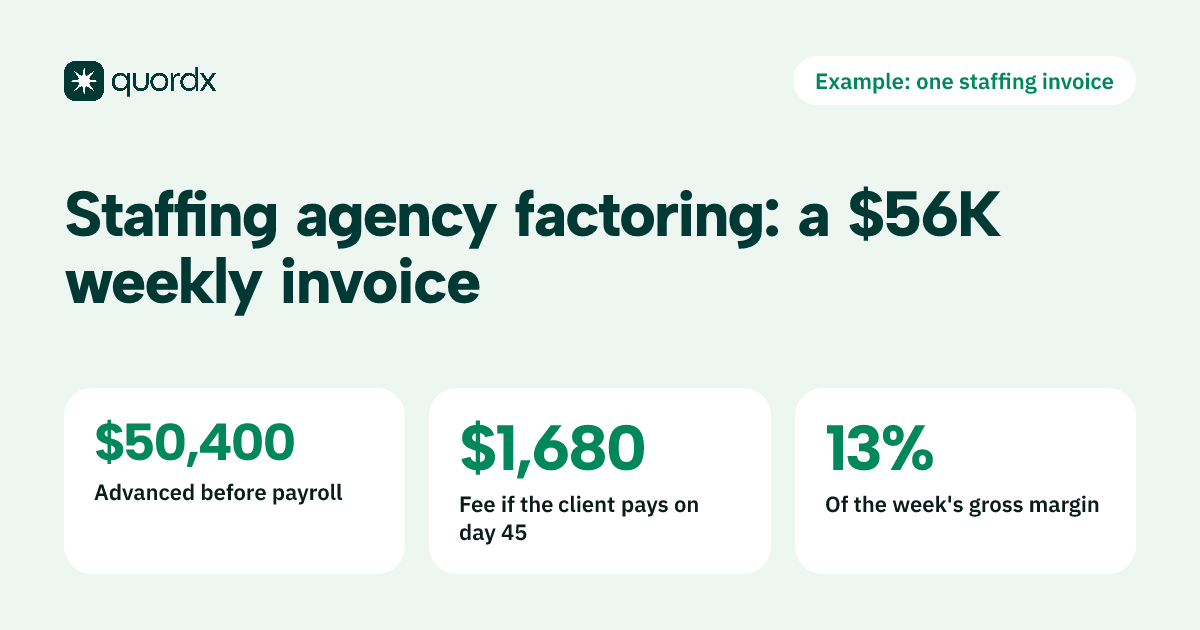
Take the $56,000 weekly invoice from the contract above. Say the factor advances 90% and charges 1.5% of the invoice for each 30 days, or part of 30 days, until the client pays. Those are hypothetical round numbers to show the mechanics, not market rates or a quote.
| Client pays on | Fee periods | Fee | Reserve returned | Fee as share of the week's margin |
|---|---|---|---|---|
| Day 28 | 1 | $840 | $4,760 | 6.5% |
| Day 45 (on time, net-45) | 2 | $1,680 | $3,920 | 13.0% |
| Day 62 (late) | 3 | $2,520 | $3,080 | 19.5% |
Judge the fee against margin, not revenue: A 3% fee sounds small next to a $56,000 invoice. Next to $12,940 of gross margin, it is 13 cents of every margin dollar, and a late payer pushes it toward 20.
Decision rule: if a client routinely pays two or three weeks past terms, either price that into the bill rate, negotiate shorter terms, or leave that client's invoices out of the factoring line if your agreement allows it. How fees are structured varies widely, so compare offers on the dollars each would cost on your real payment history. The general guide to invoice factoring costs explains flat, tiered and daily fee structures.
Payroll taxes: the risk that ends staffing factoring
Income tax, social security and Medicare withheld from paychecks are trust fund taxes. If they go unpaid, the IRS can hold a responsible person who willfully fails to pay them personally liable for the full unpaid amount, and paying other bills instead of the withheld taxes counts as willful (IRS). Using withheld tax money to make payroll is exactly that. The full mechanics are in can I get a business loan to cover payroll.
For a factor, a tax lien is a competing claim on what it bought: A federal tax lien attaches to all business property, including accounts receivable (IRS). That is why factors ask for proof that Form 941 deposits are current and search for liens before funding, and keep checking afterward.
Large weekly payrolls hit a faster deposit rule: If you accumulate $100,000 or more of employment taxes on any day of a deposit period, the deposit is due the next business day, whatever your normal schedule (IRS Publication 15). Agencies growing fast can cross that line without noticing, so set the deposit up in your payroll system before the big contract starts.
If you are already behind, say so before underwriting starts, and bring the IRS notices and any payment arrangement. A lien search will find it either way. See business loans with a tax lien for what still works.
Credit checks on your clients: what the factor underwrites
A factor is lending against your clients' promise to pay, so their credit matters more than yours. Expect it to check each client before approving its invoices and to set a limit per client.
- Client credit and payment history: large companies and government agencies with steady payment records are the easiest to fund. A small client with thin credit may get a low limit or none.
- Concentration: if one client is most of your billing, the factor may cap how much of that client's paper it will hold at once.
- Contract terms: offsets, chargebacks for worker issues and pay-when-paid clauses all reduce what a factor will advance. Many factors won't fund invoices you get paid on only after someone upstream pays.
- Assignment clauses: a client's master services agreement may say you can't assign invoices. Under the UCC as most states adopt it, a term that restricts assigning an account is generally ineffective, but read the agreement with the factor before you rely on that.
Sub-vendors on a VMS or master vendor program
If you supply workers through a master vendor or managed service provider and get paid only after that prime vendor is paid, your invoice is a pay-when-paid receivable. Some factors won't touch it, and those that do usually advance less. Ask before you sign the sub-vendor agreement.
Invoice integrity is non-negotiable: Bill only hours that were worked and approved. To a factor, an invoice for hours not yet worked is selling something that doesn't exist, and it ends relationships fast.
Factoring vs an AR line vs a business loan for a staffing agency
Factoring is the native product for staffing, but it isn't the only one. The right tool depends on your size and what the money is for.
| Product | How it's sized | Who collects from clients | Best for |
|---|---|---|---|
| Invoice factoring and payroll funding | Each invoice, by client credit | The factor | Growing agencies, new agencies with strong clients |
| AR line of credit or asset-based loan | A borrowing base of eligible receivables | You, with regular reporting to the lender | Larger, established agencies with clean books |
| Term loan or line of credit | Revenue, profit and credit | You | One-time needs: software, an office, a bridge to a known payment |
| SBA 7(a) loan | Historical cash flow | You | Buying another agency or a book of business |
| Merchant cash advance | Deposits | You, with a daily or weekly debit | Rarely a fit; the debit competes with payroll |
Notification is the usual trade-off: With factoring, clients pay the factor, and for most corporate payables teams that is a routine remit-to change. Non-notification arrangements exist but cost more and leave you carrying the collections. Who absorbs a client's non-payment is covered in recourse vs non-recourse factoring, and the difference between selling invoices and borrowing against them is in AR financing vs invoice factoring.
What to ask before signing a staffing factoring agreement
- How is the fee charged: per 30 days, per 10 days, daily, or flat? Run it on your last 6 months of real payment dates.
- What share is advanced, and when is the reserve released: per invoice or in a monthly settlement?
- Can you choose which clients or invoices to factor, or must you sell the whole ledger?
- Is there a minimum monthly volume, and what happens if you miss it?
- How long is the term, and what does it cost to leave? Ask for the termination notice period in writing.
- How fast is funding after you submit timesheets, and what is the daily cutoff to make Friday payroll?
- If you are switching factors, who pays off the old one and files the UCC release?
Where Quordx fits for a staffing agency
Quordx is a broker, not a factor. Through Quordx, a staffing agency can reach factoring for B2B invoices, with payroll funding and credit checks on your clients as part of underwriting. Because the factor underwrites your clients, a younger agency with strong clients can be a fit. Pay-when-paid sub-vendor receivables don't qualify, which is worth knowing before you apply.
For needs that aren't tied to invoices, Quordx can also place lines of credit and term loans, where lenders generally look for around $17,000 a month in revenue and about a year in business. An asset-based line for a large agency is not something Quordx places.
The application takes about 10 minutes, the lender sets terms and decides, and the lender, not the agency, pays Quordx if the deal funds. Quordx does not serve Virginia, Connecticut, Missouri or North Dakota, and California applicants see a notice first.
Questions Business Owners Ask Before Applying
Will my staffing clients know I'm factoring?
With standard notification factoring, yes. Each client receives a notice to send payment to the factor, which most corporate payables departments handle as a routine remit-to change. Tell your client contacts before the notice arrives.
Can a new staffing agency get factoring?
Often, if its clients are creditworthy, because the factor is mainly relying on them to pay. Expect lower limits on small or unknown clients and close checks on timesheets and payroll tax deposits.
Can I factor invoices if I owe payroll taxes?
It is much harder, because a federal tax lien attaches to accounts receivable and competes with the factor's claim. Disclose the balance up front and bring any IRS payment arrangement; some factors can work with a documented plan, many can't.
What happens if a staffing client doesn't pay?
Under a recourse agreement, you buy the invoice back or replace it after a set period. Under non-recourse, the factor absorbs a loss from the client's insolvency, usually not from a dispute over the work, and charges more for that protection.
Can I switch factoring companies?
Yes, once you meet your current agreement's notice and termination terms. The new factor typically pays off the old one, and the old factor files a UCC release so the new one can take first position on your receivables.
Apply for Funding
No obligation · Initial inquiry doesn't impact credit · Takes about 10 minutes
Sources

Written by
Cody Dreis
Founder, Quordx Capital
Read full bio
Related articles
Keep exploring industry financing
Quordx Capital is a business funding broker, not a lender. Lenders make every credit decision and set the rate, fees and terms, and not every business qualifies. Quordx may be paid by a lender when a deal funds. Full disclosures