

Can you have two merchant cash advances at once?
Yes, you can have two merchant cash advances at once, and funders that lend in second position exist, but taking one is called stacking and it often breaks the terms of your first advance. Both funders debit the same bank account, so the second advance doesn't add cash flow; it adds a second daily payment on top of the first. If your first contract has an anti-stacking clause, the second advance can also put you in default on the first.
The short version: Read your first contract for an anti-stacking clause before you apply anywhere. Then add both daily debits together and compare the monthly total to what the business keeps after expenses. If the two don't fit, ask your current funder for more first, or look at consolidating into one payment with a longer term.
One option in our guide to Alternative Financing.
Last updated · Reviewed by Cody Dreis
75+ Lenders|Decisions typically in 24 to 48 hours*
What first position and second position mean
A position is your place in line: The first funder to advance against your receivables is in first position. A funder that advances while the first one is still being repaid is in second position, and so on. Funders count positions by looking at your bank statements for daily or weekly debits to other funders, and by searching state UCC filings.
The line has legal weight: When funders file UCC financing statements against your receivables, the Uniform Commercial Code generally ranks competing secured parties by who filed or perfected first. A second-position funder knows that if your business runs short, the first funder's claim may come ahead of its own.
Being second in line costs you: A funder in second position is taking more risk on the same deposits, and that risk tends to show up in the price: a higher factor rate, a shorter term, a smaller amount, or some mix of all three.
Why MCA funders restrict stacking
The first funder bought a share of your future sales: It priced that purchase on the deposits it saw when you applied. A second debit from the same account shrinks what is left to cover the first one, which raises the odds that a payment bounces.
Some states limit who can debit your account: Texas's 2025 law on commercial sales-based financing bars a provider or broker from setting up automatic debits on your account unless it holds a perfected security interest in that account with first priority over everyone else's claims. If your business is in Texas, ask any second funder exactly how it plans to collect.
Stacked debits are easy to see: Any lender reading your statements will spot two funders pulling every day. That can make it harder to refinance into cheaper debt later, which is how a second advance can make the exit harder, not easier.
Run the numbers on your loan
Pick a product, set the amount and term, and see a typical payment.
What an anti-stacking clause says, and what happens if you break it
An anti-stacking clause is a promise in your first MCA contract not to sell more of your receivables, or take other financing against them, without the first funder's consent. Look for it under headings like covenants, additional financing, or events of default.
- It can count as a default even if every payment is current. The breach is taking the second advance, not missing a payment.
- A default can be expensive. Depending on the contract, it may let the funder demand the full remaining balance, add default fees, and pursue any personal guarantee you signed.
- Consent is sometimes possible. Some funders will allow a second position, or offer more money themselves, if you ask before you sign elsewhere. Get any consent in writing.
- Hiding the first advance doesn't work. The daily debits are on the statements you hand the second funder, and an advance you leave off the application can get the new deal declined or unwound.
The payment math of two daily debits
Here is what stacking does to one business's cash. Every number is made up to show the math, not a quote or a market rate.
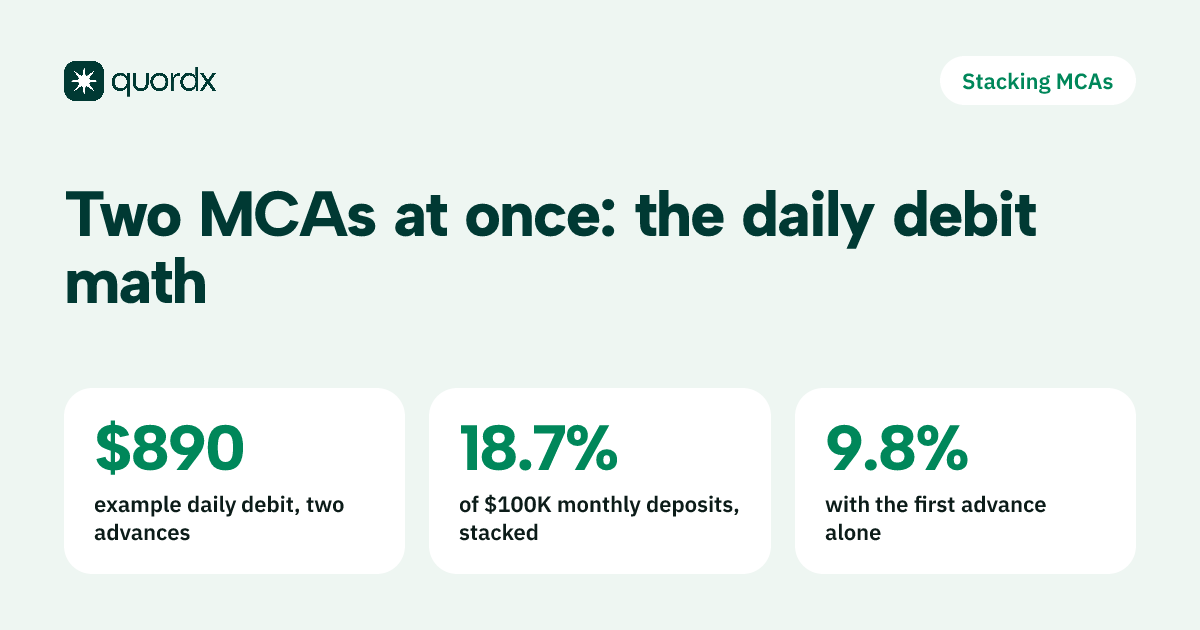
Assumptions: the business deposits $100,000 a month, about 21 business days, and keeps about $15,000 a month after its normal expenses. Its first advance is $50,000 at a 1.30 factor, so $65,000 is repaid over 140 business days. Sixty days in, it takes a second advance of $30,000 at a 1.42 factor, so $42,600 is repaid over 100 business days.
| One advance | Two advances (stacked) | |
|---|---|---|
| Daily debit | $464.29 | $464.29 + $426.00 = $890.29 |
| Monthly debits (21 days) | $9,750 | $18,696 |
| Share of $100,000 deposits | 9.8% | 18.7% |
| Left of the $15,000 the business keeps | $5,250 | $3,696 short every month |
One advance fit; two don't: The first debit took a bit under 10% of deposits and left room. The second nearly doubled the monthly drain, and now the business falls about $3,700 short of its normal expenses every month until one advance is paid off. That gap is what tempts owners toward a third advance, which makes the next month worse again.
Decision rule: add every daily and weekly debit together, multiply by the business days in a month, and compare it to what the business keeps, not to revenue. If the total is larger, a second advance doesn't solve the problem. It moves it a few weeks out and makes it more expensive.
Consolidating two merchant cash advances into one payment
Consolidation means a new lender or funder pays off both advances and you make one payment instead. It helps only if the new payment is meaningfully smaller and you stop taking new advances. Here is the same business 20 business days after the second advance, comparing three exits. Again, the numbers are hypothetical.
Where it stands: about $27,857 left to pay on the first advance (60 debits to go) and $34,080 on the second (80 debits to go), so roughly $62,000 in total. Your actual payoff may be lower if a contract offers an early payoff discount, so ask each funder for a payoff letter.
| Exit | Monthly payment | Share of deposits | Extra cost to you |
|---|---|---|---|
| Ride it out | $18,696 for about 3 months, then $8,946 | 18.7%, then 8.9% | $0 |
| Consolidation advance: $62,000 at a 1.30 factor over 12 months | about $6,717 | 6.7% | $18,600 |
| Consolidation term loan: $62,000 at 20% APR over 24 months | about $3,156 | 3.2% | about $13,733 in interest |
How to choose between them
- If the business can survive about three tight months, riding it out is the cheapest option by far. Ask both funders about reconciliation if sales dip in the meantime.
- If it can't, a term loan is the cleaner fix when you can qualify for one: a lower payment, a known end date and interest that stops when you pay it off.
- A consolidation advance re-prices old balances. The $18,600 extra cost is charged on money you had nearly paid off, so only take it if the lower daily debit is what keeps the business open.
- Reverse consolidation is not consolidation. It covers your existing debits for a while and adds a new advance without paying anything off. See MCA reverse consolidation before agreeing to one.
Read the payoff disclosure: In Texas, if a new sales-based financing requires paying off an existing one, the provider must disclose how much of the new money goes to prepayment charges and unpaid finance charges on the old deal. New York's disclosure rule requires a renewal from the same funder to state whether you are paying old fees a second time. Our guides to consolidating merchant cash advances and business debt consolidation loans go through the steps.
Better moves than a second advance
- Ask your current funder first. Additional money from the funder you already have avoids the anti-stacking problem, though you should still price it on total cost.
- Use reconciliation if sales dropped. If the first debit no longer matches your sales, a written reconciliation request may lower it without adding new debt. See how merchant cash advances work for how that clause operates.
- Look at products without a daily debit. A business line of credit or invoice factoring can cover a recurring gap without stacking a second daily payment on the same account.
- If you're already behind, start with what to do when you can't pay back a merchant cash advance before taking on anything new.
How Quordx handles a business that already has an advance
Quordx is a broker, not a lender, and it lists every open advance on the file it sends to lenders, because a hidden position gets deals declined. If you already carry two advances, Quordx's answer is a consolidation conversation, not a third. At least one lender on its panel will pay off existing advances as part of a new loan, subject to that lender's own underwriting.
Expect its cash-flow lenders to want at least roughly $17,000 in monthly revenue (more for advances) and, in most cases, a year of operating history. The application takes about 10 minutes, you can explore most options without a hard credit pull, and lenders typically answer in 24 to 48 hours*. Quordx charges the business owner nothing and is paid by the lender when a deal funds.
Questions Business Owners Ask Before Applying
Is it illegal to have two merchant cash advances?
Not as a general rule. Stacking is usually a contract problem, not a crime: if your first agreement bans additional financing against your receivables, the second advance can put you in default on the first. Some states add their own limits, such as Texas's restriction on automatic debits by a funder without first-priority security in the account.
Will a second MCA funder know about my first advance?
Almost certainly. The first funder's daily or weekly debits appear on the bank statements you submit, and a UCC search shows any filing it made. Leaving an advance off your application can get the new deal declined or unwound.
What is a second position merchant cash advance?
It is an advance funded while another advance is still being repaid, so the new funder stands second in line for the same deposits. Because it carries more risk, it tends to cost more, run shorter, or be smaller than a first-position advance.
Can I consolidate two merchant cash advances with a loan?
Yes, if you can qualify for a term loan or line of credit large enough to pay off both. In our example, a hypothetical 24-month term loan cut the monthly payment from $18,696 to about $3,156. Get payoff letters from both funders first, since early payoff discounts can lower the amount you need.
How much of my revenue can MCA payments take?
There is no published rule, and funders each set their own limits. The test that matters is yours: total every daily and weekly debit for a month and compare it to what the business keeps after normal expenses. If the debits are bigger, the advances are drawing down the business.
Apply for Funding
No obligation · Initial inquiry doesn't impact credit · Takes about 10 minutes
Sources

Written by
Cody Dreis
Founder, Quordx Capital
Read full bio
Related articles
Keep exploring alternative financing
Quordx Capital is a business funding broker, not a lender. Lenders make every credit decision and set the rate, fees and terms, and not every business qualifies. Quordx may be paid by a lender when a deal funds. Full disclosures