
$50,000 business loan: where to get $10K to $50K and what it costs
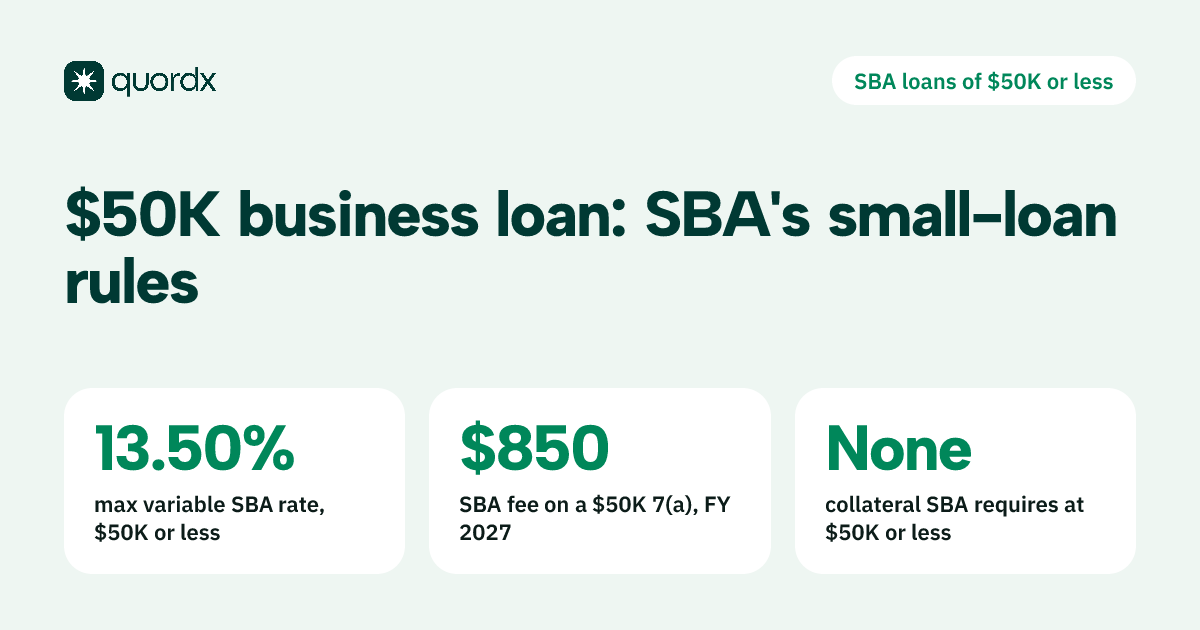
You can get a $50,000 business loan from more kinds of lenders than any larger amount: SBA 7(a) and Express lenders, SBA microlenders, banks and online lenders with lines of credit, equipment lenders, and companies that advance cash against future sales. For an SBA loan of $50,000 or less, the variable rate is capped at 13.50% as of October 2026, SBA requires no collateral, and the upfront fee on a 7(a) loan approved this fiscal year is $850. What changes at this size is the cost per dollar: flat fees weigh more on a small loan, so $10,000 often costs more in percentage terms than $50,000.
The short version: If your business can wait for underwriting and its cash flow covers the payment 1.10 times, ask an SBA lender for no more than $50,000, because one dollar more brings in SBA's collateral rules. If you need closer to $10,000 or the business is new, start with an SBA microlender, where the average loan is about $13,000. Compare every offer in total dollars and annual rate, not the payment alone. Quordx fits the upper end only: the lenders it works with generally look for around $17,000 a month in revenue and about a year in business.
Part of our guide to Business Loans.
Last updated · Reviewed by Cody Dreis
50+ Lenders|Decisions typically in 24 to 48 hours
Common Reasons Operators Apply
Operators looking at $50,000 in capital commonly use Quordx-matched funding for situations like these:
- Hiring sprints across multiple roles
- Equipment purchases or fleet additions
- Marketing campaigns and brand initiatives
- Inventory buys ahead of a sales season
Where to get a business loan of $10,000 to $50,000
Six kinds of financing work in this range. They differ mostly in how they decide and how you repay.
- SBA microloans. Up to $50,000 from nonprofit, community-based lenders that SBA funds, which also offer management and technical help. The average is about $13,000 (SBA microloans).
- SBA 7(a) and SBA Express loans. Banks and other lenders make them with an SBA guaranty. At $50,000 or less the variable rate cap is prime plus 6.5 points, the highest of any 7(a) size band, and SBA requires no collateral.
- Lines of credit. You draw what you need and pay interest only on the balance, which suits uneven needs like stocking up before a busy season. See how a business line of credit works.
- Business credit cards. For a few thousand dollars you can repay within a billing cycle or two, a card can be simpler than any loan.
- Equipment financing. The equipment secures the loan, so the lender weighs what you're buying alongside your file. See equipment financing.
- Short-term loans and advances. Online lenders and cash advance companies decide mostly on bank deposits and often collect daily or weekly. They tend to be the quickest and the costliest; what a merchant cash advance costs shows how to price one.
SBA does make small loans: In fiscal 2025, lenders approved 18,722 SBA 7(a) loans of $50,000 or less, 24% of all 7(a) approvals, and 6,535 of them were for exactly $50,000, according to SBA's loan-level 7(a) data (approvals, some later cancelled). About 71% of those small loans went through SBA Express, where the lender makes the credit decision itself.
Why small business loans cost more in percentage terms
Much of what a loan costs doesn't scale with its size. Documentation, filing and closing fees are often flat dollar amounts, and reviewing a $10,000 file can take a lender nearly as much work as a $50,000 one. Spread over fewer dollars, the same fee raises the real rate.
Worked example with made-up terms: three loans at the same hypothetical 12% rate over 24 months, each with a flat $500 fee taken out of the proceeds.
| Loan | Monthly payment | Interest over 2 years | Fee as a share of the loan | Annual rate counting the fee |
|---|---|---|---|---|
| $10,000 | $470.73 | $1,297.63 | 5.0% | 17.23% |
| $25,000 | $1,176.84 | $3,244.08 | 2.0% | 14.05% |
| $50,000 | $2,353.67 | $6,488.17 | 1.0% | 13.02% |
Same rate, same fee, and the $10,000 borrower pays over 4 points a year more than the $50,000 borrower. If a small loan comes with a flat fee, convert it: divide the fee by the amount, then ask the lender for the APR on the money you'll actually receive.
SBA's own rules follow the same pattern. A loan packager that bills by percentage may charge an SBA applicant up to 3% of a loan of $50,000 or less, against 2% on the first $1 million of a larger one (SOP 50 10 8.1). SBA's guaranty fee, by contrast, is a straight percentage, so it stays proportional at every size up to $150,000.
Run the numbers on your loan
Pick a product, set the amount and term, and see a typical payment.
SBA loan for $50,000: rate cap, fee and the collateral line
SBA sets the maximum variable rate by loan size. For $50,000 or less it is prime plus 6.5 points, and with prime at 7.00% after the Federal Reserve's September 2026 rate increase, that's 13.50%. Lenders may charge less, and the cap moves whenever prime does.
- Upfront fee: $850. For 7(a) loans approved October 1, 2026 through September 30, 2027 with terms over 12 months, the fee is 2% of the guaranteed portion. SBA guarantees up to 85% of a $50,000 loan, so it's $42,500 × 2% (Information Notice 5000-881797).
- SBA Express: $500. Express loans carry a 50% guaranty, so the fee is 2% of $25,000, and $0 for a business owned and controlled by a veteran or a veteran's spouse.
- 0% fee on 7(a) loans of $700,000 or less to manufacturers, listed food supply chain businesses and rural businesses.
- No required collateral. For 7(a) Small and SBA Express loans of $50,000 or less, SBA doesn't require collateral, though a lender may take some under its own policy (SBA 7(a) terms).
- The cash-flow test. On a 7(a) Small loan, EBITDA must cover all business debt payments, the new loan included, at least 1.10 times. SBA stopped screening these loans with its own small business credit score in March 2026, so the lender's credit analysis decides.
What $50,000 at the SBA cap costs, and the cash flow it needs
| $50,000 SBA loan at 13.50% | Monthly payment | Total interest | EBITDA needed at 1.10x, no other debt |
|---|---|---|---|
| 5 years | $1,150.49 | $19,030 | $15,186 |
| 7 years | $923.24 | $27,553 | $12,187 |
| 10 years | $761.37 | $41,365 | $10,050 |
The term can decide whether you qualify: A business with $12,000 of EBITDA and no other debt passes the test on the 10-year loan but fails it on the 5-year one. Add a $400 monthly payment the business already makes, and the 10-year loan needs about $15,330 of EBITDA.
Why $50,000 is a better SBA request than $50,001
One dollar over $50,000 drops the rate cap to 13.00%, which saves $14.80 a month and about $1,777 of interest over 10 years if you're priced at the cap. It also ends the collateral exemption. Above $50,000 a 7(a) Small lender must take a first lien on anything the loan buys, and if half or more is working capital, a lien on all of the business's fixed assets, real estate included, until the loan is fully secured (SOP 50 10 8.1).
Loans over $50,000 also generally need hazard insurance on pledged assets, and when half or more is working capital, the lender has to justify that amount in writing. If $50,000 covers the need, ask for $50,000.
SBA microloans: up to $50,000 for newer and smaller businesses
Microloans come from nonprofit intermediaries that borrow from SBA and lend the money on, and those intermediaries make the credit decisions and set the terms. SBA says their rates generally run 8% to 13%. The money can go to working capital, inventory, supplies, furniture, fixtures, machinery and equipment, but not to paying off existing debt or buying real estate.
With an average loan of about $13,000, microloans fit the bottom of this range best: a first piece of equipment, opening inventory, or a cushion while a new location ramps up. Find a lender through the intermediary search on SBA's microloan page, and see what an SBA microloan is for how the program works.
$10,000, $25,000 or $30,000 business loan: matching the amount to the route
A $10,000 business loan
At $10,000, compare in dollars, because flat costs matter most. A 5-year SBA loan at the 13.50% cap is $230.10 a month with $3,805.91 of interest and a $170 upfront fee; a microloan at a hypothetical 10% over 3 years is $322.67 a month with $1,616.19 of interest. A short-term online loan or advance can arrive sooner, so price it in total dollars before you sign.
SBA lenders approved 7,391 loans of $25,000 or less in fiscal 2025, so the size itself isn't the obstacle. Finding a lender that goes that small can be: one of the largest U.S. banks starts its 7(a) loans at $200,000.
A $25,000 business loan without collateral
At $25,000, SBA requires no collateral on a 7(a) Small or Express loan. Over 7 years at the 13.50% cap the payment is $461.62, the 7(a) fee is $425, and the 1.10x test needs about $6,093 a year of EBITDA if the business has no other debt.
Online lenders often advertise no collateral too, so read what the contract means by it. Ask whether the lender will file a UCC-1 lien on business assets or require a personal guarantee, since either can apply when no specific asset is pledged. Small business loans without collateral explains the difference.
A $30,000 business loan based on revenue
Revenue-based lenders look mainly at bank deposits: how much comes in, how steady it is, and which other debts already hit the account. Example with made-up numbers: a $30,000 advance repaid with $38,400 over 35 weeks takes $1,097.14 a week. On $20,000 a month of deposits, about $4,615 a week, that's 24% of everything coming in.
Because the balance starts shrinking in week one, that $8,400 cost works out to roughly 75% a year. The same $30,000 as a 5-year SBA loan at the 13.50% cap costs $690.30 a month and $11,418 of interest, spread over five years instead of eight months. Before you sign a weekly or daily schedule, test the debit against your slowest month of deposits, not your average.
What lenders check on a $10,000 to $50,000 request
- Bank statements. Almost every route starts here. For a 7(a) Small loan, SBA requires the lender to review your two most recent months to confirm the debts in its cash-flow math.
- Cash flow against the payment. SBA's 1.10 test is written down; other lenders apply their own version, usually against deposits.
- The owners. Everyone who owns 20% or more must personally guarantee an SBA loan, so their personal credit is part of the file.
- History. Lenders that size off deposits need months of statements to read, so a very new business has fewer choices. SBA lenders can underwrite a 7(a) Small loan on 12-month projections that reach 1.10x within a year.
- Citizenship, for SBA 7(a). Since March 1, 2026, all direct and indirect owners must be U.S. citizens or nationals whose main residence is in the U.S. Green card holders no longer qualify.
Can Quordx help with a loan under $50,000?
Sometimes, and it turns on revenue. Quordx is a broker that sends one application to the lenders whose criteria fit. For term loans, lines of credit and working capital advances, those lenders generally look for around $17,000 a month in revenue and about a year in business, and equipment financing in this range is also possible.
If your business is well short of that, Quordx probably isn't the right route. SBA loans through Quordx generally start around $400,000, so SBA 7(a), Express and microloans at this size belong elsewhere. For those, use SBA's Lender Match or a microlender from SBA's intermediary list.
If you're there, the application takes about 10 minutes and most options can be checked without a hard credit pull. You pay Quordx nothing; a lender pays a commission if your loan funds, and that lender alone approves and prices it. Apply here if your numbers fit (Quordx does not serve Virginia, Connecticut, Missouri or North Dakota), or see the $100,000 business loan guide for larger amounts.
Questions Business Owners Ask Before Applying
Can I get a $50,000 business loan with no collateral?
Yes. SBA doesn't require collateral on 7(a) Small or SBA Express loans of $50,000 or less, and many online loans and advances don't take a specific asset. Expect a personal guarantee either way: SBA requires one from every owner of 20% or more.
What is the monthly payment on a $50,000 business loan?
At the 13.50% SBA cap, $761.37 a month over 10 years or $1,150.49 over 5. At a hypothetical 12% over 2 years, it's $2,353.67. Try other terms in the business loan payment calculator.
Is a $10,000 business loan easier to get than $50,000?
The cash-flow test is easier, because the payment is smaller. Finding a lender can be harder, since some set minimums above $10,000 and flat costs make tiny loans less worthwhile for them. SBA microlenders, whose average loan is about $13,000, are built for this size.
How much revenue do I need for a $50,000 business loan?
No single number applies. SBA's test is cash flow: on a 10-year loan at the 13.50% cap, about $10,050 a year of EBITDA if the business has no other debt. Deposit-based lenders set their own floors; the ones Quordx works with generally look for around $17,000 a month.
What fees come with a $50,000 SBA loan?
For loans approved in fiscal 2027 with terms over 12 months, $850 upfront on a 7(a) loan and $500 on an SBA Express loan. Veteran-owned businesses pay $0 on Express, and manufacturers, listed food supply chain and rural businesses pay $0 on 7(a). The 0.55% annual service fee is the lender's, and SBA bars passing it on to you.
Apply for Funding
No obligation · Initial inquiry doesn't impact credit · Takes about 10 minutes
Sources

Written by
Cody Dreis
Founder, Quordx Capital
Read full bio
Related articles
Keep exploring business loans
Quordx Capital is a business funding broker, not a lender. Lenders make every credit decision and set the rate, fees and terms, and not every business qualifies. Quordx may be paid by a lender when a deal funds. Full disclosures