
$100,000 business loan: what it takes to qualify
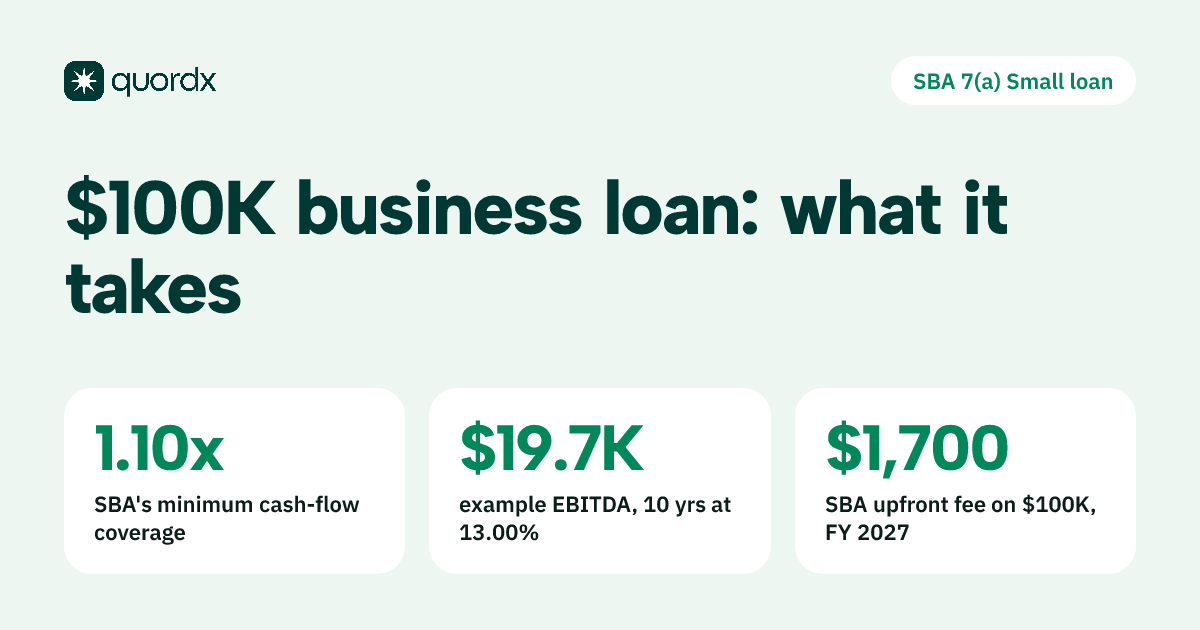
Qualifying for a $100,000 business loan comes down to cash flow that covers the payment with a margin, records a lender can verify, and a stated use for the money. As an SBA loan, $100,000 is a 7(a) Small loan: the variable rate is capped at 13.00% as of October 2026, the upfront fee is $1,700, and SBA requires your EBITDA to cover all business debt payments at least 1.10 times. On a 10-year term at the cap, that's about $19,709 a year of EBITDA if the business carries no other debt.
The short version: Work out your EBITDA and existing debt payments before you pick a product, because together they set how much you can carry. If the money is mostly working capital, know that a 7(a) Small lender must take a lien on the business's fixed assets, real estate included, to secure it. If the 1.10 test comes out close, $75,000 or a longer term may clear it where $100,000 doesn't. For payment tables by rate and term, see the monthly payment on a $100K loan.
Part of our guide to Business Loans.
Last updated · Reviewed by Cody Dreis
50+ Lenders|Decisions typically in 24 to 48 hours
Common Reasons Operators Apply
Operators looking at $100,000 in capital commonly use Quordx-matched funding for situations like these:
- Hiring sprints across multiple roles
- Build-out, expansion, or remodel costs
- Inventory buys ahead of a sales season
- Equipment purchases or fleet additions
Who lends $100,000, and what each one checks
At $100,000 the choice is wide, but each product tests something different. Lead with your strongest point and pick the product that weighs it most.
| Product | What decides it | What you hand over | What secures it |
|---|---|---|---|
| SBA 7(a) Small | EBITDA at least 1.10x all debt payments, plus the lender's credit review | SBA Form 1919, tax returns the lender checks with the IRS, financial statements, 2 months of bank statements | First lien on what the loan buys, more if it's mostly working capital; guarantees from 20% owners |
| SBA Express | The lender's own credit process, which may use a business credit score | The lender's application; IRS tax verification can follow disbursement | The lender's own collateral policy above $50,000; guarantees from 20% owners |
| Bank term loan or line | Profit, credit history, the banking relationship | Tax returns, financial statements, a debt schedule | Often business assets and a personal guarantee |
| Online term loan or line | Deposits, existing debt payments, time in business | An application and recent bank statements | Often a general lien and a personal guarantee rather than one asset |
| Equipment financing | The equipment's value plus your credit | A vendor quote or invoice | The equipment itself |
| Invoice factoring | Your customers' credit more than yours | Open invoices and a customer list | The invoices you sell |
If your tax returns show profit that covers the payment: start with SBA 7(a) or a bank. If deposits are strong but reported profit is thin, a deposit-based lender may say yes where SBA can't, at a higher price. If you're buying a machine, finance it against the machine. If your customers pay on net terms, factoring turns open invoices into cash; see invoice factoring.
Where $100,000 sits in SBA's loan rules
SBA rules change by loan size, and $100,000 lands in the same band on almost all of them. It's a 7(a) Small loan (those run to $350,000), it gets the 85% guaranty that applies up to $150,000, and its variable rate cap is prime plus 6.0 points, the band for $50,001 to $250,000. With prime at 7.00% after the Federal Reserve's September 2026 increase, that cap is 13.00%.
- Upfront fee: $1,700 on a 7(a) loan approved in fiscal 2027 with a term over 12 months, which is 2% of the $85,000 guaranteed share (Information Notice 5000-881797). An SBA Express loan, with a 50% guaranty, pays $1,000, or $0 if a veteran or a veteran's spouse owns and controls the business.
- The 1.10x test. EBITDA divided by all principal and interest due on business debt, the new loan included, must reach 1.10 on last year's numbers or on 12-month projections (SOP 50 10 8.1). If it falls short, the loan has to go through Standard 7(a) processing, where the bar is 1.15, or SBA Express.
- Collateral above $50,000. The lender must take a first lien on anything the loan buys. If half or more of the $100,000 is working capital, it must also lien all of the business's fixed assets, real estate included, until the loan is fully secured, and explain in writing why the business needs that much working capital.
- Credit elsewhere. The lender's credit memo has to say why you can't get the money on reasonable terms without SBA's guaranty.
- Personal guarantees. Every person who owns 20% or more gives an unlimited personal guarantee.
Loans this size are routine for SBA lenders. In fiscal 2025, 36% of 7(a) approvals were $100,000 or less, and 3,492 were for exactly $100,000, according to SBA's loan-level 7(a) data. SBA's own published processing time for 7(a) Small loans is 2 to 10 business days (SBA 7(a) terms).
Run the numbers on your loan
Pick a product, set the amount and term, and see a typical payment.
How much cash flow and revenue you need for a $100,000 loan
Lenders size a loan from the payment backward: a year of payments, times the coverage they want, plus your existing debt payments on the same basis. Here is that bar at SBA's 1.10 for three ways to borrow $100,000.
| $100,000 loan | Payments per year | Cash flow needed at 1.10x, no other debt |
|---|---|---|
| SBA 7(a), 10 years at 13.00% | $17,917 | $19,709 |
| SBA 7(a), 7 years at 13.00% | $21,830 | $24,013 |
| Online term loan, 3 years at a hypothetical 14% | $41,013 | $45,114 |
Worked example: a business with $24,000 of EBITDA already pays $350 a month on an equipment note. With a 10-year $100,000 SBA loan at the cap, its debt payments total $22,117 a year, for coverage of 1.085x, just under the line. At 1.10x it could carry about $98,300, and at $75,000 its coverage would be 1.36x.
There are three ways to fix a near miss: borrow a little less, pay off the small note first, or show 12-month projections that reach 1.10 within a year of funding. SBA accepts projections for 7(a) Small loans except when the loan buys a business.
Turning the EBITDA you need into revenue
Divide the EBITDA by your margin. At a 12% EBITDA margin, $19,709 takes about $164,000 of annual revenue; at 15%, about $131,000. That's why two companies with the same sales can get different answers, and why it pays to know whether a lender reads gross or net revenue.
Deposit-based lenders work from the other end and compare the payment with monthly deposits. The 3-year payment above, $3,417.76, is about 8.5% of $40,000 a month in deposits and about 13.7% of $25,000.
Documents for a $100,000 business loan
An SBA lender at this size will ask for most of this list. Online lenders usually start with the application and bank statements, then ask for more as the amount grows.
- SBA Form 1919, the borrower information form, for an SBA loan.
- Business tax returns. SBA lenders check them against IRS transcripts before the first disbursement, usually for the last three years, or every year if the business is younger. SBA Express lenders may disburse first and verify with the IRS afterward.
- Financial statements. For a 7(a) Small loan, a year-end statement dated and received within 120 days of year end, or that statement plus an interim one dated within 120 days of submission.
- A personal financial statement (SBA Form 413 or the lender's version) from each owner of 20% or more, signed within 90 days.
- Your two most recent months of business bank statements for the main operating account.
- A debt schedule listing every loan, lease and advance with its payment, because the lender checks it against those statements.
- Proof of the use of funds: an equipment quote, an inventory order, a lease, or a short working capital budget.
For an SBA loan, ownership matters too: since March 1, 2026, all direct and indirect owners must be U.S. citizens or U.S. nationals whose main residence is in the U.S. The full list by product is in documents needed for a business loan.
A $75,000 business loan: when asking for less helps
Everything SBA sets for $100,000 applies at $75,000 too: the same 13.00% cap, the same 85% guaranty and the same 2% fee rate, which comes to $1,275 on a 7(a) loan or $750 on Express. What changes is the payment, and with it the cash flow you need.
At the cap over 10 years, $75,000 costs $1,119.83 a month, so the 1.10x test needs about $14,782 of EBITDA with no other debt, against $19,709 for $100,000. If your numbers clear $75,000 comfortably but $100,000 only barely, take the smaller loan now and add a line of credit once the first loan has a record of on-time payments.
Time that second step. SBA combines 7(a) loans approved within 90 days of each other when it sets the guaranty and the fee, so a quick second loan is priced as if it were part of the first. Deposit-based lenders work the same way in spirit: they size an offer to your deposits, so a smaller request leaves more room in the math.
Getting $100,000 through Quordx
Quordx is a broker, and SBA loans through it generally start around $400,000, so for an SBA 7(a) or Express loan of $100,000 go to a bank or SBA's Lender Match. What it can place at this size are term loans, lines of credit, working capital, equipment financing, and invoice factoring for companies that bill other businesses.
For the cash-flow products, the lenders Quordx works with generally look for around $17,000 a month in revenue and about a year in business. Treat that as the point where they'll read a file, not the point where $100,000 is likely, because the amount offered is sized to your deposits.
The application takes about 10 minutes, most options can be checked without a hard credit pull, and the lender alone decides and sets the terms. Lenders pay Quordx when a deal funds, not you. Start here; businesses in Virginia, Connecticut, Missouri and North Dakota aren't served. For smaller amounts, see the $50,000 business loan guide, and for larger ones the $250,000 page.
Questions Business Owners Ask Before Applying
What credit score do I need for a $100,000 business loan?
SBA doesn't set a minimum score for 7(a) Small loans; since March 2026 the lender runs its own credit analysis and records the result. Banks and online lenders set their own minimums, so check each one. Because owners of 20% or more personally guarantee an SBA loan, their personal credit will be read.
Can I get a $100,000 business loan without collateral?
Not as a 7(a) loan in the usual sense: above $50,000 the lender must lien what the loan buys, and more if it's mostly working capital. An SBA Express lender may use its own collateral policy, and online lenders often take a general lien and a personal guarantee instead of a specific asset. How much collateral a loan needs covers the options.
Can a startup get a $100,000 business loan?
Through SBA, possibly: a 7(a) Small loan can be underwritten on 12-month projections that reach 1.10x within a year of funding. SBA counts a business operating a year or less as a start-up and expects an equity injection of at least 10% of total project costs. Deposit-based lenders need deposit history to read, so they're usually harder at this stage.
Is $75,000 easier to get than $100,000?
On cash flow, yes. At SBA's 13.00% cap over 10 years, $75,000 needs about $14,782 of EBITDA at 1.10x with no other debt, against $19,709 for $100,000. The rate cap and fee percentage are the same at both amounts.
What is the monthly payment on a $100,000 SBA loan?
$1,493.11 over 10 years at the 13.00% cap, or $1,819.20 over 7 years. For other rates and terms, see the $100K payment tables.
Apply for Funding
No obligation · Initial inquiry doesn't impact credit · Takes about 10 minutes
Sources
- SBA SOP 50 10 8.1, Lender and Development Company Loan Programs (effective Oct 1, 2026)
- SBA Information Notice 5000-881797, 7(a) fees for FY 2027
- SBA, 7(a) loan program terms, conditions and eligibility
- SBA, 7(a) and 504 FOIA loan-level data (FY 2020 to present, as of June 30, 2026)
- Federal Reserve, FOMC minutes, September 15-16, 2026

Written by
Cody Dreis
Founder, Quordx Capital
Read full bio
Related articles
Keep exploring business loans
Quordx Capital is a business funding broker, not a lender. Lenders make every credit decision and set the rate, fees and terms, and not every business qualifies. Quordx may be paid by a lender when a deal funds. Full disclosures