
$250,000 business loan: options and costs from $150K to $300K
A $250,000 business loan needs cash flow that covers the payment with a margin, and for an SBA 7(a) Small loan, the program this size falls into, that margin is set in writing: your EBITDA must be at least 1.10 times all your business debt payments, the new loan included. On a 10-year SBA loan at today's 13.00% maximum rate for this size, the payment is $3,732.77 a month, so a business with no other debt needs about $49,273 a year of cash flow. Between $150,000 and $350,000, SBA's fee, guaranty and rate ceiling change at three points, and at the maximum rate a $250,001 loan costs less each month than a $250,000 one.
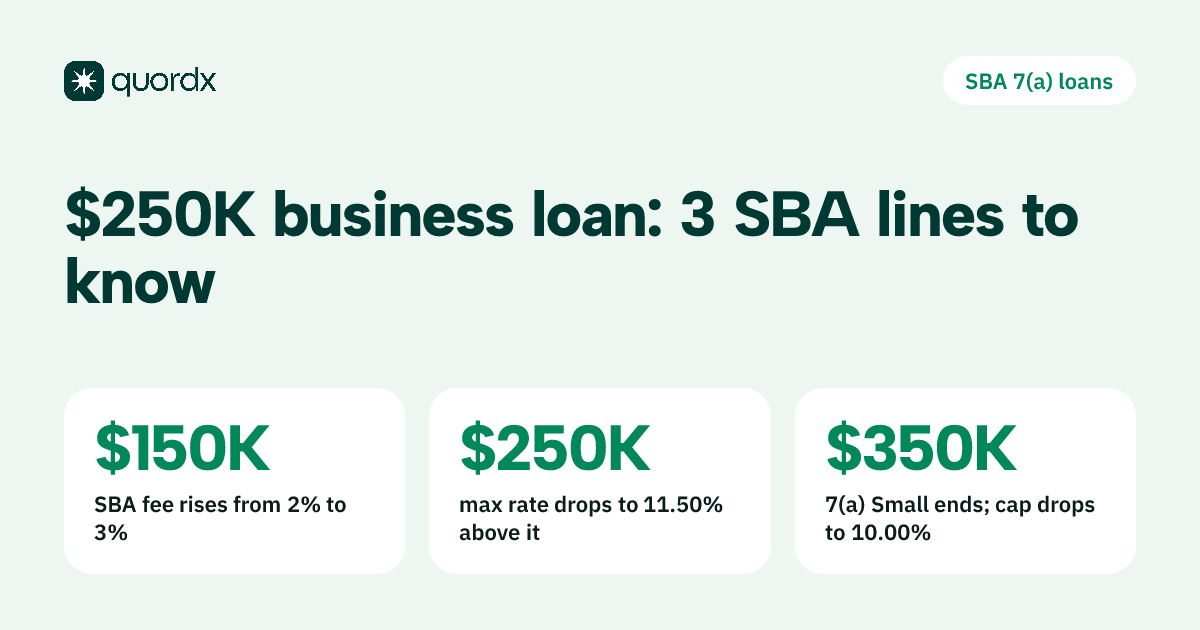
The short version: If your number is near a line, check which side you're on. At $150,000 the SBA fee rises from 2% to 3% of the guaranteed share; above $250,000 the maximum rate drops 1.5 points; above $350,000 it drops again and the loan moves to full Standard 7(a) underwriting. If speed matters more than cost, a nonbank term loan or line is the faster route, but price it first: on $300,000, the made-up advance below costs $90,000 in a single year.
Part of our guide to Business Loans.
Last updated · Reviewed by Cody Dreis
50+ Lenders|Decisions typically in 24 to 48 hours
Common Reasons Operators Apply
Operators looking at $50,000 in capital commonly use Quordx-matched funding for situations like these:
- Build-out, expansion, or remodel costs
- Equipment purchases or fleet additions
- Inventory buys ahead of a sales season
- Bridging payment cycles on larger contracts
Where SBA rules change between $150,000 and $350,000
SBA 7(a) pricing doesn't rise smoothly with the loan amount. It moves in steps, and three of them fall in this range. Prime is 7.00% as of October 2026, after the Federal Reserve's September 15-16 rate increase, and the caps below are built on it.
| Loan amount | SBA guaranty | FY 2027 upfront fee | Maximum variable rate | 10-year payment at the max |
|---|---|---|---|---|
| $150,000 | 85% | $2,550 (2%) | 13.00% | $2,239.66 |
| $150,001 | 75% | $3,375 (3%) | 13.00% | $2,239.68 |
| $200,000 | 75% | $4,500 | 13.00% | $2,986.21 |
| $250,000 | 75% | $5,625 | 13.00% | $3,732.77 |
| $250,001 | 75% | $5,625 | 11.50% | $3,514.90 |
| $300,000 | 75% | $6,750 | 11.50% | $4,217.86 |
| $350,000 | 75% | $7,875 | 11.50% | $4,920.84 |
| $350,001 | 75% | $7,875 | 10.00% | $4,625.29 |
The $150,000 line: the fee and the guaranty
SBA guarantees up to 85% of loans of $150,000 or less and up to 75% above that (SBA 7(a) terms). At the same point, SBA's FY 2027 fee notice moves the upfront fee from 2% to 3% of the guaranteed portion. Net result: one dollar over $150,000 adds $825.02 to the fee.
If $150,000 covers the need, stop there: Splitting the request doesn't get around it, because SBA prices 7(a) loans approved within 90 days of each other as one loan. Two $150,000 loans would pay $6,750 together, not $5,100.
The $250,000 line: the rate cap
For loans of $50,001 to $250,000, the maximum variable rate is prime plus 6.0%, or 13.00% today. From $250,001 to $350,000 it is prime plus 4.5%, or 11.50%. At the cap, $250,001 over 10 years costs $217.87 a month less than $250,000, and about $26,145 less in total interest.
That only matters if your quote is near the ceiling; a lender pricing well below the cap charges the same either way. But if you're quoted the maximum on $240,000 and could put $255,000 to work, ask what rate the larger amount would carry.
The $350,000 line: where 7(a) Small ends
7(a) Small loans are term loans of $350,000 or less, and an increase that pushes one past $350,000 turns it into a Standard 7(a) loan with fuller underwriting. Above that line the cap drops to prime plus 3.0% (10.00%). SBA's own published processing time is 2 to 10 business days for Small loans and 5 to 10 for Standard ones; for the full timeline, see how long an SBA loan takes.
The 1.10x cash-flow test for a $250,000 SBA loan
Since March 1, 2026, SBA no longer screens 7(a) Small loans with its own credit score model. Instead, the lender must show that the business's debt service coverage is at least 1.10:1 on historical or projected numbers (SBA Procedural Notice 5000-876777).
Coverage is operating cash flow, defined as EBITDA, divided by the principal and interest due on all business debt, the new SBA loan included. The lender also reviews your two most recent months of business bank statements to confirm the debts that go into that calculation.
Worked example: $250,000 over 10 years at the 13.00% cap is $3,732.77 a month, or $44,793.22 a year. Multiply by 1.10 and the business needs at least $49,273 of EBITDA if it has no other debt. If it already pays $2,500 a month on an equipment note, total payments reach $74,793 and the bar rises to $82,273.
Run it the other way: A business with $50,000 of EBITDA and no other debt covers $250,000 at the cap 1.12 times, just over the line; at exactly 1.10x it could carry about $253,700. With $60,000 of EBITDA, coverage is 1.34x and the same math supports about $304,400.
Treat 1.10 as SBA's floor, not the goal, because lenders apply their own credit standards too. For how the ratio is built and adjusted, see debt service coverage ratio explained.
Run the numbers on your loan
Pick a product, set the amount and term, and see a typical payment.
Fastest vs cheapest: $150,000 to $300,000 compared
In this range the choice is usually an SBA loan, with its long term and low payment, against a nonbank term loan or line that decides faster and costs more. The table puts numbers on the trade.
| Amount | SBA 7(a), 10 years at the cap | Term loan, 5 years at a hypothetical 12% |
|---|---|---|
| $150,000 | $2,239.66 a month; $118,759 interest | $3,336.67 a month; $50,200 interest |
| $200,000 | $2,986.21 a month; $158,346 interest | $4,448.89 a month; $66,933 interest |
| $250,000 | $3,732.77 a month; $197,932 interest | $5,561.11 a month; $83,667 interest |
| $300,000 | $4,217.86 a month (11.50%); $206,144 interest | $6,673.33 a month; $100,400 interest |
Read the two columns differently: The SBA loan has the lower payment at every amount, which is what a coverage test rewards. The 5-year loan carries far less total interest because it's paid off twice as fast, but it needs about half again as much cash every month.
- If speed matters more than total cost and your cash flow carries the higher payment, a nonbank term loan or line of credit is the practical route.
- If you can wait for SBA underwriting and want the lowest payment, apply for 7(a), and check your amount against the three lines above first.
- If you need to draw money in pieces, a line of credit charges interest only on what you use. Line of credit vs business loan compares the two.
- If your customers are businesses that pay on net terms, factoring advances cash against those invoices rather than against your own cash flow. See accounts receivable financing and invoice factoring.
What a $300,000 loan costs two ways
At $300,000, the price of fast money adds up quickly. Compare a 10-year SBA loan at the 11.50% cap with a fixed-payback advance. Example with made-up numbers: the advance pays out $300,000 and collects $390,000 over 12 months, or $7,500 a week.
| First 12 months on $300,000 | SBA 7(a), 10 years at 11.50% | Fixed-payback advance (made-up) |
|---|---|---|
| Monthly outflow | $4,217.86 | about $32,500 |
| Cost in year one | $33,623 interest plus a $6,750 upfront fee | $90,000 |
| Still owed after 12 months | $283,009 | $0 |
| Annualized cost | 11.50% maximum | about 54% |
In year one, the advance costs about $90,000 against roughly $40,373 for the SBA loan, and its debits run nearly eight times the SBA payment. The SBA borrower still owes $283,009 at that point, so this compares cost, not payoff. An advance can fit a short, high-return need; as a stand-in for long-term money, it is the expensive way to borrow. What a merchant cash advance costs shows how to convert any offer.
Where Quordx can and can't help in this range
Here is the honest limit first: Quordx generally isn't the route for an SBA 7(a) loan between $150,000 and $300,000, because its SBA lending typically starts around $400,000. For an SBA loan this size, use SBA's own Lender Match, where more than 800 lenders participate and SBA says matches arrive in about two business days.
Where Quordx does fit is the faster side of the table: nonbank term loans, lines of credit, working capital and equipment financing, plus invoice factoring for B2B companies, construction subcontractors included. Quordx is a broker, not a lender. One application of about 10 minutes goes to the lenders whose criteria fit, most options can be checked without a hard credit pull, and those lenders typically return decisions in 24 to 48 hours.
There's no charge to you; the lender pays Quordx if your deal funds, and the lender sets the terms. If that side of the table suits you, apply here. If you are in Virginia, Connecticut, Missouri or North Dakota, Quordx does not serve your state. If you need more than $350,000, see the $500,000 business loan page.
Questions Business Owners Ask Before Applying
Is a $150,000 SBA loan cheaper than a $151,000 one?
On fees, yes. For FY 2027, $150,000 pays 2% of an 85% guaranty, or $2,550, while $151,000 pays 3% of a 75% guaranty, or $3,397.50. Both carry the same 13.00% maximum rate.
What is the fastest way to get $200,000?
Usually a nonbank term loan, line of credit or working capital product, which skip SBA's full process. Expect a shorter term and a higher payment: on $200,000, a 5-year loan at a hypothetical 12% is $4,448.89 a month, against $2,986.21 for a 10-year SBA loan at the 13.00% cap.
Can a $300,000 loan be a 7(a) Small loan?
Yes. 7(a) Small loans go up to $350,000, so $300,000 qualifies on size and needs coverage of at least 1.10x. The maximum variable rate is 11.50% at today's prime, and the FY 2027 upfront fee is $6,750.
What is the monthly payment on a $250,000 business loan?
Over 10 years at the 13.00% SBA maximum, it is $3,732.77 a month. Over 5 years at a hypothetical 12%, it is $5,561.11. Try other terms in the business loan payment calculator.
Does SBA Express work for $250,000?
Yes. Express loans go up to $500,000 with a 50% guaranty, and lenders may still use their own business scoring models for them, so the 1.10x Small loan rule doesn't apply. The FY 2027 upfront fee on $250,000 would be 3% of $125,000, or $3,750, and $0 for businesses owned by a veteran or a veteran's spouse.
Apply for Funding
No obligation · Initial inquiry doesn't impact credit · Takes about 10 minutes
Sources

Written by
Cody Dreis
Founder, Quordx Capital
Read full bio
Keep exploring business loans
Quordx Capital is a business funding broker, not a lender. Lenders make every credit decision and set the rate, fees and terms, and not every business qualifies. Quordx may be paid by a lender when a deal funds. Full disclosures