
Emergency Business Funding: What to Do in the First 72 Hours
The fastest emergency business funding is usually money you can already reach: an open line of credit, the lender you already have, and customers who owe you. New financing from a lender you've never used takes days rather than hours, and an SBA disaster loan takes longer still, so the first 72 hours are for sizing the gap and protecting your cash, not grabbing the first offer that lands in your inbox.
The short version: Work out exactly how much you need and by what date. Call your lender, landlord and key suppliers before anything is late, draw any open line, and factor invoices if business customers owe you money. If your area has a declared disaster, check SBA's disaster loans on SBA.gov, and read the total repayment on any fast offer before you sign it.
Part of our guide to Business Loans.
Last updated · Reviewed by Cody Dreis
50+ Lenders|Decisions typically in 24 to 48 hours
Common Reasons Operators Apply
Operators in an urgent capital situation commonly use Quordx-matched funding for situations like these:
- A short-window opportunity to close a contract or deal
- An equipment failure that requires same-day replacement
- Cash flow gaps caused by slow-paying clients
- Payroll due before customer payment lands
Hours 0 to 12: size the emergency before you borrow
Panic borrowing usually means borrowing the wrong amount. Before you apply anywhere, write down every payment due in the next 30 days and every dollar you can count on receiving in that time.
Example: a restaurant that lost its walk-in cooler and a week of sales
| Item | Amount |
|---|---|
| Payroll, two runs | $42,000 |
| Rent | $8,500 |
| Food supplier | $15,000 |
| Existing loan payment | $3,200 |
| Due in the next 30 days | $68,700 |
| Cash in the bank | $21,000 |
| Card sales and catering invoices you can count on | $30,000 |
| Reliable money in | $51,000 |
| Gap to fund | $17,700 |
Decision rule: borrow the gap plus a modest cushion, here roughly $20,000, not the largest amount someone offers you. Emergency money tends to be expensive, and you pay for every dollar of it, used or not.
Then rank the bills: Payroll and the taxes withheld from it come first. The IRS can hold the people who control a business's payments personally liable for unpaid withheld payroll taxes, and it treats paying other creditors while those taxes go unpaid as a sign of willfulness. Never borrow from that money to cover something else.
Hours 12 to 24: call the people you owe and the lenders you have
The cheapest emergency money is a bill you don't have to pay this week. Landlords and suppliers who hear from you early, with a date and a plan, may agree to split or delay a payment; hearing about it after a missed due date gives them less reason to help.
- Your current lender: ask about a short payment deferral, interest-only months or a temporary extension. Call before the payment date.
- Your landlord: ask to split this month's rent across the next two or three.
- Key suppliers: ask for longer payment terms on the next few orders instead of a pause in deliveries.
- Your bank: if you have a relationship, ask what it can do quickly. In the Federal Reserve's 2025 survey, applicants at small banks were more likely to be fully approved (57%) than applicants at other kinds of lenders.
Draw an open line of credit now: if you have one and the gap is short. It's already approved, so there's no new application. Use it for the gap you sized in step one, and repay it from the recovery so it's there for the next emergency. Our guide to the business line of credit covers how draws and repayment work.
Estimate your funding
Answer a few questions about your business to see a likely range.
Hours 24 to 72: match the emergency to the right money
With the gap sized and the calls made, pick the funding that fits what actually happened. This triage table is the order we'd work through.
| If this is your situation | First move | What it needs | Watch out for |
|---|---|---|---|
| You have an open line of credit | Draw only the gap | Available limit | Letting a short-term draw become permanent debt |
| Business customers owe you money | Factor or finance those invoices | Invoices to creditworthy customers | Recourse terms and per-invoice fees |
| A payment to an existing lender is coming due | Call that lender before the due date | Your numbers and a short plan | Going silent until a payment bounces |
| Steady deposits and a year or more in business | Short-term loan or a new line | Recent bank statements | Comparing payments instead of total cost |
| Equipment failed and you need a replacement | Equipment financing for the new unit | A quote and your credit | Draining cash to buy it outright |
| A declared disaster damaged property or cut revenue | SBA disaster loan plus your insurance claim | Location in the declared area | Waiting on it alone; bridge with other money |
| Revenue fell and nothing is scheduled to change | Cut costs and restructure before borrowing | A hard look at the numbers | Borrowing to cover ongoing losses |
Invoice factoring: cash from work you've already done
If your emergency is a timing problem, with customers who owe you but pay in 30 or 60 days, factoring turns those invoices into cash now. The factor mainly checks whether your customers are good for the money, so a rough month for you matters less than it would on a loan. Read how invoice factoring works for the costs and recourse terms to compare.
SBA disaster loans: low cost, not fast
If a disaster has been declared for your area, SBA lends directly. Check the current declaration and terms on SBA.gov before you rely on any summary, including this one.
- Physical damage loans: up to $2 million to repair or replace real estate, equipment, inventory and fixtures, for businesses of any size.
- Economic Injury Disaster Loans: working capital for bills you can't pay because of the disaster, even without property damage, for businesses that can't get credit elsewhere. A sales decline alone doesn't qualify.
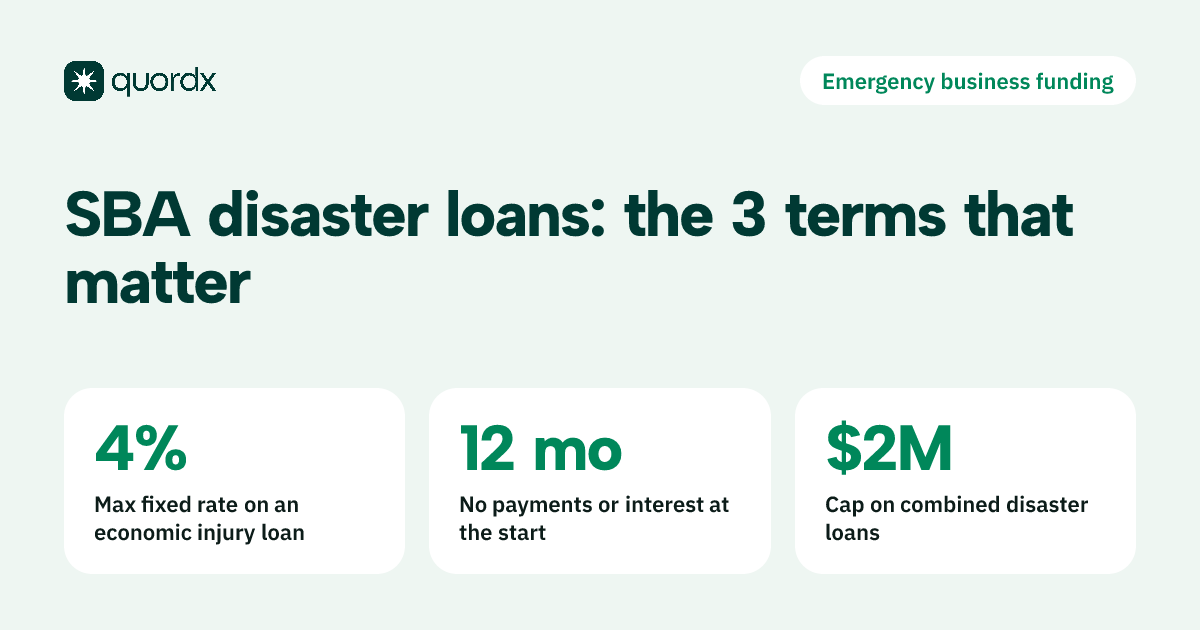
- Published terms: a fixed rate of no more than 4% on economic injury loans (up to 8% on physical loans if you can get credit elsewhere), up to 30 years, and no payments or interest for the first 12 months. Combined loans are capped at $2 million.
- How to apply: online at lending.sba.gov or by calling SBA at 800-659-2955. SBA inspects the damage after you apply, so plan other money for the meantime.
How fast can emergency business funding actually arrive?
Speed depends on whether the money is already approved. An open line moves as fast as your bank processes a draw. New money takes longer, and true same-day funding from a lender you've never used is rare; our page on whether same-day business loans are real explains why.
- Online lenders reached through a broker like Quordx: those lenders advertise decisions in 24 to 48 hours and funding 3 to 7 business days after that.
- SBA 7(a) loans: SBA lists a turnaround of 5 to 10 business days for a standard 7(a), and the lender still has to underwrite the loan.
- SBA disaster loans: SBA reviews the application and inspects damage first. Plan to bridge the gap with other money while it processes.
How to spot a predatory emergency business loan
Emergencies are when bad offers look best. The FTC has sued merchant cash advance providers over practices that land hardest on a business in a hurry. In one case it alleged that the funding shown on contracts didn't reflect fees deducted from it, and that withdrawals continued after customers had paid in full. In another, it alleged that a provider advertised no personal guaranty while its contracts included one, and required confessions of judgment that let it go straight to court for a judgment.
Red flags to walk away from
- Pressure to sign today, or an offer that expires within hours.
- No total repayment figure in writing, or a funding amount that shrinks once fees come out.
- A fee you pay before you're funded.
- Marketing that says no personal guarantee when the contract has a guarantee section.
- A confession of judgment in the contract.
- Daily debits you can't cover on a slow day.
Example: test a fast offer against your slowest day
Say a provider offers $20,000 now and takes back $26,000 through 120 business-day debits (hypothetical terms). That's about $217 every business day. If your slow days bring in $600, the debit takes about 36% of that day's sales before you pay a single other bill.
Costs surprise people: In the Fed's 2025 survey, 60% of firms that borrowed from online lenders said the actual cost was higher than expected, against 37% at small banks and 32% at large banks. Before you sign, compare the total repaid, not the payment. Our page on what a merchant cash advance really costs shows how to do that.
Where Quordx fits in a business emergency
Quordx is a broker, not a lender, and it can't make anyone's emergency same-day. What it can do is send one application, about 10 minutes, to lenders for term loans, lines of credit and working capital advances at once, and most options can be explored without a hard credit pull. Those lenders generally look for around $17,000 a month in revenue and, in most cases, a year in business.
If your emergency is unpaid invoices: Quordx also works with factoring lenders for business-to-business companies, including trucking firms and construction subcontractors. If you're newer or smaller than that, your open line, your current lender and a CDFI will usually get you further. Quordx doesn't serve Virginia, Connecticut, Missouri or North Dakota, and the lender, not Quordx, makes every decision. The application is at apply.quordx.com.
Questions Business Owners Ask Before Applying
How fast can I get emergency business funding?
Same day only if the money is already approved, like an open line of credit. New loans from online lenders typically take a few business days from application to funding, and SBA loans take longer. Plan the first week around money you can already reach.
Can I get emergency business funding with bad credit?
Sometimes, through routes that lean on something other than your score. Factoring looks mainly at your customers' credit, and equipment or property-backed loans lean on the asset. Be most careful here, because high-pressure offers aimed at owners with weak credit are where the red flags above show up most.
Are SBA disaster loans available for any business emergency?
No. They require a declared disaster, and your business must be located in the declared area. A fire, a lost customer or a broken machine that isn't part of a declared disaster won't qualify.
Is a merchant cash advance a good emergency option?
It's fast, but it's usually the most expensive choice and the daily debits start right away. If you consider one, get the total repayment in writing, test the debit against your slowest day, and check for a confession of judgment. Look at a line draw, factoring or a supplier payment plan first.
What if the emergency is that I can't make payroll?
Call your payroll provider and bank first, and never cover the gap with taxes you've already withheld from employees. Our guide to a business loan to cover payroll walks through the options in order.
Apply for Funding
No obligation · Initial inquiry doesn't impact credit · Takes about 10 minutes
Sources
- SBA: Disaster assistance
- Federal Reserve Banks: 2026 Report on Employer Firms (2025 Small Business Credit Survey)
- IRS: Employment taxes and the Trust Fund Recovery Penalty
- FTC: FTC Alleges Merchant Cash Advance Provider Overcharged Small Businesses Millions (Aug 3, 2020)
- FTC: New York-Based Finance Companies Deceived Small Businesses (June 2020)

Written by
Cody Dreis
Founder, Quordx Capital
Read full bio
Keep exploring business loans
Quordx Capital is a business funding broker, not a lender. Lenders make every credit decision and set the rate, fees and terms, and not every business qualifies. Quordx may be paid by a lender when a deal funds. Full disclosures