
Short-Term Business Loans
A short-term business loan is a lump sum you repay on a fixed schedule over months rather than years, usually with daily, weekly or monthly payments taken straight from your business bank account. Lenders size it from your bank deposits, often quote the price as a total payback or a fee instead of an interest rate, and expect the money to pay for itself before the last payment. That makes it a good fit for a cost that turns back into cash quickly, like inventory for a busy season or the upfront costs of a new contract, and a poor fit for equipment, buildings or a business that runs short every month.
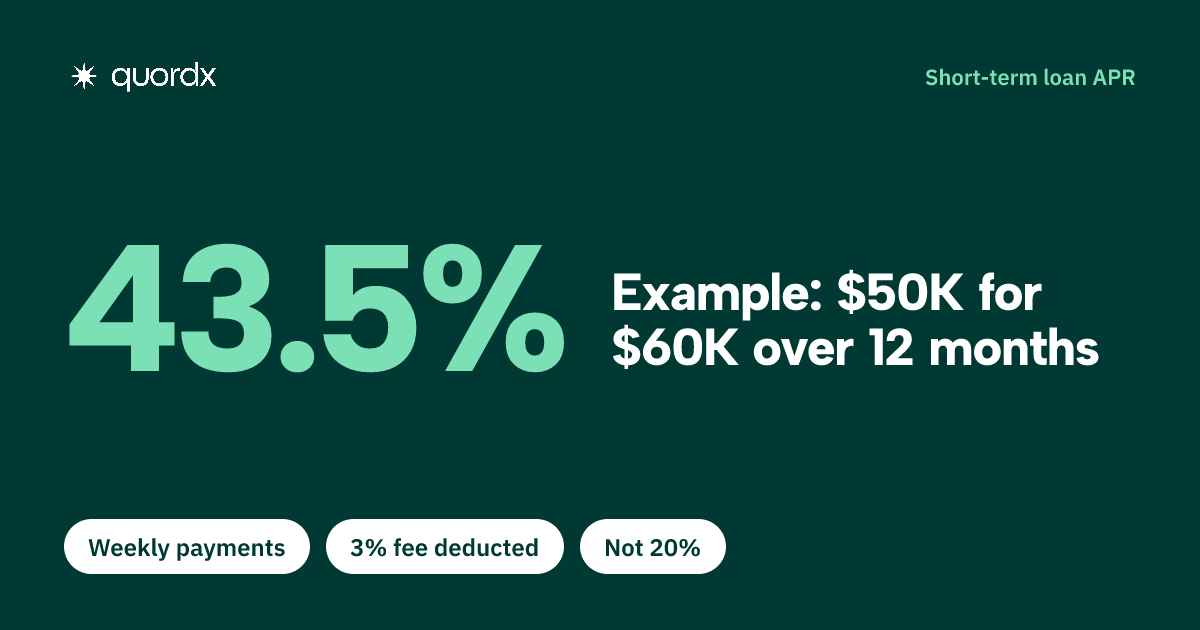
The short version: Before you compare offers, convert each one to the same four numbers: the cash you actually receive, the total you pay back, the payment and how often it comes out, and the APR. A quote of "$50,000 for $60,000 over 12 months" sounds like 20 percent, but with weekly payments and a 3 percent fee taken at funding it works out to about 43.5 percent APR. Take a short-term loan only when you can name the sale, invoice or season that repays it, and read the prepayment and renewal terms before you sign.
Part of our guide to Business Loans.
Last updated · Reviewed by Cody Dreis
75+ Lenders|Decisions typically in 24 to 48 hours*
What is a short-term business loan?
It is an installment loan with the clock compressed. You receive one deposit, then repay principal and cost together in equal payments until the balance is gone. Accountants call any debt due within 12 months a current liability, but the lending market uses the label more loosely: the online short-term loan products we reviewed run from a few months up to 24 months.
You will find short-term loans at online lenders and other non-bank lenders, and some banks meet the same needs with short loans or lines of credit. The Federal Reserve's 2025 Small Business Credit Survey found that 60 percent of firms that borrowed from online lenders said their actual borrowing costs were higher than expected. Most of this page is about not becoming one of them.
Typical amounts
Lenders size a short-term loan from the deposits running through your business bank account, so the ceiling moves with your revenue. Published amounts on the online short-term products we reviewed start around $5,000 and top out at a few hundred thousand dollars, with the largest amounts reserved for the strongest files. Ask for what the use actually needs; a bigger approval only makes the payment bigger.
How payments work: daily, weekly or monthly
Short-term lenders publish daily, weekly or monthly payment schedules, collected by automatic debit (ACH) from your operating account. Daily means every business day, about 21 debits a month. Weekly means about 4.33 debits a month (52 weeks divided by 12). The frequency changes your cash flow more than it changes your price, which the worked example further down shows in dollars.
How the price is quoted
You will see the cost stated in one of four ways: an interest rate, a flat fee, a total payback amount, or "cents on the dollar" (a quote of 20 cents means you repay $1.20 for every $1.00 borrowed). Only the APR (annual percentage rate) lets you compare offers of different lengths and payment schedules on equal terms. Some states now require lenders to show it, covered below, and you can calculate it yourself everywhere else.
Origination fees and the amount you actually receive
Many short-term loans charge an origination fee, usually a percentage of the loan, and most take it out of the deposit. Borrow $50,000 with a 3 percent fee deducted and $48,500 arrives, but you repay as if you received $50,000. Always ask whether the fee is deducted at funding or added to the balance, and run the math on the net amount.
Prepayment terms
This is where short-term loans differ most from each other. A loan that charges interest on the declining balance gets cheaper if you pay it off early. A loan priced as a fixed total payback may owe every dollar of that total no matter when you pay, unless the contract grants a prepayment discount. Some lenders waive part or all of the remaining cost on early payoff, so read the exact words.
Short-term loans vs lines of credit, MCAs, factoring and SBA small loans
A short-term loan is one of five tools that business owners commonly weigh for a gap measured in months. They differ in how the money arrives, how it is repaid and how the price is stated, and that last part is where comparisons usually go wrong.
| Product | How you get the money | How you repay | How the price is quoted | Best fit | Main catch |
|---|---|---|---|---|---|
| Short-term loan | One lump sum | Fixed daily, weekly or monthly payments, usually by ACH | Interest rate, fee, total payback or cents on the dollar | A one-time need with a clear payback, like a seasonal inventory buy | Fixed-payback loans may give no savings for paying early |
| Business line of credit | Draw what you need, up to a limit | Each draw repaid on its own schedule; interest or fees on what you use | Interest rate or periodic fee per draw | A gap that repeats, like slow months every year | The lender can review and reduce the limit |
| Merchant cash advance | A lump sum for a share of future sales | A fixed daily or weekly amount, or a percentage of sales | Factor rate (for example 1.30 times the advance) | Card-heavy businesses that cannot qualify for a loan | Often the highest cost; an estimated term, not a fixed one |
| Invoice factoring | An advance against unpaid B2B invoices | Your customer pays the factor; you get the rest minus fees | Fee per period the invoice stays unpaid | Gaps caused by customers paying on 30 to 90 day terms | Cost climbs the longer customers take to pay |
| SBA Express or 7(a) Small | A term loan or line through an SBA lender | Monthly payments, terms up to 10 years for most non-real-estate uses | Interest rate capped by SBA at a base rate plus a spread | Lower cost for owners who can wait and document more | Slower, more paperwork, SBA guaranty fee |
Where SBA small loans fit
SBA Express loans go up to $500,000 and 7(a) Small loans up to $350,000, per SBA's terms table. SBA lists a turnaround of 2 to 10 business days* for 7(a) Small and lists no turnaround for Express, where the lender makes the credit decision. Interest is negotiated but may not exceed SBA's maximum, which for variable-rate loans is the base rate plus 6.5 percent for loans of $50,000 or less, plus 6.0 percent from $50,001 to $250,000, plus 4.5 percent from $250,001 to $350,000, and plus 3.0 percent above $350,000. SBA publishes separate caps for fixed-rate loans.
With the prime rate at 7.00 percent (Fed H.15 data via FRED, November 9, 2026), those variable-rate caps work out to 13.50, 13.00, 11.50 and 10.00 percent on a prime-based loan. If your file can clear an SBA lender's documentation and you can wait, the cost difference against the example quotes on this page is large. If the need is weeks away and the payback is certain, the extra speed of a short-term loan can be worth paying for.
Run the numbers on your loan
Pick a product, set the amount and term, and see a typical payment.
How short-term loan costs work: simple, add-on and amortized interest
Two loans can both say "15 percent" and cost very different amounts. What matters is whether the percentage applies to the balance you still owe or to the original amount for the whole term.
Amortized (simple interest on the declining balance)
Interest accrues only on what you still owe, so each payment buys down more principal than the last. A $100,000 loan at 15 percent APR repaid in 12 monthly payments costs $9,025.83 a month and $8,309.97 in total interest. Pay it off early and you stop paying interest on the money you returned.
Add-on or flat fee (cost charged on the original amount)
The lender calculates the cost on the full $100,000 for the full term, adds it on, and divides by the number of payments. At "15 percent" that is $15,000 of cost and $9,583.33 a month. Because you are paying down the balance all year while being charged as if you held all of it, the true APR is about 26.6 percent, not 15.
| Same headline: $100,000 at "15%" for 12 months | Amortized at 15% APR | Add-on 15% flat fee |
|---|---|---|
| Monthly payment | $9,025.83 | $9,583.33 |
| Total cost | $8,309.97 | $15,000.00 |
| Total repaid | $108,309.97 | $115,000.00 |
| Actual APR | 15.0% | about 26.6% |
| Pay off early, save money? | Yes, interest stops | Only if the contract grants a discount |
The rule: when a quote is a fee, a factor or cents on the dollar, assume it is add-on pricing until the lender shows you an amortization schedule or an APR.
Worked example: turning a total-payback quote into an APR
Say a lender offers $50,000, total payback $60,000, 52 weekly payments, and a 3 percent origination fee deducted at funding. These are example numbers chosen to make the math easy to check, not market rates.
- Weekly payment: $60,000 divided by 52 = $1,153.85.
- Cash you receive: $50,000 minus the $1,500 fee = $48,500.
- Total cost: $60,000 minus $48,500 = $11,500.
- APR ignoring the fee: about 37.0 percent.
- APR on the cash you actually receive: about 43.5 percent.
To check it yourself in Excel or Google Sheets, enter =RATE(52, -1153.85, 48500) * 52. RATE finds the weekly rate that turns 52 payments of $1,153.85 into $48,500 today, and multiplying by 52 states it as an annual rate, the same way an APR is stated.
Why "20 percent" turns into 43.5 percent
The $10,000 of payback cost is 20 percent of the loan, but you never hold the full $50,000 for a year. You start paying it back in week one, so on average you hold roughly half of it. Paying a full year's cost on about half the money roughly doubles the rate, and the fee taken at funding pushes it higher still.
The same quote on a shorter term
Now keep the $60,000 payback and the $1,500 fee but shrink the term to 26 weekly payments of $2,307.69. The dollars of cost are identical, $11,500, yet the APR rises to about 85.5 percent, because you have the money for half as long. That is why "cents on the dollar" is useless for comparing offers of different lengths.
| Offer: $50,000, $60,000 payback, 3% fee | Payments | Payment amount | APR without fee | APR on $48,500 received |
|---|---|---|---|---|
| 12 months, monthly | 12 | $5,000.00 | about 35.1% | about 41.2% |
| 12 months, weekly | 52 | $1,153.85 | about 37.0% | about 43.5% |
| 12 months, daily | 252 | $238.10 | about 37.5% | about 44.0% |
| 6 months, weekly | 26 | $2,307.69 | about 85.5% |
Use the payment calculator on this page to run your own amount, rate and term, then check any fee-based quote with the RATE formula above.
Daily vs weekly vs monthly payments: what actually changes
Payment frequency matters, but mostly for your cash, not your price. Take a $40,000 short-term working capital loan with a $50,000 total payback over nine months and no fee, again as an example.
| Schedule | Number of payments | Each payment | About per month | APR |
|---|---|---|---|---|
| Daily (business days) | 189 | $264.55 | $5,556 | about 61.6% |
| Weekly | 39 | $1,282.05 | $5,556 | about 60.6% |
| Monthly | 9 | $5,555.56 | $5,556 | about 56.5% |
Daily and weekly payments land within about one point of APR of each other. Monthly is cheaper by about five points because you keep each dollar a little longer before it goes back to the lender.
The bigger difference is timing. A daily debit hits on your slowest Tuesday just as hard as on your best Friday. If your deposits arrive in lumps (a contractor paid on progress billings, a wholesaler paid on net 30 terms), a daily schedule can overdraw the account between deposits even when the monthly total is affordable. Ask for weekly or monthly if your deposits are lumpy, and size the payment against your weakest recent month, not your average.
When a short-term loan is the right tool
The test is simple: can you point to the specific sale, invoice or season that will repay this loan before the last payment? If yes, a short-term loan can be a sensible tool even at a high APR, because the dollars of cost are small next to what the money earns.
Inventory ahead of a busy season
Say a retailer borrows $60,000 in early September to stock up for the holidays, with a $69,000 total payback over 26 weekly payments of $2,653.85. If that inventory sells for $120,000, the $9,000 cost is easy to cover. The catch is timing: about eight weekly payments, roughly $21,230, come due before the holiday rush starts, so that money has to come from cash you already have.
A seasonal gap with a known end
A lawn care company that bills heavily from April to October and carries payroll through a slow March fits the same logic, as long as the loan's last payment falls inside the busy season. If the gap shows up every year, a line of credit you reuse is usually the cheaper tool.
Mobilizing a new contract
A subcontractor who wins a job often has to buy materials and carry payroll for weeks before the first progress payment arrives. A short-term loan sized to those upfront costs, with the final payment set after the first one or two progress payments are due, matches the debt to the cash that repays it. Bring the signed contract and the payment schedule to the lender; it makes the case for you.
A discount that pays for itself
A supplier offering a meaningful discount for paying cash on a large order can justify a short-term loan when the discount is bigger than the loan's dollar cost over the same period. Do the math in dollars, not percentages.
When a short-term loan is the wrong tool
Long-lived assets: Equipment, vehicles, buildouts and real estate earn their keep over years. Paying for them in a few months crushes cash flow for no reason. Equipment financing, term loans and SBA loans are built to match the repayment to the asset's useful life.
A chronic shortfall: If the business runs short every month because costs exceed revenue, a short-term loan adds a large fixed payment to a business that already cannot cover its bills. It buys a few weeks and makes the next shortfall bigger. The fix is pricing, costs or collections, and sometimes a conversation with an accountant before a lender.
Paying off another expensive advance: Using a new short-term loan to retire an older one rarely lowers the total cost unless the new one is clearly cheaper and longer. See the renewal math below before agreeing to a payoff.
When you cannot name the payback: "Growth" or "breathing room" is not a repayment source. If you cannot say which deposits will cover the payment, a line of credit you draw only when needed, or no borrowing at all, is safer.
Stacking and renewals: how short-term debt compounds
Stacking: a second loan on top of the first
Stacking means taking a second short-term loan or advance while the first is still being repaid. Lenders can see the first loan's debits in your bank statements, and some contracts treat taking on new financing without consent as a default. Even when it is allowed, the payments add up faster than owners expect.
Example: a business deposits $90,000 a month and keeps about 8 percent of that, $7,200, after its operating costs. It already pays $1,153.85 a week, about $5,000 a month, on a first loan. A second offer of $30,000 with a $39,000 payback over six months of daily payments adds $309.52 a day, about $6,500 a month.
Together that is $11,500 a month in payments against $7,200 of monthly profit, and the $4,300 difference comes out of the bank balance until something gives. Our page on carrying two advances at once walks through how this plays out.
Renewals: refinancing before you finish
Lenders may offer to renew once you have paid down part of the balance. With a fixed-payback loan and no prepayment discount, the payoff includes cost you would have owed anyway, and the new loan charges fresh cost on the whole new amount.
Go back to the $50,000 loan with a $60,000 payback and a 3 percent fee. After 26 of 52 weekly payments you still owe $30,000. The lender offers to renew into a new $50,000 loan on the same terms: $30,000 goes to the payoff, $1,500 to the fee, and $18,500 reaches your account.
Your weekly payment stays $1,153.85, but instead of finishing in 26 weeks you now pay for 52. You received $18,500 of new cash in exchange for $30,000 of extra payments over weeks 27 through 52 of the new loan, which works out to about 64.6 percent APR on the new money.
The rule: before you renew, compare the new cash you will actually receive with the extra payments you are signing up for. A renewal is a new loan, and it deserves the same worksheet as any other offer.
What lenders look at on a short-term loan application
Short-term lenders underwrite mainly from your business bank statements, because deposits show what the business can repay week to week. Many ask for the last three months of statements and some want more. Our guide to what lenders look for in bank statements goes line by line; here is the short list.
Bank statement signals
- Revenue deposits: real sales deposits, with transfers between your own accounts, loan proceeds and owner contributions taken out.
- Consistency: whether deposits are steady or lumpy, and whether the trend is up, flat or down.
- Average daily balance: how much cushion sits in the account on a typical day, which tells the lender whether a payment will clear.
- NSFs and overdrafts: returned items and negative-balance days are among the clearest warning signs in a file.
- Existing positions: recurring debits to other lenders or funders, which show how much of your cash is already spoken for.
Business and owner signals
- Time in business: many lenders want a year or more of history, and some will consider less.
- Personal and business credit: many short-term lenders check the owner's personal credit, and many look at business credit reports too. Recent defaults, tax liens and judgments matter more than the score alone.
- Industry: some industries are restricted or excluded by individual lenders.
- Ownership: lenders usually want every owner above a set percentage to sign, and many require a personal guarantee. The Fed's credit survey found that 59 percent of firms with debt used a personal guarantee to secure it.
Application red flags that slow or stop a deal
- Statements that do not match the revenue on the application.
- A cluster of NSFs or negative days in the most recent month.
- An existing loan or advance you left off the application but that shows up as a debit.
- A recent change of bank account, which can look like an attempt to hide existing debits.
- Unfiled tax returns or a tax lien, which some lenders treat as a stop.
States that make lenders show you an APR
A set of state commercial financing disclosure laws now require lenders and funders to hand you a standardized cost disclosure before you sign. A March 2026 survey by the law firm Venable counts ten states with these laws: California, Connecticut, Florida, Georgia, Kansas, Missouri, New York, Texas, Utah and Virginia. What each one requires differs, and only some require an APR.
| State | Who is covered | APR required? | What else you see |
|---|---|---|---|
| California | Commercial financing offers of $500,000 or less, including loans, lines, factoring and cash advances | Yes. Since January 1, 2026 (SB 362), once a specific offer is made, the APR must also be stated whenever the provider quotes a charge, pricing metric or amount for it | Amount funded, payment, term, prepayment terms, and an average monthly cost when there is no monthly payment |
| New York | Commercial financing up to $2,500,000 | Yes, with an estimated APR where the cost depends on future sales or other assumptions | Finance charge, payment terms and the other items set by DFS rules |
| Florida | Commercial financing transactions covered by the statute | No | Total funds, funds actually disbursed, total repaid, total dollar cost, payment terms and prepayment terms |
California's rules took effect December 9, 2022 and require providers to disclose the APR along with the amount funded, payment, term and prepayment details, according to the California DFPI. Starting January 1, 2026, SB 362 also requires the APR whenever a charge or pricing metric is quoted for a specific offer of $500,000 or less, and bars using "interest" or "rate" in a misleading way. New York's law covers financing up to $2,500,000 and its rule explains how providers calculate the finance charge and APR, per the New York DFS.
Florida's statute, by contrast, requires the total funds, the funds actually disbursed, the total repaid and the total dollar cost, with no APR, under Florida Statutes 559.9613. In a state without an APR rule, use the dollar figures on the disclosure and the RATE formula from the worked example to get the APR yourself. Each of these laws has exemptions (in California, for example, banks are exempt), so a missing disclosure is a question to ask, not proof of wrongdoing.
How to compare short-term loan offers: a worksheet
Put every offer through the same rows, in writing, before you choose. If a lender will not fill in a row, treat the offer as incomplete. Here is the worksheet filled in for the two example offers from this page.
| Row | Offer A (example) | Offer B (example) |
|---|---|---|
| Amount approved | $50,000 | $50,000 |
| Fees deducted at funding | $1,500 (3%) | $1,500 (3%) |
| Cash you actually receive | $48,500 | $48,500 |
| Total of all payments | $60,000 | $60,000 |
| Total dollar cost (payments minus cash received) | $11,500 | $11,500 |
| Payment and frequency | $1,153.85 weekly | $2,307.69 weekly |
| Number of payments and term | 52, 12 months | 26, 6 months |
| Payment as a monthly figure | about $5,000 | about $10,000 |
| APR (disclosed or calculated) | about 43.5% | about 85.5% |
| Prepayment terms | Ask: discount, no penalty, or no benefit? | Ask |
| Personal guarantee | Who signs, and is it unlimited? | Ask |
| Collateral and lien | Blanket UCC lien or specific assets? | Ask |
| Renewal terms | When can you renew, and is the old cost forgiven? | Ask |
| Other fees | Late, NSF, ACH, wire, default | Ask |
How to read the worksheet
- Lowest total dollar cost matters most if you are sure you will keep the money for the full term.
- Lowest APR matters most if the offers have different lengths or you might pay early.
- Lowest monthly payment matters most if cash flow is tight, but a longer term usually means more total cost.
- Prepayment terms decide everything if you expect the use to repay early, such as an invoice you know will be paid in 60 days.
In this example both offers cost the same $11,500, but Offer B doubles the monthly payment. Unless you are sure the money comes back within six months, Offer A is the safer choice.
Contract terms and red flags to check before you sign
The offer is a summary. The contract is what binds you, and it can add terms the offer never mentioned. Read it with these in mind, and have an attorney review anything you do not understand, especially on a large loan.
- Amounts match the offer: the principal, the fees and the total payback in the contract should match the offer to the dollar.
- Prepayment clause: "prepayment discount", "no prepayment penalty" and "no prepayment benefit" mean very different things on a fixed-payback loan.
- Personal guarantee: who signs, and whether it covers the full balance.
- UCC lien: many short-term lenders file a lien on business assets. A blanket lien can make it harder to get other financing until it is released.
- Events of default: watch for clauses triggered by changing banks, a drop in deposits, or taking any other financing.
- Default fees and acceleration: late fees, NSF fees, and the right to demand the whole balance at once.
- Confession of judgment: a clause letting the lender get a court judgment without a hearing if it says you defaulted. The FTC has sued cash advance providers that required these and used them to seize assets in situations the contracts did not allow. Flag it and ask an attorney before you sign.
- Auto-renewal or automatic re-advances: know whether a renewal can be triggered without a new signature.
Red flags in the offer itself
- A request for a fee before you are funded.
- A promise of approval before anyone has seen your statements.
- No written figure for the cash you will receive, the total payback, or the payment.
- Pressure to sign the same day, or a contract sent before the offer terms are in writing.
- In California or New York, a covered offer that arrives without the required disclosure and no explanation of an exemption.
- Debits larger or more frequent than the contract allows.
How to apply for a short-term business loan
- Name the use and the payback. Write down what the money buys and which deposits repay it, with dates. This sets the amount and the term you ask for.
- Size the payment. Take your weakest month of deposits in the last six and make sure the payment, converted to a monthly figure, still leaves room for payroll and rent.
- Gather the documents on the checklist below so an underwriter is not waiting on you.
- Apply to more than one lender, or through a broker, so you have offers to compare. Ask whether the first look uses a soft credit pull.
- Fill in the worksheet for each offer and compute every APR the same way.
- Read the contract against the offer and the red-flag list before signing.
- Plan the end. Put the final payment date on the calendar and decide now whether you will renew, so the decision is not made under pressure in month six.
Document checklist
- Government-issued photo ID for each owner who will sign.
- Business bank statements, usually the last three months at least, and more for larger amounts.
- A voided check or bank letter for the account that will receive funds and make payments.
- EIN confirmation and formation documents (articles of organization or incorporation).
- The most recent business tax return, often required on larger requests.
- A year-to-date profit and loss statement and balance sheet for larger requests.
- A schedule of existing debts: each lender, balance, payment and frequency.
- Proof of the use where it applies: a signed contract or purchase order, a supplier quote or invoice, or an accounts receivable aging report.
- Payoff letters for any loan or advance the new money will retire.
Where Quordx fits on a short-term loan
Quordx is a broker, not a lender. One application, about 10 minutes, goes to the lenders in a network of 75+ that fit the size of the need and how fast it repays, and each lender makes its own decision. Most options can be explored without a hard credit pull, and the lender pays Quordx if a loan funds, so you pay no fee to Quordx.
What that changes on a short-term loan is the comparison. You get offers you can put side by side on the worksheet above, and you can ask for a longer term or a line of credit instead when the use calls for it. Lenders that match typically return decisions in 24 to 48 hours*, and no one can promise an approval or a funding date. If the numbers in your offers do not pass the payback test on this page, the right move may be to wait.
Start an application when you have the use and the payback written down. For the broader picture of financing day-to-day costs, see our guide to working capital loans.
Questions Business Owners Ask Before Applying
How long is a short-term business loan?
Usually somewhere from a few months up to about two years; the online short-term products we reviewed top out at 24 months. Accountants treat debt due within 12 months as short-term, so many short-term loans run a year or less. Match the term to how long the money takes to come back, not to the lowest payment.
What is a short-term working capital loan?
It is a short-term loan used for day-to-day costs like inventory, payroll or materials rather than for an asset. The structure is the same: a lump sum repaid on a fixed daily, weekly or monthly schedule. It works best when the expense turns back into cash within the loan's term.
Is a short-term business loan the same as a merchant cash advance?
No. A short-term loan is a loan with a fixed repayment schedule and a set term. A merchant cash advance is structured as a purchase of future sales, often with an estimated term and a factor rate instead of an interest rate. Both can debit your account daily, which is why they get confused, but the legal terms and the cost math differ.
Can I pay off a short-term business loan early?
Usually yes, but whether it saves money depends on the contract. A loan that charges interest on the remaining balance gets cheaper when you pay early. A fixed-payback loan may require the full payback amount unless the contract grants a prepayment discount, so read that clause before you sign.
Do short-term business loans need collateral?
Most don't require a specific asset, but most are still secured in some way. Lenders commonly file a UCC lien on business assets and ask owners for a personal guarantee. The Fed's 2025 credit survey found that 59 percent of firms with debt used a personal guarantee.
What credit score do I need for a short-term business loan?
There is no single cutoff; each lender sets its own and weighs it alongside your deposits, time in business and existing debts. Short-term lenders lean heavily on bank statements. Recent defaults, liens or a run of NSFs can hurt more than a middling score.
Is a short-term loan cheaper than a line of credit?
It depends on how you use the money. A line charges only on what you draw, so for a gap that comes and goes it is often cheaper in total dollars. For a single, defined purchase repaid quickly, a short-term loan can cost about the same or less, so compare both in total dollars and APR.
Why does my state require an APR on a business loan offer?
California and New York passed commercial financing disclosure laws that require providers to show an APR on covered offers, so business owners can compare products priced in different ways. California covers offers of $500,000 or less and New York covers financing up to $2,500,000. Several other states require dollar-cost disclosures without an APR.
Apply for Funding
No obligation · Initial inquiry doesn't impact credit · Takes about 10 minutes
Sources
- SBA, 7(a) loan program terms, conditions and eligibility
- California DFPI, commercial financing disclosure regulations (effective December 9, 2022)
- Buchalter, California SB 362 and commercial financing offers of $500,000 or less (Dec 29, 2025)
- New York DFS, regulation for commercial financing disclosure requirements (Feb 1, 2023)
- Florida Statutes 559.9613, commercial financing disclosures
- Venable, State Commercial Financing Disclosure Laws (March 2026)
- Federal Reserve Banks, 2026 Report on Employer Firms (2025 Small Business Credit Survey)
- FTC, court judgment in a merchant cash advance case (Feb 14, 2024)

Written by
Cody Dreis
Founder, Quordx Capital
Read full bio
Related articles
Keep exploring business loans
Quordx Capital is a business funding broker, not a lender. Lenders make every credit decision and set the rate, fees and terms, and not every business qualifies. Quordx may be paid by a lender when a deal funds. Full disclosures