

Small business loans without documents: the minimum file that still gets funded
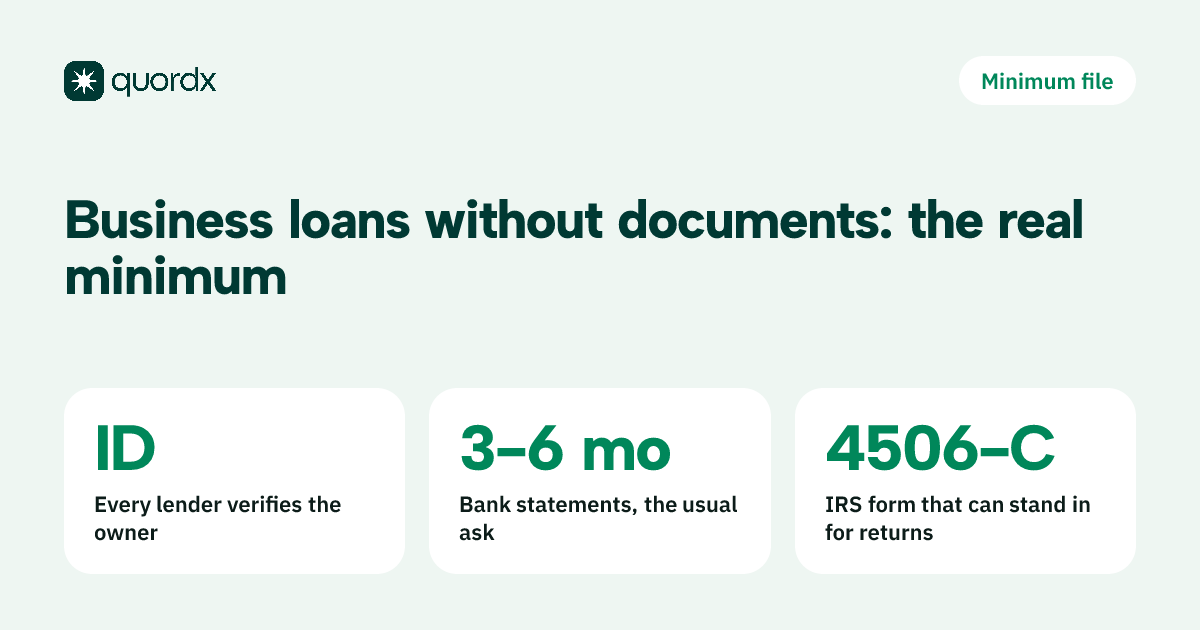
You can't get a legitimate small business loan without any documents, but for many products the minimum file is short: a photo ID, your business details, a signed application that lets the lender check credit, and recent business bank statements or a live connection to the account. What gets added depends on the product and the amount. Invoice factoring wants your invoices, equipment financing wants a quote for the machine, and SBA loans want the full package. The fastest file is the one that fits the product, not the one with the fewest pages.
The short version: Pick the product first, then gather only what it needs, using the table below. Run every dollar of revenue through one business account, because a lender can only count what it can see. If your tax returns are filed, signing a transcript request can stand in for digging them up. And if a lender asks for nothing at all, find out how it plans to get repaid.
Part of our guide to Business Loans.
Last updated · Reviewed by Cody Dreis
75+ Lenders|Decisions typically in 24 to 48 hours*
The minimum documents for a business loan, by product
The product decides the file. Each one leans on a different source of repayment, and the lender asks for whatever proves that source is real.
| Product | Minimum file | Added for bigger amounts or open questions | Usually not needed |
|---|---|---|---|
| Working capital advance or merchant cash advance | ID, application, recent business bank statements, account details for payments | Card processing statements, a list of current loans and advances | Tax returns, financial statements, business plan |
| Short-term loan or online line of credit | ID, application, EIN, bank statements or an account connection | Most recent tax return, profit and loss statement, debt schedule | Business plan, projections |
| Invoice factoring | ID, application, the invoices to be funded, accounts receivable aging report, customer list | Customer contracts, proof of delivery, formation documents | Projections, business plan |
| Equipment financing | ID, application, quote or invoice from the seller | Bank statements, then tax returns or financial statements as the price rises | Business plan, for an established business |
| Bank term loan or line of credit | Business and personal tax returns, financial statements, bank statements, debt schedule, formation documents | Interim financials, projections, collateral documents | Very little |
| SBA 7(a) loan | SBA Form 1919 plus the lender's own list | Personal financial statement, tax returns, a business plan for newer businesses | Nothing you can count on skipping |
The pattern: the less a lender can lean on an asset or on your customers, the more it needs to see about you. A factor cares most about who owes you. An equipment lender cares most about the machine. A cash-flow lender has only your account to go on, so it reads that account closely.
SBA loans are the far end of the scale: SBA says the contents of a 7(a) application vary with the loan size and the lender's processing method, and its lender rules make Form 1919, the Borrower Information Form, required for every standard 7(a) loan. Even SBA Express lenders, who use their own forms, add Form 1919.
Business loan document checklist: what each item proves
Every document answers one question for the lender. If you know the question, you can often answer it a faster way.
| Document | What it proves | Fastest way to get it |
|---|---|---|
| Government photo ID | You are who you say, and you can sign or guarantee | A clear scan or photo of your license or passport |
| EIN | The business's federal tax identity | Your IRS confirmation letter or a past business tax filing |
| Formation documents and good standing | The business legally exists and you can sign for it | Your state's Secretary of State website |
| Business bank statements | Revenue, balances and existing debt payments | Full PDF statements from online banking, every page, or a direct account connection |
| Voided check or account and routing numbers | Where funds go and where payments come from | Your bank or online banking |
| Card processing statements | Card sales volume for card-heavy businesses | Your processor's dashboard |
| Accounts receivable aging report and invoices | Who owes you, how much and how overdue | Your accounting software |
| Equipment quote or invoice | What is being financed and what it costs | The seller or dealer |
| Tax returns, or a signed Form 4506-C | The income you reported to the IRS | Your CPA, or the IRS transcript request the lender sends you |
| Debt schedule | Every current loan, advance and lease, with balances and payments | A one-page spreadsheet you write yourself |
| Personal financial statement | Your assets and debts as a guarantor | The lender's own form |
On bank statements, the lenders whose requirements we reviewed ask for the most recent three to six months. Send whole months as the bank produces them. For everything an underwriter reads in those pages, see what lenders look for in bank statements, and for the full-doc version of this list, see documents needed for a business loan.
Estimate your funding
Answer a few questions about your business to see a likely range.
How to keep the paperwork short without paying for it
- Connect the account instead of uploading it. Some online lenders read your account through a bank-connection service, so there are no PDFs to gather. It is still your bank data, just delivered directly. More on that in small business loans without bank statements.
- Sign for your transcript instead of hunting for returns. If your returns are filed, a lender can request your transcript through the IRS Income Verification Express Service on Form 4506-C. The IRS sends it only with your consent.
- Send complete statements the first time. Screenshots, cropped pages and missing months are the most avoidable reason a lender comes back with questions.
- Write the explanations before anyone asks. A one-line note for each unusual deposit or dip, such as an owner injection, an insurance payout or a slow month after a lost contract, saves a round of back-and-forth.
- Size the request to the file you have. Lenders tend to ask for more as the amount grows. If a smaller amount solves the problem, it may also keep the file short.
- Keep a debt schedule ready. Lenders see your current payments on your statements anyway. Listing them yourself shows you have nothing to hide.
Worked example: the revenue a lender can't see
Say a catering company deposits $24,000 a month into its business account. The owner also takes about $9,000 a month in cash and app payments into a personal account. The business really earns about $33,000 a month, but a lender reading the business statements counts $24,000.
Now say a lender's floor is $25,000 a month. That number is made up for this example, but cash-flow lenders commonly set a revenue floor. On paper the file misses by $1,000, even though real revenue clears it by $8,000. The fix isn't a lender with fewer document requirements: it is running every sale through the business account for a few months, so the statements tell the true story.
Documents that slow down a low-doc application
These are the problems that turn a two-item file into a two-week back-and-forth.
- Business money in a personal account. It hides revenue and raises questions about what is business and what is personal. Sole proprietors run into this most; see business loans for sole proprietors.
- A brand-new business account. If you just switched banks, send the old account's statements too. A lender wants history, not a fresh account with two deposits in it.
- Names that don't match. The legal name on the application, the bank account and state records should be identical. A mismatch triggers a request for formation documents.
- An advance you didn't mention. The daily debit shows up in your statements whether you list it or not, and leaving it off reads as concealment.
- Unfiled returns or a tax lien. A bank-statement product may not need your return, but a lien search can still find unpaid tax that became a lien.
When gathering more documents is worth it
A short file is a convenience, and lenders charge for it. The cost side of that trade, with a worked example, is in what no-doc business loans really are. Here is how to decide which side of it you're on.
If you need more than a few months to repay: gather the full file. Longer terms and lower prices sit with the lenders that read tax returns and financial statements.
If your books are already clean: a full-doc application costs you an afternoon, not a week. Send it.
If you want an SBA loan: plan for the full package from the start, and use SBA Lender Match to find SBA lenders near you, especially for smaller loan amounts.
If the need is small, short and urgent: a bank-statement product is a fair choice. Compare at least two offers on total dollars repaid.
Sending a short file through Quordx
Quordx is a broker, not a lender, and it can't make a lender skip its document list. What it can do is match the file you have to products that fit it. A cash-flow request goes to term loan, line of credit and advance lenders that work mostly from bank statements; those generally start around $17,000 a month in deposits and about a year in business. A business that invoices other companies can go to factors that care more about its customers, and an equipment purchase can start with the seller's quote.
The application takes about 10 minutes, most options can be explored without a hard credit pull, and lenders typically come back in 24 to 48 hours*. Lenders pay Quordx when a deal funds, so the business owner pays nothing for the match. Quordx's SBA option is generally for loans of roughly $400,000 and up, so smaller SBA requests belong with Lender Match.
Questions Business Owners Ask Before Applying
Can I get a business loan with just bank statements?
Close to it, for some products. Working capital advances and some short-term loans decide mostly from bank statements, but you will still provide a photo ID, a signed application with consent to check credit, and your business details. Expect follow-up questions if something in the statements needs explaining.
How many months of bank statements do lenders want?
The lenders whose requirements we reviewed ask for the most recent three to six months. Send complete months as PDFs from your bank, not screenshots. If you changed banks during that window, include the old account's statements too.
Do I need a business plan to get a business loan?
Usually not for an established business applying for a short-term loan, a line of credit, an advance or equipment financing. Startups and SBA borrowers are the ones most likely to be asked, because the lender has little history to read. The lender decides, so ask before you write one.
What if I haven't filed last year's tax return yet?
A bank-statement product may not need the return at all. Full-doc and SBA lenders usually do, so you may have to wait until it is filed. If unpaid tax has turned into a lien, it can show up on a lien search either way.
Can an SBA loan be done with minimal paperwork?
Not really. SBA requires Form 1919 on every standard 7(a) loan, and SBA Express lenders add it to their own forms. The rest of the list comes from the lender, and it grows with the loan size.
Apply for Funding
No obligation · Initial inquiry doesn't impact credit · Takes about 10 minutes
Sources

Written by
Cody Dreis
Founder, Quordx Capital
Read full bio
Related articles
Keep exploring business loans
Quordx Capital is a business funding broker, not a lender. Lenders make every credit decision and set the rate, fees and terms, and not every business qualifies. Quordx may be paid by a lender when a deal funds. Full disclosures