
Small business loans without bank statements: the rare cases that work
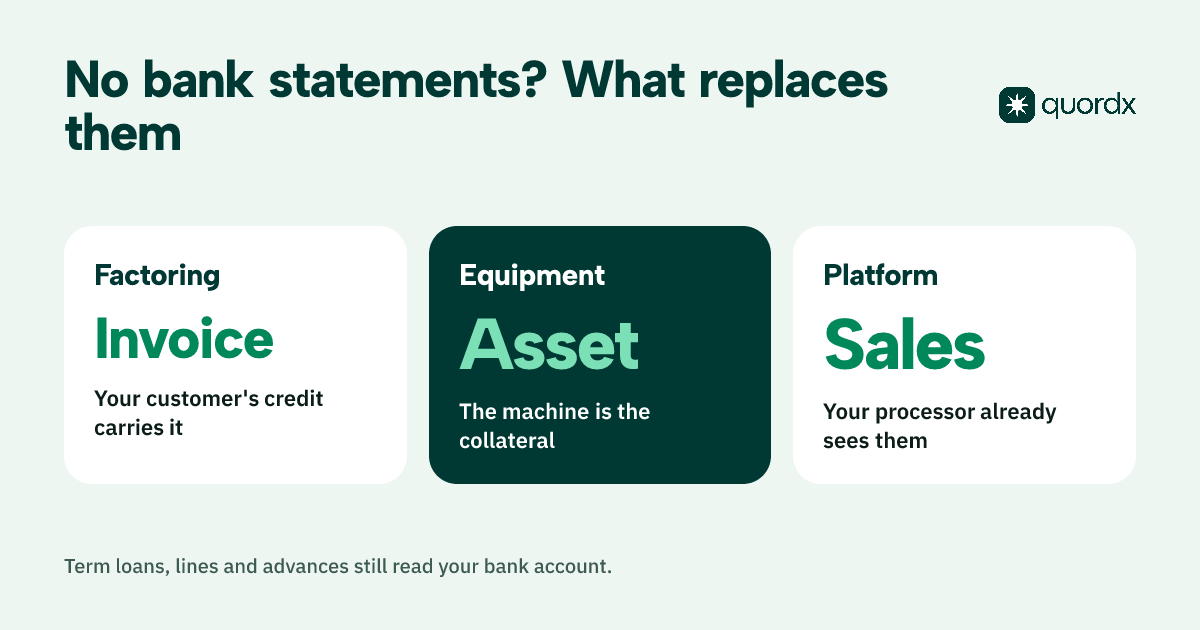
Very few small business lenders will fund without seeing your bank data, because the business bank account is where they confirm revenue and where repayment comes from. The real exceptions are narrow: connected-account underwriting (no PDFs, but the lender still reads the account), financing from a payment processor or sales platform that already sees your sales, invoice factoring where your customer's credit carries the deal, and equipment or real estate loans where the asset does much of the work. If you're avoiding statements because of what they show, the better fix is usually to repair the account, not to find a lender who won't look.
The short version: If you just don't want to upload files, connect the account instead. If you sell through a processor or platform that offers financing, check your dashboard for an offer. If you invoice other businesses, price factoring, and if you're buying equipment, lead with the seller's quote. Term loans, lines of credit and advances will want the account.
Part of our guide to Business Loans.
Last updated · Reviewed by Cody Dreis
75+ Lenders|Decisions typically in 24 to 48 hours*
Why nearly every business lender wants bank statements
Business funding without bank statements: the cases that work
Each of these replaces the statement with something else the lender trusts. None of them is a way around being reviewed.
Connected-account underwriting: no PDFs, same data
Some online lenders skip uploaded statements and read your account directly. Fundbox, for example, says it uses Plaid to connect to your bank account and stay connected, and it publishes a minimum length of checking-account history. You sign in through a secure connection screen, the lender sees your transactions, and no one asks you for a PDF.
This is the most common answer to 'no bank statements,' and it is worth being clear about what it is. You skip the uploading, not the review. Read the authorization too, because the connection may stay active for as long as you have the account with that lender.
Financing from your payment processor or sales platform
If you already sell through a processor or a commerce platform, it has your sales history and may make you an offer without a statement in sight. Square Loans are offered by invitation, based on your Square account activity, and you can't apply without an offer. Shopify evaluates Capital eligibility automatically from sales, disputes and how long you've used the platform, and shows offers in your admin.
The limits are real. You can only get these if you already sell through that platform, you can't shop them against other offers in one place, and both companies still review your application: Square says applications are subject to credit review, and Shopify says an offer doesn't guarantee funding.
Invoice factoring: the invoice is the file
With invoice factoring, you sell unpaid invoices to a factor and your customer pays the factor. Under the Uniform Commercial Code, once your customer gets notice of the assignment, it pays the factor, not you. So the factor's main question is whether your customer pays its bills, and your bank history matters less.
Expect to provide the invoices, an accounts receivable aging report, customer details and proof the work was done. Expect to give account details for the advances, and some factors ask for statements as well.
| Step | Amount |
|---|---|
| Invoices sold, due in 30 days | $60,000 |
| Advance at a hypothetical 85% | $51,000 |
| Fee at a hypothetical 2.5% for 30 days | $1,500 |
| Paid to you when the customer pays (reserve minus fee) | $7,500 |
| Total you receive | $58,500 |
Notice what drove that math: the invoice amount and when your customer pays. Nothing in it came from your bank statements.
Equipment financing: the machine carries much of the risk
The equipment is collateral, so the lender can take it back and resell it. For an established business buying equipment that holds its value, some lenders start from the seller's quote and your credit and ask for statements or financials only as the price climbs. Used, specialized or hard-to-resell equipment brings the paperwork back. See how equipment financing works.
Real estate bridge and hard money loans
These are sized mainly from the property's value and how you plan to repay or refinance. The lender still wants to know you can pay the interest along the way, but the property, not your deposits, is the center of the file. Read what a bridge loan is before you go this route, because these loans are short and built around an exit.
| Option | What replaces the statements | What you still provide | Who it fits |
|---|---|---|---|
| Connected-account lending | A live read of the same account | ID, application, credit consent | Anyone who would rather not upload files |
| Processor or platform financing | Sales data the platform already holds | Acceptance of the offer, an application review | Businesses already selling through that platform |
| Invoice factoring | Your customers' credit | Invoices, aging report, account details | Businesses that invoice other businesses |
| Equipment financing | The equipment's resale value | Seller's quote, ID, credit consent | Established businesses buying equipment that holds value |
| Bridge or hard money loan | The property's value | Property details, exit plan, ID | Owners with real estate equity and a clear exit |
Estimate your funding
Answer a few questions about your business to see a likely range.
Why you don't have bank statements, and what to do about it
Most people searching this phrase have a specific reason. Match yours to the fix.
- You just switched banks. Download the old account's statements before online access ends, or request them from the bank. Send both accounts; the lender wants the history, not where it lives.
- Your revenue runs through a personal account. Ask whether the lender will read a personal account used for the business, then open a business account and move every sale into it. See how sole proprietors get business loans.
- You're mostly a cash business. A lender can only count what reaches the bank. Deposit cash regularly, in full, and the statements will start showing your real size.
- Your statements show overdrafts or returned payments. Waiting a few months and building a clean run will usually do more for you than any lender that promises not to look.
- The business is brand new. There is no history yet, so this is a startup question, not a statements question. Start with startup business loans with no revenue.
- You'd simply rather not share them. Connected-account lending or a processor offer may suit you. Otherwise, accept that term loans, lines of credit and advances will read the account.
When a lender says 'no bank statements needed'
Read that line closely, because it usually means one of three honest things. The lender reads your account through a connection instead of a PDF. It already holds your sales data as your processor. Or it is lending against an invoice, a machine or a property.
If it means none of those, ask how the lender will verify your revenue and how it will collect payments. A lender that verifies nothing and then asks for an upfront fee is following the pattern the FTC warns about. For the full set of warning signs, see what no-doc business loans really are.
Where Quordx fits when bank statements are the problem
Quordx is a broker, not a lender. Several products it can place lean on something other than your account: factoring for businesses that bill other businesses, including trucking companies and construction subcontractors, equipment financing from mid-size machines to large-ticket deals, and bridge or hard money loans secured by real estate in some states. Those lenders may still ask for some bank data, but the invoice, the asset or the property is the heart of the file. For the full minimum file by product, see small business loans without documents.
The term loans, lines of credit and working capital advances Quordx places will read your bank account, and there is no way around that. Processor and platform offers come only from the platform itself, so check your dashboard directly. If one of the asset-based routes fits, the application takes about 10 minutes, lenders typically decide in 24 to 48 hours*, and lenders pay Quordx when a deal funds, not you.
Questions Business Owners Ask Before Applying
Can I use tax returns instead of bank statements for a business loan?
Usually not as a full substitute. Lenders that weigh tax returns and financial statements most heavily, like banks and SBA lenders, generally want bank statements as well. A return shows last year's income; a statement shows how cash moves now.
Can I use personal bank statements for a business loan?
Some lenders will read a personal account a sole proprietor uses for the business, so ask. Mixed personal and business money makes revenue harder to verify, and it may count against you. The long-term fix is a separate business account with every sale running through it.
Is connecting my bank account to a lender safe?
A connection through a bank-data service lets the lender read your transactions without you sending files, and you sign in through the connection screen yourself. Never give a login to a person by email, text or phone. Read the authorization so you know how long access lasts and how to end it.
Do card processing statements count instead of bank statements?
For card-heavy businesses, some advance providers read processor statements closely. Most still want the bank account where those card settlements land, because that is where payments are collected. Expect to provide both.
Does invoice factoring require bank statements?
Sometimes, but they are not the center of the file. A factor mostly looks at your invoices, your aging report and your customers' payment history. You will still give account details so the factor can send you the advance.
Apply for Funding
No obligation · Initial inquiry doesn't impact credit · Takes about 10 minutes
Sources

Written by
Cody Dreis
Founder, Quordx Capital
Read full bio
Related articles
Keep exploring business loans
Quordx Capital is a business funding broker, not a lender. Lenders make every credit decision and set the rate, fees and terms, and not every business qualifies. Quordx may be paid by a lender when a deal funds. Full disclosures