
What Is Purchase Order (PO) Financing?
Purchase order financing is short-term funding that pays your supplier so you can fill a confirmed customer order you could not otherwise afford to buy. The funder pays the supplier directly, often through a letter of credit, and once the goods are delivered your invoice is usually factored so the funder is repaid out of your customer's payment. You keep what is left after the supplier cost and the fees, which is why it only works on orders with a healthy margin sold to a customer that pays reliably.
The short version: PO financing fits resellers, distributors and importers holding a large, firm order for finished goods from a creditworthy business or government buyer. Before you sign, price the deal twice: once with everything on time, and once with the supplier a month late and the customer paying a month late. If the slow case still leaves a profit worth the effort, the deal works.
One option in our guide to Alternative Financing.
Last updated · Reviewed by Cody Dreis
75+ Lenders|Decisions typically in 24 to 48 hours*
See Purchase Order (PO) Financing offers you qualify for, free.
One 10-minute application. Matched to 3-7 best-fit lenders from a 75+ network. Decisions typically in 24-48 hours*.
How purchase order financing works, step by step
A PO deal is two transactions stitched together: an advance to your supplier before anything ships, then a receivables deal once you can invoice. Here is the usual order of events.
- Your customer issues a firm purchase order. It fixes the goods, price, quantity, delivery date and payment terms, and the buyer cannot cancel it at will.
- You send the funder the PO and your supplier's quote or pro forma invoice. Expect questions about the supplier's track record, your margin, and how the goods will ship.
- The funder underwrites the deal, not just you. It checks your customer's credit, your supplier's ability to deliver to spec, and whether the margin covers its fees with room to spare.
- The funder pays the supplier. Often this is a letter of credit that pays out when the supplier presents shipping documents; sometimes it is a direct wire. The money does not pass through your account.
- The goods ship. Many deals ship straight from the supplier to your customer, sometimes with a third-party inspection before release.
- You invoice your customer, and the invoice is factored. A factor, often the PO funder itself or a partner, advances against the invoice and uses that cash to repay the PO side. Your customer is told to pay the factor.
- Your customer pays. The factor takes its fees, the PO funder has already been repaid, and the remainder comes to you.
Where the letter of credit fits
A letter of credit is an issuer's promise to pay a named party when that party presents the documents the credit calls for. In Uniform Commercial Code terms, the person who asks for the credit is the applicant, the supplier is the beneficiary, and the issuer pays on a documentary presentation (UCC 5-102). For a supplier that has never sold to you, this is the point: it gets paid for shipping without having to trust a small buyer it does not know.
Why the invoice gets factored at the end
The PO funder is repaid out of your customer's payment, so it needs that payment sent to it. Once your customer receives notice that the invoice was assigned, paying you no longer settles what it owes; it has to pay the assignee (UCC 9-406). That is why your customer will know a funder is involved, and why a buyer that refuses to pay a third party can sink the deal. Our guide to how invoice factoring works covers that half in detail.
Purchase order financing requirements: what a deal needs
Because repayment comes from your customer, a PO funder studies the order more closely than your balance sheet. Your own credit and history still count, mainly as evidence that you can deliver what you promised.
| Requirement | What the funder checks | Usual deal-breakers |
|---|---|---|
| Finished goods you resell | The supplier makes or ships a finished product and you add little or no work | Services, products you build yourself, raw materials you turn into something else |
| A firm PO | Price, quantity, delivery date and payment terms are fixed in writing | Cancellable orders, consignment or sale-or-return terms |
| A creditworthy customer | The buyer's size and payment record; businesses and government agencies | Consumers, or buyers with a history of paying late or disputing invoices |
| A proven supplier | The supplier has made this product, at this volume, on time before | A new supplier with no record on this item |
| Margin that survives fees | Gross margin after freight, duties, inspection and the funder's fees | A margin that disappears if the deal runs a month late |
| Clean liens | No lender holds a blanket lien over your inventory and receivables, or it agrees to subordinate | An existing lender or cash advance provider whose lien will not step aside |
Margin is where most deals are decided: Funders set their own margin floors and they differ, so instead of trusting a rule of thumb, build the example below with your own numbers and see what survives.
Expect the funder to contact your supplier and your customer: Verification calls, inspection reports and a notice of assignment are standard. Tell both parties what is coming before the funder does.
PO financing example: a $100,000 order, on time and running late
Every figure below is hypothetical, picked to show the mechanics. None is a quote or a market rate, and we don't print a market range for PO fees because no reliable public source publishes one.
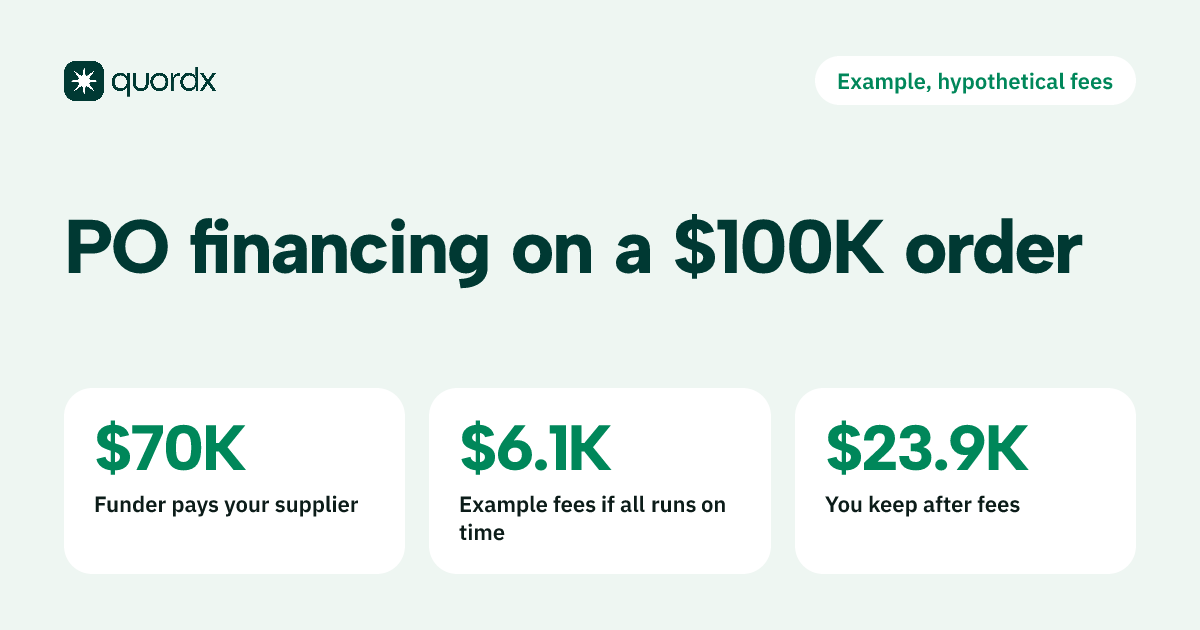
The setup: a regional retailer sends you a firm $100,000 PO for finished goods, payable 60 days after delivery. Your supplier's cost, freight included, is $70,000, a 30% gross margin. Say the PO funder charges 3% of the money it advances for each 30 days, and the factor advances 80% of the invoice and charges 2% of the invoice face per 30 days.
| Step | On time | Supplier 30 days late, customer pays in 90 |
|---|---|---|
| Funder pays the supplier | $70,000 | $70,000 |
| PO fee (3% of $70,000 per 30 days until delivery) | $2,100 (1 period) | $4,200 (2 periods) |
| Factor advance at delivery (80% of $100,000) | $80,000 | $80,000 |
| Used to repay the PO funder | $72,100 | $74,200 |
| Cash to you at delivery | $7,900 | $5,800 |
| Factor fee (2% of $100,000 per 30 days) | $4,000 (60 days) | $6,000 (90 days) |
| Reserve returned when the customer pays ($20,000 less the factor fee) | $16,000 | $14,000 |
| Total you keep | $23,900 | $19,800 |
| Total financing cost | $6,100 | $10,200 |
Running late costs $4,100: Nothing about the order changed; the supplier shipped a month late and the customer paid a month late. Financing took about 20% of your $30,000 gross profit in the on-time case and 34% in the slow one.
To compare with a loan, annualize the fee: A fee of 3% per 30 days works out to about 36.5% a year in simple interest (3% times 365, divided by 30). That is not a market figure, but the same arithmetic works on any real quote.
What happens at a 12% margin
Run the same order with a supplier cost of $88,000. On time, the fees come to $6,640 ($2,640 PO fee plus $4,000 factor fee) and you keep $5,360. Running late, they come to $11,280 and you keep $720 for the entire order.
Thin margins also break the handoff: At delivery you would owe the PO funder $90,640, but the factor advances only $80,000, so you would need $10,640 of your own cash to close the gap. Ask both funders to show the handoff on paper before you sign.
Estimate your funding
Answer a few questions about your business to see a likely range.
What PO financing costs and how to compare quotes
Funders price per period, not per year: A quote is usually a fee for each period the money is out, charged either on the amount advanced or on the order value. Ask which, and whether a period that has started is charged in full.
Get every other charge in writing: Deals can carry due diligence or setup fees, letter of credit issuance and amendment fees, wire fees, inspection costs, and the factor's own fees on the receivable side. Add them all before you compare.
Compare in dollars on your real timeline: Use the supplier's actual lead time and your customer's actual payment history, not the dates printed on the PO. The quote with the lowest headline fee is not always the cheapest once the periods are counted.
Alternatives to purchase order financing
PO financing is one of the more expensive ways to fund an order, so check whether a cheaper tool covers the same gap first.
| Option | When it fits | Trade-off |
|---|---|---|
| A customer deposit | Large or custom orders where the buyer wants the goods badly | Many large buyers will not pay up front |
| Longer supplier terms | A supplier you have bought from and paid on time before | Needs a payment history with that supplier |
| Business line of credit | Steady revenue and frequent orders | Sized to your revenue, not to the order |
| Invoice factoring alone | You can pay the supplier yourself but need cash after delivery | Does nothing before you can invoice |
| SBA 7(a) Working Capital Pilot or Contract CAPLine | A bank relationship and time to set up a standing facility | Slower to set up; the lender decides |
| SBA Export Working Capital Program | The order is an export sale | Export sales only |
| Inventory financing | You stock goods ahead of demand rather than against one order | Lenders advance only part of what the stock is worth |
SBA has order-based working capital, delivered through banks: SBA says its 7(a) Working Capital Pilot can provide working capital against domestic and international orders under one loan facility, and the Contract CAPLine finances the costs of specific contracts (SBA). Both are standing facilities through an SBA lender, built for repeat orders rather than a single deal.
For export orders, ask about EWCP: SBA's Export Working Capital Program guarantees up to 90% of loans of up to $5 million for businesses with export sales, and the export inventory and foreign receivables from those sales are generally treated as adequate collateral (same SBA page).
If you can wait until you invoice, factoring alone is simpler: See AR financing and invoice factoring. If you stock goods for a season rather than a specific order, see how to get inventory financing, and for revolving needs, a business line of credit.
PO financing mistakes that cost owners the margin
- Pricing the deal on the PO's dates. Suppliers slip and customers pay late. Price the slow case before you accept the order.
- Forgetting landed cost. Freight, duties, inspection and insurance come out of your margin, not the funder's.
- Letting the notice surprise your customer. The notice of assignment will arrive either way. A call from you first keeps the buyer comfortable.
- Overlooking your existing lender. A blanket lien on inventory or receivables can block the deal or put you in default on that loan. Ask for a subordination or payoff letter early.
- Using PO financing for goods you build. If you do the manufacturing, the funder would be backing work in process, which PO financing is not built for. A line of credit, or factoring once you can invoice, fits better.
- Accepting a cancellable PO. If the buyer cancels after the supplier has been paid, the funder will look to you for its money.
Can Quordx help with purchase order financing?
Not with the PO itself. Quordx is a broker, and no PO financier sits on the lender panel it submits to today, so sending you an application for one would waste your time. For the order in front of you, go to a specialist purchase order finance company, or ask a factor you already use whether it works with a PO partner. For an export order, an SBA lender can tell you whether EWCP fits.
Quordx can help with the pieces around the order. Its panel includes factors that buy B2B invoices, so once you can invoice, the receivables side is something it can place, and a business with a year or so of steady deposits may qualify for a line of credit that covers supplier deposits on smaller orders. The application takes about 10 minutes, the business owner pays Quordx nothing because lenders pay it when a deal funds, and each lender makes its own decision.
Questions Business Owners Ask Before Applying
Is purchase order financing a loan?
Not usually in form. The funder pays your supplier and is repaid from your customer's payment, often through a factoring agreement on the resulting invoice, so there is no fixed monthly payment. You can still owe the funder if the deal fails, for example if the customer cancels or rejects the goods.
What is the difference between PO financing and invoice factoring?
Timing. PO financing pays your supplier before the goods ship; factoring advances against an invoice after you have delivered. Most PO deals end in factoring, because the invoice is how the funder gets repaid.
Can a new business get purchase order financing?
It can, because the funder leans on the order, the supplier and the customer more than on your history. A first order still needs a supplier with a record on the product and a buyer with good credit. Expect more verification on the first deal than on later ones.
Will my customer know I am using PO financing?
Usually, yes. The invoice is assigned to the funder or factor, your customer receives a notice to pay them, and the funder may call to confirm the order. A short call from you beforehand keeps the relationship comfortable.
Can I use PO financing for services or for products I manufacture?
Generally not. PO financing backs finished goods moving from a supplier to your customer. If you perform the work or build the product yourself, look at a line of credit, equipment financing, or factoring once you can invoice.
How long does a PO financing deal take to set up?
The first deal takes longest, because the funder vets your customer, supplier and liens and may arrange a letter of credit. Repeat orders with the same customer and supplier usually move faster. Build the setup time into the delivery date before you accept the order.
Apply for Funding
No obligation · Initial inquiry doesn't impact credit · Takes about 10 minutes
Sources

Written by
Cody Dreis
Founder, Quordx Capital
Read full bio
Keep exploring alternative financing
Quordx Capital is a business funding broker, not a lender. Lenders make every credit decision and set the rate, fees and terms, and not every business qualifies. Quordx may be paid by a lender when a deal funds. Full disclosures