
How to Get a Loan for a Daycare Business
To get a loan for a daycare business, match the loan to the job: a line of credit for the gap between delivering care and getting paid for it, equipment financing or a term loan for a classroom build-out, and an SBA 7(a) or 504 loan to buy or build a facility. Lenders will want your state license and the capacity it allows, bank statements that show steady tuition and subsidy deposits, and proof that new slots will fill. The two things that make childcare different from other small businesses are state subsidy payments, which can arrive weeks after the care is delivered, and staff-to-child ratios, which turn every enrollment decision into a payroll decision. Size the loan around both.
The short version: Find out exactly how and when your state pays subsidy invoices, because that tells you how big a line of credit you need. Model any new room at the ratio your license requires before you borrow for it. If you are buying a building, compare SBA 504 (as little as 10% down for an established center) with 7(a), and if your center is a nonprofit, know that 7(a) and 504 are off the table but an SBA microloan is not.
Part of our guide to Business Loans.
Last updated · Reviewed by Cody Dreis
50+ Lenders|Decisions typically in 24 to 48 hours
What lenders check before funding a daycare
Underwriting a childcare center starts where any small business loan does: deposits, credit, time in business and debt already on the books. A few items are specific to this industry, and having them ready saves a round of follow-up questions.
- Your license and its capacity. States set minimum health and safety rules a program must meet to operate legally, and the license caps how many children you can serve (Childcare.gov). A lender reads that cap as the ceiling on your revenue.
- Inspection and monitoring history. Licensed programs are monitored for ongoing compliance. Open violations or a pending enforcement action can stall a loan, so resolve them first.
- An enrollment roster and waitlist. Current enrollment by age group, tuition rates and a dated waitlist show the slots you want to add will fill.
- Subsidy agreements. If you take state child care assistance, the written payment agreement or authorization shows the rate, the payment schedule and the dispute process. Federal rules require states to provide one (45 CFR 98.45).
- Your lease or deed. For a build-out, the lender wants a lease long enough to cover the loan term and a landlord who allows childcare use.
Subsidy deposits are revenue: On a bank statement, a payment from the state agency looks like any other deposit. What helps is showing they recur: the payment agreement plus several months of statements where the state's deposits land on a predictable schedule.
How state child care subsidies pay providers (CCDF)
The federal Child Care and Development Fund (CCDF), run by HHS's Administration for Children and Families, sets the rules for how states pay providers who serve families with child care assistance. Each state's lead agency picks its own payment practices within those rules, and the rules changed in 2026.
The 2024 requirements were rescinded: A March 2024 rule had required states to pay providers in advance and based on enrollment rather than attendance. ACF's 2026 final rule, effective July 13, 2026, removed both requirements (ACF). States may keep paying that way, but they no longer have to.
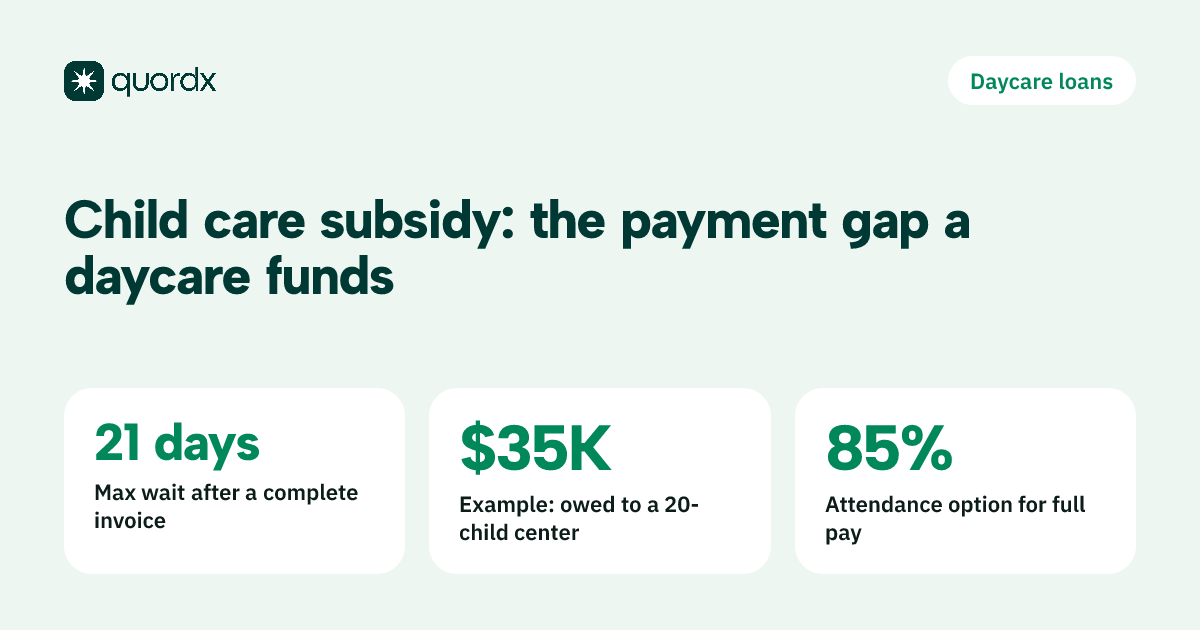
What federal rules require now: A state must ensure timely payment by either paying prospectively, before care is delivered, or paying within 21 calendar days of receiving a complete invoice. It must also, to the extent practicable, keep a child's occasional absences from cutting your payment, using one of four options (45 CFR 98.45(m)):
| State's absence policy | Example: child authorized for 20 days attends 16 | What it means for your cash |
|---|---|---|
| Pay on enrollment | Full payment | Most predictable |
| Full pay at 85% attendance | 80% attendance, so not automatic full pay | Absences can cut what you collect |
| Full pay with 5 or fewer absent days a month | 4 absent days, so full payment | Predictable unless a child is out a week |
| Alternative approach in the state's plan | Depends on the plan | Read your state's CCDF Plan |
Ask your state two questions before you borrow: does it pay in advance or after an invoice, and which absence policy does it use? The answers decide how much cash you have to front and how much of a subsidized child's tuition you can count on.
Estimate your funding
Answer a few questions about your business to see a likely range.
Worked example: the subsidy payment gap
This example uses round, hypothetical numbers to show the mechanics. Your state's rates and schedule will differ.
The setup: a center serves 20 children paid through the state subsidy at a hypothetical $1,000 per child per month, or $20,000 a month. The state pays after the fact. The center submits a complete invoice for October care on November 3, and the state pays on day 21, November 24, the latest the federal rule allows for invoice-based payment.
| Line | Amount | How it is worked out |
|---|---|---|
| October care, unpaid | $20,000 | 20 children x $1,000 |
| November 1 to 23 care, unpaid | $15,333 | 23/30 of $20,000 |
| Subsidy owed to the center on November 23 | $35,333 | $20,000 + $15,333 |
| Days from October 1 care to payment | 54 days | October 1 to November 24 |
The center fronts more than a month and a half of subsidized care at all times: Teachers get paid every week or two, and rent comes due on the first, while the state's money arrives once a month. A line of credit of around $35,000 to $40,000 covers this cycle; a state that pays in advance would make most of it disappear.
Decision rule: if subsidized children are a large share of your enrollment and your state pays after invoicing, size a business line of credit to at least one invoice cycle of subsidy revenue. Draw it when payroll runs, repay it when the state pays. A lump-sum loan for this gap means paying interest on cash you only need for a few weeks at a time.
Staff-to-child ratios: model the room before you borrow for it
Licensed programs must keep enough adults present to supervise safely, and your state sets the ratio and group size for each age (Childcare.gov). Infant rooms need the most staff per child, so adding infant slots is where ratio math bites hardest.
Example assumptions (all hypothetical; check your state's actual ratio): the state requires one teacher for every four infants; the room is open 50 hours a week; teachers earn $20 an hour plus 12% for payroll taxes and benefits, about $4,853 a month for each teacher the room needs on the floor; infant tuition is $1,600 a month; and the room fills by two infants a month.
| Month | Infants | Teachers needed | Tuition | Teacher cost | Room before rent and supplies |
|---|---|---|---|---|---|
| 1 | 2 | 1 | $3,200 | $4,853 | -$1,653 |
| 2 | 4 | 1 | $6,400 | $4,853 | $1,547 |
| 3 | 6 | 2 | $9,600 | $9,707 | -$107 |
| 4 | 8 | 2 | $12,800 | $9,707 | $3,093 |
The fifth infant costs you a whole teacher: Month 3 loses money even though enrollment grew, because crossing the ratio line forces a second hire before the room is full. Only a full room carries itself, and it still has to pay its share of rent, food and supplies.
Now add the loan: Say converting the room (sinks, cribs, flooring and the licensing inspection) costs $45,000, financed over five years at a hypothetical 12%. That is a payment of about $1,001 a month, which the full room covers but the ramp-up months do not. Borrow enough to carry the room until it fills, or pay for the build-out from a loan and the ramp-up from a line, and treat a slow-filling waitlist as a reason to wait.
Financing a daycare building or build-out
For leased space: the build-out is usually the biggest cost: plumbing for handwashing and diapering, partitions, flooring, fencing and a playground. A term loan covers the construction; equipment financing can carry cribs, kitchen equipment, playground structures and vans with the items as collateral. The SBA 7(a) program also lists improving buildings, furniture, fixtures and working capital among its uses, up to $5 million (SBA).
To buy or build a facility: SBA 504 offers long-term, fixed-rate financing for buildings, land, construction and renovation, up to $5 million (more for certain manufacturing and energy projects). It cannot pay for working capital or inventory (SBA). The usual structure is a bank loan for at least 50% of the project, a Certified Development Company (CDC) loan for up to 40%, and the borrower's own cash for the rest.
SBA 504 down payment on a daycare building
The minimum contribution is 10%, rising to 15% if the business has operated two years or less or the building is a limited or single-purpose property, and to 20% if both apply. Ask the CDC early how it classifies your building.
| $1.2 million project (example) | Your cash | Bank loan (50%) | CDC loan |
|---|---|---|---|
| Established center, standard building | $120,000 (10%) | $600,000 | $480,000 (40%) |
| Center open two years or less | $180,000 (15%) | $600,000 | $420,000 (35%) |
| New center and single-purpose building | $240,000 (20%) | $600,000 | $360,000 (30%) |
For the trade-offs between the two SBA routes, see SBA 7(a) vs 504 loans and our guide to an SBA loan to buy real estate.
Nonprofit, church-run and home-based daycares
SBA 7(a) and 504 require a for-profit business: An applicant must be an operating business organized for profit (13 CFR 120.100), so a nonprofit center, including many run by churches, cannot use either program.
The SBA microloan is the exception: Microloans go through SBA intermediary lenders, reach up to $50,000 with a maximum term of seven years, and the regulation lets a borrower use the proceeds to establish a nonprofit childcare business. Proceeds can cover working capital, supplies, furniture, fixtures and equipment, but not real estate or existing debt (SBA). Our SBA microloan guide covers how intermediaries decide.
Family child care homes: are licensed or registered businesses too, and their lenders look at the same deposits and credit. Revenue is smaller, so the realistic tools are smaller: a microloan, equipment financing for a specific purchase, or a modest line from your own bank.
Mistakes that sink daycare loan applications
- Projecting enrollment past your licensed capacity. A lender will check the license, and a projection it cannot support undermines the rest of the file.
- Assuming subsidy pays on enrollment. Federal rules no longer require it, so it depends on your state. Use your state's actual policy in any cash flow you show a lender.
- Borrowing a lump sum for a recurring gap. The subsidy float comes back every month; a line fits it, a term loan does not.
- Signing a lease before confirming zoning and licensing approval. A build-out loan on space that cannot be licensed is debt with no revenue behind it.
- Mixing personal and business accounts. Tuition paid into a personal account is revenue a lender may not count.
If you are opening your first center, the SBA loan to start a business guide covers what lenders expect from a business with no operating history.
Where Quordx fits for a childcare center
Quordx is a broker, not a lender, and lenders make every decision. The lenders it works with generally look for around $17,000 a month in revenue and about a year in business. A center past that point can use one application, about 10 minutes, to reach lenders for lines of credit, term loans and equipment financing, and lenders pay Quordx only if a deal funds.
SBA loans through Quordx generally start around $400,000, so a building purchase may fit there. A smaller SBA loan, a 504 project or a microloan does not: go to SBA's Lender Match, a local CDC or a microlender directly. A home daycare or a center still in its first year will usually do better starting there too. Quordx does not serve Virginia, Connecticut, Missouri or North Dakota.
Questions Business Owners Ask Before Applying
Can I get a loan to start a daycare with no operating history?
Yes, but the options narrow to an SBA 7(a) startup loan, an SBA microloan or equipment financing, and lenders will lean on your childcare experience, your license application, a business plan and your own cash in the deal. For a building purchase through SBA 504, a business open two years or less needs at least 15% down.
Do state child care subsidy payments count as revenue for a loan?
Yes. They show up as deposits on your bank statements like tuition does. Bring your written payment agreement with the state so the lender can see the rate and schedule, and expect it to notice if the deposits arrive weeks after the care was delivered.
Does my state still have to pay child care providers in advance?
Not under federal rules since July 13, 2026, when ACF's final rule removed the requirement to pay prospectively. A state can still choose to pay in advance; if it pays after invoicing, federal rules require payment within 21 calendar days of a complete invoice. Check your state's CCDF Plan or ask its child care agency.
Can a nonprofit or church daycare get an SBA loan?
Not a 7(a) or 504 loan, because both require a business organized for profit. An SBA microloan of up to $50,000 can be used to establish a nonprofit childcare business, and a bank can still lend to a nonprofit outside the SBA programs on its own terms.
Is a childcare business loan different from a daycare loan?
No. Lenders use the terms interchangeably for centers, preschools and family child care homes. What changes the loan is your license type, your capacity, how much of your revenue comes from subsidies and whether you own or lease.
Apply for Funding
No obligation · Initial inquiry doesn't impact credit · Takes about 10 minutes
Sources

Written by
Cody Dreis
Founder, Quordx Capital
Read full bio
Keep exploring business loans
Quordx Capital is a business funding broker, not a lender. Lenders make every credit decision and set the rate, fees and terms, and not every business qualifies. Quordx may be paid by a lender when a deal funds. Full disclosures