

Restaurant business loans: equipment, build-outs, cash advances and slow seasons
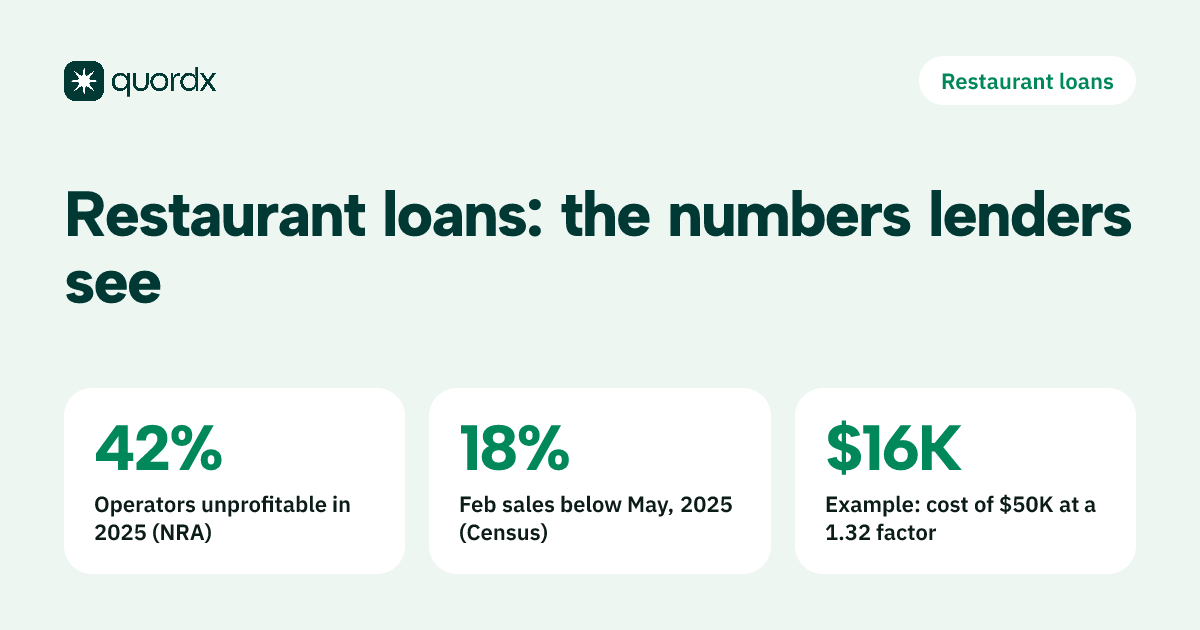
Most restaurants can get a business loan, but the right one depends on what the money is for: equipment financing for kitchen gear, an SBA 7(a) or term loan for a build-out, and a line of credit for slow months and vendor bills. Lenders size a restaurant off its card deposits and the years left on its lease, and they price it as a risky industry because margins are thin: in the National Restaurant Association's 2026 report, 42% of operators said their restaurant was not profitable in 2025. That same card-heavy revenue is why merchant cash advance funders find restaurants so easily, and why an advance is worth pricing in dollars before you sign.
The short version: Finance anything with a serial number as equipment, finance a build-out with a loan whose term fits inside your lease, and cover the slow season with a line of credit you draw only when you need it. Treat a cash advance as a short bridge, and compare its total payback with a line before you take one. Apply after a busy season, when your statements look their best.
Part of our industry guide: Industry Financing.
Last updated · Reviewed by Cody Dreis
50+ Lenders|Decisions typically in 24 to 48 hours
Common Reasons Operators Apply
Restaurant operators commonly use Quordx-matched funding for situations like these:
- Refreshing dining room furniture, decor, or POS equipment
- Build-out costs for a second location, patio, or kitchen expansion
- Covering vendor deposits for catering contracts or large events
- Replacing a walk-in cooler, oven, or hood when it goes down mid-service
How restaurant cash flow shapes the loan you get
Your sales arrive daily, in small pieces, mostly on cards: Credit and debit cards made up 65% of US consumer payments in 2025 (34% credit, 31% debit) against 14% for cash, according to the Atlanta Fed's payment survey as reported by Pew Research Center. For a restaurant, that means a lender can see nearly every sale in your processor statements and bank deposits, and most restaurant underwriting runs on exactly that.
Your costs arrive on someone else's schedule: Food vendors bill on short terms, payroll runs every week or two, and rent is due on the first whether January was busy or not. A restaurant can be profitable over a year and still be short in a given week.
The year has a shape: Restaurants and other eating places sold $66.5 billion in February 2025 and $81.5 billion in May, not seasonally adjusted, per the Census Bureau's monthly retail trade data. February ran about 18% below May nationally, and the swing can be much larger in a beach, ski or college town.
| What the money is for | What usually fits | Why |
|---|---|---|
| Kitchen equipment: ranges, fryers, refrigeration, dish machines | Equipment loan or lease | The equipment secures the deal, so approval leans less on your credit |
| Build-out, remodel or second location | SBA 7(a) or a term loan | A long payback needs a long term, and the lease has to outlast it |
| Slow season, vendor bills, payroll gaps | Business line of credit | You draw only what you need and pay it down when sales recover |
| A short, urgent gap with no time for a loan | Cash advance repaid from card sales | Payments can fall with sales, but the cost is high |
| Bar build or liquor license | Depends on your state's license rules | Licenses are regulated, sometimes scarce, and not simple collateral |
Restaurant equipment financing: loan or lease?
Equipment financing is the easiest restaurant credit to get: because the lender can take the asset back. A range, fryer, combi oven or dish machine has a resale market. A hood system, a walk-in built into the space or new ductwork is different: it is attached to a building you probably don't own, so a lender may treat it as a leasehold improvement with little resale value.
Loan or lease comes down to how long you'll keep it: Buy what lasts, like the cooking line, refrigeration and prep tables. Lease what you expect to replace in a few years, such as POS hardware. Our equipment lease vs loan guide explains buyout options and who owns what at the end.
Worked example: an $80,000 kitchen package
Say you finance $80,000 of ranges, a fryer bank and reach-in refrigeration over 60 months at a hypothetical 11%. The payment is $1,739.39 a month, and total interest over five years is $24,363.63. Both figures illustrate the math; they are not quotes.
The tax side can offset part of that: IRS Publication 946 lists refrigerators among the property that qualifies for Section 179 expensing (IRS), and the 2026 limit is $2,560,000. Section 179 can't create a loss, so whether it helps this year is a question for your CPA; our page on equipment financing and Section 179 shows how it interacts with a loan.
Ask about soft costs before you sign: Freight, installation, gas and electrical hookups and the fire suppression contractor can add a real share to the sticker price. Ask whether the lender will include them in the financed amount, or plan to pay them in cash.
Estimate your funding
Answer a few questions about your business to see a likely range.
Restaurant build-out loans and your lease
A build-out loan is really a bet on your lease: If the landlord can end your tenancy before the loan is paid, the lender loses the location that produces the payments. SBA's rules spell this out: when at least $500,000 or 30% of a 7(a) loan's proceeds (whichever is less) go to leasehold improvements, the lease, counting renewal options only you can exercise, should run at least as long as the loan, and the lender should get an assignment of the lease and a landlord's waiver (SBA SOP 50 10 8.1).
SBA also caps the term: A 7(a) loan for leasehold improvements can run up to 10 years, plus up to 12 months to finish the work. Equipment loans generally run up to 10 years, or up to 15 where the IRS useful life supports it.
Worked example: a $400,000 second-location build-out
Say a restaurant borrows $400,000 through SBA 7(a) to build out a second location, over 10 years. The maximum variable rate on a 7(a) loan over $350,000 is prime plus 3 points, which is 10.00% with prime at 7.00% as of October 2026. At that cap the payment is $5,286.03 a month.
The upfront SBA fee would be $9,000: on a loan approved in fiscal 2027: 3% of the $300,000 guaranteed portion, assuming a 75% guarantee (SBA Information Notice 5000-881797). Restaurants are not on SBA's food supply chain list that pays 0%, but a restaurant located in a rural area pays 0% on loans of $700,000 or less.
Decision rule: if your lease has fewer years left than the loan you want, renegotiate the lease or its renewal options before you apply, not after. The interior work itself may qualify for Section 179 as qualified improvement property, which Publication 946 defines as interior improvements to a nonresidential building, excluding enlargements, elevators and the internal structural framework.
Restaurant merchant cash advances: how they target card sales
An MCA buys a slice of your future card sales: You get a lump sum and repay a fixed total, the advance times a factor rate, either as a percentage of each day's card receipts (a holdback or split) or as a fixed daily debit from your bank account. Restaurants are an easy fit for funders because the card processor already sees every sale. Our merchant cash advance guide covers the APR math and state disclosure laws.
The holdback version is the one built for restaurants: When the processor takes a percentage, a slow Tuesday costs you less. A fixed daily debit is the funder's estimate of that percentage, and it does not drop in February unless you request a reconciliation.
Worked example: a $50,000 advance through a slow month
Say a restaurant with $100,000 of card sales in its busy month and $82,000 in its slow month (the same 18% gap as the national figures above) takes a $50,000 advance at a hypothetical 1.32 factor rate. It owes $66,000, so the advance costs $16,000 no matter how it is collected.
| 10% holdback of card sales | Fixed debit of $455 per business day | |
|---|---|---|
| Busy month, $100,000 in card sales | $10,000 | $10,010 over 22 business days |
| Slow month, $82,000 in card sales | $8,200 | $10,010, which is 12.2% of card sales |
| Time to repay $66,000 | About 7.3 months at an average $9,100 a month | About 145 business days, about 6.6 months |
| Total cost | $16,000 | $16,000 |
Now price the same $50,000 on a line of credit: Drawn in full and repaid in seven equal monthly payments at a hypothetical 15% APR, it costs $2,531.05 in interest. The difference, about $13,500, is what the advance charges for speed and for not having to qualify for the line.
Count the advances you already have: An advance offered through your POS system or a delivery platform is repaid out of the same sales, so the next funder sees it as an existing position. Each added daily debit shrinks what is left for food and payroll; see two merchant cash advances at once and, if you're already stacked, how to consolidate MCAs.
Restaurant working capital: slow seasons and food-cost swings
Seasonality is predictable, so set up the line before you need it: Apply in your strong months, when your statements look best, and draw in the slow ones. A lender reading three months of January and February deposits will size you smaller than one reading your summer.
Food-cost swings are a pricing problem, not a financing one: USDA's Economic Research Service forecasts wholesale beef prices up 8.5% in 2026, against a 3.5% rise in what restaurants charge (USDA ERS Food Price Outlook, updated September 2026). If beef is $10,000 of your monthly food purchases, an 8.5% increase adds $850 a month, or $10,200 a year, that your menu may not be covering.
Borrowing to cover a margin squeeze only delays it: Use a line of credit for timing gaps, such as a large vendor bill due before a busy weekend's deposits clear. If the gap never closes, the fix is menu pricing, portions or suppliers; our guide to working capital loans shows how to size a true timing gap.
Read the industry numbers the way a lender does: The National Restaurant Association projects $1.55 trillion in restaurant and foodservice sales for 2026, yet 60% of operators reported lower traffic in 2025. Lenders see a large industry with thin margins, so a clean, well-documented file counts for more here than in most businesses.
Liquor licenses and bar build-outs
A liquor license is set by state rules, and in some states it is scarce: California, for example, limits general licenses (beer, wine and spirits) in each county based on population, issues new ones once a year by drawing when applicants outnumber licenses, and otherwise requires buying an existing license from a current holder (California ABC). Its priority application fee for an original on-sale general license is $19,840, before a single tap is installed.
Most of a bar's cost finances like the rest of the restaurant: The bar build, coolers and draft systems are build-out and equipment. The license is different: whether and how it can be pledged depends on state law, and when an SBA loan finances buying a restaurant that comes with a transferable liquor license, SBA's SOP requires the lender to secure the license as collateral.
Timing rule: get the license approved, or the approval date in writing, before you close on build-out money that only pays off with alcohol sales. Until it is issued, a delay is your risk, and a lender will ask about it.
What lenders look at in a restaurant application
- Processor statements and bank deposits. Recent card processing summaries show that deposits are sales and how they split between card and cash.
- Your lease: years remaining, renewal options, and whether the landlord will sign a waiver or assignment.
- Permits and licenses: health permit, business license, and the liquor license or its status. Have them current before you apply.
- Sales tax returns. Lenders compare them with deposits, and unpaid sales tax can turn into a state tax lien.
- Existing advances. Every daily or weekly debit to a funder, including POS and delivery-platform advances.
- Delivery share. Third-party delivery payouts arrive net of commissions, so lenders count what lands in the bank, not the menu price.
- For a new location: a build-out budget with contractor bids, and projections based on your first location's actual numbers.
Decision rule: size any payment to your slowest month, not your average one. If the new payment plus existing debits would take more than your slow month can spare after food, labor and rent, borrow less or pick a longer term.
Restaurant financing through Quordx
Quordx is a broker, so it can't approve a restaurant or set its rate; lenders decide. What it can do is send one application, about 10 minutes, to lenders that place equipment financing, term loans, lines of credit and working capital advances. Those lenders generally look for around $17,000 a month in revenue and about a year in business, so a restaurant that hasn't opened yet is usually better served by an SBA lender or its equipment vendor.
For a build-out, SBA loans through Quordx generally start around $400,000. A smaller SBA loan, or a 504 loan to buy your building, is easier to find through SBA's Lender Match. Quordx does not serve Virginia, Connecticut, Missouri or North Dakota, and the restaurant pays Quordx nothing: the lender pays it when a deal funds.
Questions Business Owners Ask Before Applying
Is a restaurant merchant cash advance a loan?
No. It is structured as a purchase of your future sales, so it carries a factor rate and a fixed payback amount instead of an interest rate. Several states now require funders to disclose the cost in a standard format, and California and New York require an estimated APR.
Can I finance used restaurant equipment?
Often, yes. Expect the lender to want a dealer invoice or an inspection and possibly a shorter term. Equipment with a strong resale market, like ranges and refrigeration, is easier to finance than custom pieces.
How much can a restaurant borrow?
It depends on the product. Cash-flow lenders size from your average monthly deposits and existing debits, equipment lenders from the equipment's value, and SBA 7(a) loans go up to $5 million based on cash flow and collateral. Whatever the source, the payment should fit inside your slowest month.
Can I get a loan to open a new restaurant?
It is harder without an operating history. Expect a lender to treat a new location as a startup, even if you run another restaurant, unless the existing business guarantees the loan. SBA 7(a) loans can fund startups with a solid plan, an equity injection and industry experience.
Do restaurants get SBA's 0% upfront fee?
Not as a category. For fiscal 2027, SBA waives the upfront fee on 7(a) loans of $700,000 or less to manufacturers, listed food supply chain businesses such as farms and grocery wholesalers, and businesses in rural areas. A rural restaurant qualifies; one in a city pays the normal fee.
Apply for Funding
No obligation · Initial inquiry doesn't impact credit · Takes about 10 minutes
Sources
- National Restaurant Association: 2026 State of the Restaurant Industry, sales to hit $1.55T
- U.S. Census Bureau: Monthly Retail Trade, retail and food services sales (2025 not seasonally adjusted)
- USDA Economic Research Service: Food Price Outlook, summary findings (updated September 25, 2026)
- SBA SOP 50 10 8.1: Lender and Development Company Loan Programs (effective October 1, 2026)
- SBA Information Notice 5000-881797: 7(a) fees for fiscal year 2027

Written by
Cody Dreis
Founder, Quordx Capital
Read full bio
Keep exploring industry financing
Quordx Capital is a business funding broker, not a lender. Lenders make every credit decision and set the rate, fees and terms, and not every business qualifies. Quordx may be paid by a lender when a deal funds. Full disclosures